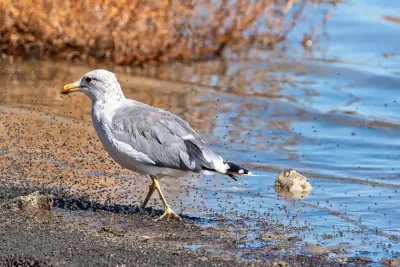
Water levels at Mono Lake, nestled in a stunningly beautiful location on the eastern slope of the Sierra Nevadas that provides the eastern gateway to Yosemite, have fallen to a critical level of a local population of nesting gulls.


The nonprofit Mono Lake Committee recently filed a request with the State Water Resources Control Board that asks for the suspension of Los Angeles Department of Water and Power’s (LADWP) water diversions from Mono Lake, located about 330 miles away from Los Angeles, east of the Sierra Nevada mountain range.
According to an article by Louis Sahagún for the Los Angeles Times, the Mono Lake Committee hopes to alleviate a threat to natural habitat at the lake.
In its request, the nonprofit Mono Lake Committee argues that the combination of drought and diversions from streams that feed the lake are exposing the lake bottom near islands that host one of the world’s largest nesting gull populations. Unless this is addressed, they say coyotes will be able to access the islands and feast on the eggs of 50,000 California gulls.
Sahagún also provides a history of the city’s diversions from the lake:
Los Angeles […] has been importing water from this eerie, hyper-saline lake since World War II. Last year, the DWP rejected a committee request that it voluntarily cease its diversions of 4,500 acre-feet of Mono Lake water each year. One acre-foot of water is enough to fill an Olympic-size swimming pool halfway.
The water diverted from Mono Lake amounts to roughly 1% of the water consumed by Los Angeles residents in a year. While the city got good news about a recovered source of drinking water at the end of 2022 thanks to a superfund project in the San Fernando Valley groundwater basin, the city still relies on imported water from various environmentally troubled sources, including Mono Lake, the Colorado River, and the Owens Valley. The Owens Valley provides a regional example (located about 70 miles south of Mono Lake) of the environmental risks of L.A.s water supply diversions. The Owens Valley is completely dry, kicks up dust that is a public health risk to local residents, including the indigenous Bishop, Big Pine and Lone Pine tribes of Owens Valley Paiute Shoshone Indians.
Meanwhile the number of gull nests around Mono Lake declines. “The largest number of gull nests ever recorded at Mono Lake was about 32,000 in the early 1990s. In 2019, 11,075 nests were counted, the lowest number recorded over the 34-year course of one of the longest studies of birds in North America,” reports Sahagún.
FULL STORY: Conservationists fight to end Los Angeles water imports from Eastern Sierra’s Mono Lake

Owens Valley Calls on Eminent Domain to Buy its Water Back from Los Angeles
Call it a reverse Chinatown.
LA Will Double its Wastewater Recycling Capacity to Serve Half a Million Residents
A new wastewater treatment facility will be able to process 45 million gallons of water per day.
Southern California's Water Conservation and Storage Efforts Paying Off
The region has poured over a billion dollars into storage infrastructure and demand management policies in anticipation of worsening drought conditions.

The state-sanctioned urbicide of Austin
People don’t kill cities. Freeways do.

US to reduce Colorado River water deliveries to Mexico
A new Colorado Treaty amendment reduces Mexico’s Colorado River water allocation by 250,000 acre feet.

New Jersey’s second-largest city bans standalone data centers
Jersey City will continue to allow co-location facilities, such as those meant for research institutions that store their own data.

Amtrak not solely to blame for New Jersey commuter rail's unreliability, report finds
A new study from the Garden State Initiative found that NJ Transit’s budget grew 20% across a 4 year period, but reliability declined significantly over the same period.

EPA erases limits on planet-warming pollution from power plants
Under Monday’s plan, power plants would still have some limits on how much mercury, arsenic and other contaminants they can emit.

Phoenix announces new on-demand transit service, more frequent RAPID buses
Both new services will launch in October, and are part of Phoenix's Project Effective Access Solutions for Easing Congestion.

FREE Course: Walkable City 1: Why Walkability?
After describing his path towards focusing on walkability as the essence of good planning, Jeff Speck marches through his five principal reasons for making more walkable places.
Reinventing Malls: Planning Alchemy—Turning Gray Fields Into Gold
The course focuses on the opportunities and imperatives that shape reinvention of mall sites.

Eagle County Government
Harvard University Graduate School of Design
Nashville Planning Department
The Architects Foundation
University of Cincinnati Online
The Pocatello Development Authority
The Urban Renewal Agency of the City of Pocatello
Journal of the American Planning Association