Could the chaos that has plagued the 6th Street Viaduct’s first few weeks signal an opportunity to reimagine its intended uses?


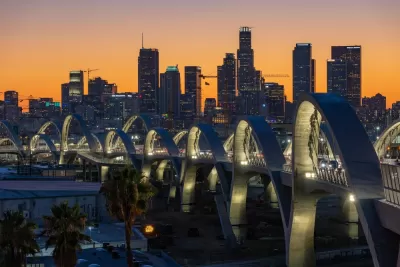
Two weeks after its much-anticipated public opening, L.A.’s 6th Street Viaduct is closed. As Andy Kalmowitz reports in Jalopnik, the closure is “largely due to a near constant stream of illegal activity from drivers taking over the brand-new, $588 million bridge in downtown L.A.”
After a series of temporary closures, the city is installing speed bumps in order to discourage street racers and other reckless drivers. “Along with the new speed bumps, the city is installing a center median divider as well as fencing to discourage people from scaling the archways, which is just one more baffling thing people have been doing on the bridge.”
Even before its reconstruction, the 6th Street bridge was a famous backdrop. “The original bridge the Viaduct replaces was an iconic LA landmark, seen in movies like Grease and Terminator 2: Judgement Day. The new bridge wasted no time making a name for itself, clearly.”
The Los Angeles Times editorial board, meanwhile, recently advocated for closing the bridge to cars altogether.
The board argues that the bridge could become a West Coast version of New York City’s High Line, literally and figuratively elevating people over cars. “Despite less than ideal conditions (the speeding cars and the flimsy “protected” bicycle lanes), the 6th Street Viaduct has become a spot for family strolls, bike rides, scenic views, even quinceañera photos and a podcast recording. This is no mere roadway connecting Boyle Heights and downtown. It’s an opportunity to rethink L.A. transportation infrastructure and public space.”
Read the full story: LA's Half-a-Billion-Dollar Bridge Shut Down After Just 2 Weeks

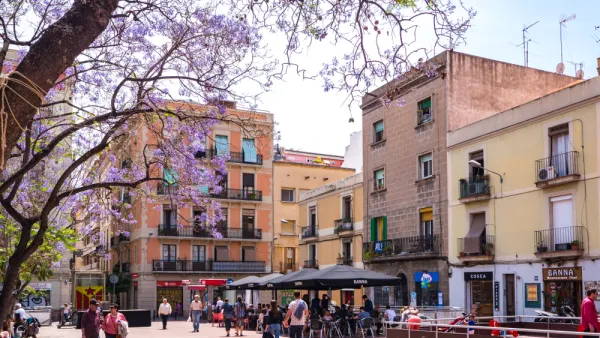
Could Los Angeles Emulate Barcelona’s ‘Superblocks’?
A proposal in the city council could bring the ‘superblock’ model to Los Angeles, opening up neighborhood streets to more biking, walking, and public amenities.
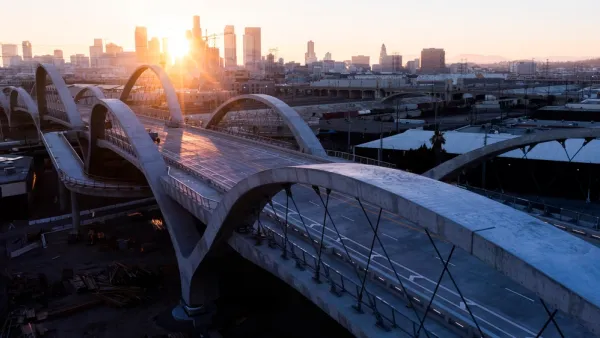
L.A.’s 6th Street Bridge Bike Lane Disappoints
Bike and pedestrian infrastructure on the much-anticipated new bridge leaves much to be desired, according to advocates.
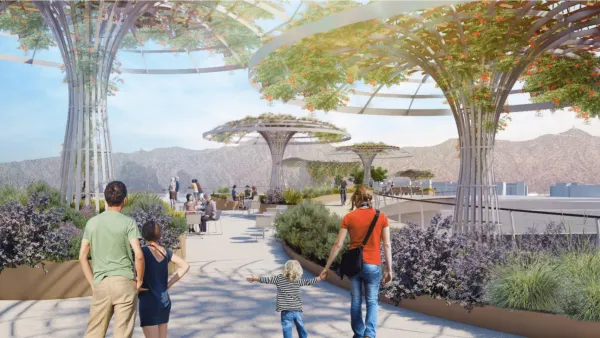
'Transformative' pedestrian bridge planned for LA River in Glendale Narrows
A new bridge will link Griffith Park and the Glendale Narrows Riverwalk.

Planetizen Federal Action Tracker
A weekly monitor of how Trump’s orders and actions are impacting planners and planning in America.

California plans to bury El Niño’s downpour
If the state plays its cards right, it may be able to store a billion acre-feet of El Niño’s water in aquifers.

Chicago breaks ground on $3 billion megadevelopment
The new neighborhood, titled Foundry Park, will one day host 3,700 residences.

Satanic place names
From streams and lakes to valleys and canyons, I mapped more than 1,000 places named after the Devil.

California High-Speed Rail Authority CEO resigns after $600,000 scandal
Under Ian Choudri, the authority used taxpayer dollars to fund first class flights and trips to nightclubs.

Want to study the Missouri River? Soon, you may need unanimous approval from 10 states
Legislation would require 10 governors’ permission to study or build projects moving water outside the basin.

FREE Course: Walkable City 1: Why Walkability?
After describing his path towards focusing on walkability as the essence of good planning, Jeff Speck marches through his five principal reasons for making more walkable places.
Reinventing Malls: Planning Alchemy—Turning Gray Fields Into Gold
The course focuses on the opportunities and imperatives that shape reinvention of mall sites.

City of Rosemead
Rutgers University, Edward J. Bloustein School of Planning and Public Policy
One Hundred Miles
Hunter College, City University of New York (CUNY)
The Architects Foundation
University of Cincinnati Online
City of Cambridge
Montrose County
The Pocatello Development Authority