While residents differ on how to allocate the neighborhood’s street space, many want to see safer infrastructure for pedestrians and people on bikes.


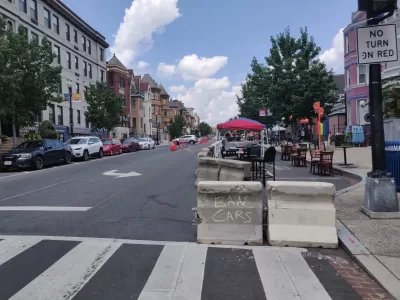
Ashley Hopko reports on efforts to bring street safety improvements to Washington, D.C.’s Adams Morgan neighborhood, where pandemic-era ‘streateries’ and bike lanes are vying with traffic lanes for space. “Adams Morgan community stakeholders are pushing for road changes that would increase safety for bicyclists and pedestrians, potentially shift bus routes, and limit vehicle access to major thoroughfares in the neighborhood.”
According to Hopko, “To address growing pains in the area, the District Department of Transportation (DDOT) began drafting the Columbia Road Bus Priority Plan in 2021. It aims to improve infrastructure for pedestrians, cyclists, and bus commuters by rethinking how street space is utilized by various modes of transit.”
In the article, two local bike commuters criticized the use of ‘sharrows,’ calling for fully segregated bike lanes that would better serve both cyclists and drivers. Advocates also want to see more pedestrian-only segments, such as on 18th Street. “The Adams Morgan Business Improvement District has been pushing for approval to repeat the pilot pedestrian zone program launched in 2020, according to Kristen Barden, the group’s executive director.”
Residents also express concerns about the on-street restaurant patios known as ‘streateries,’ Hopko writes. “Though most community members don’t seem to mind the squeeze caused by streateries, there are safety issues that arise due to narrow roadways and limited visibility caused by pop-up structures.”
Read the full story: Adams Morgan stakeholders grapple over road safety improvements

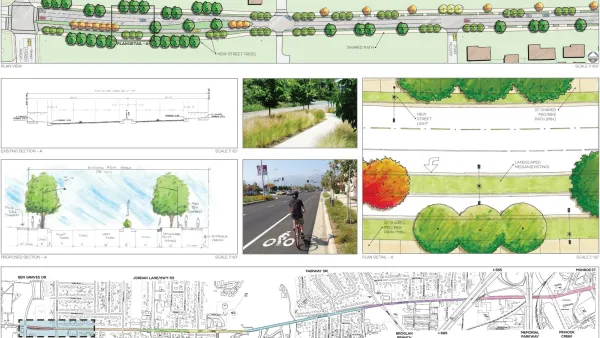
Huntsville, Alabama Launches $30M Complete Streets Project
A redesign of Holmes Avenue will bring new sidewalks, bike lanes, lighting, and street furniture to the corridor.
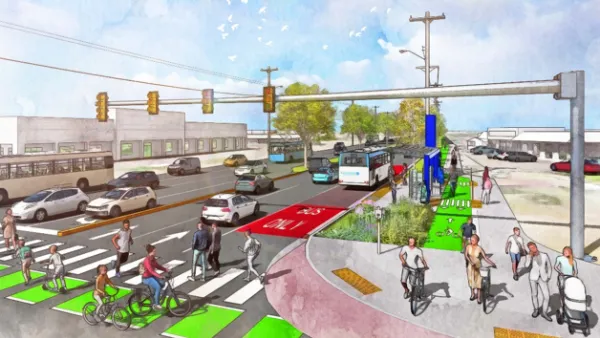
WSDOT Offers Ambitious Multimodal Vision for Dangerous SR 99 Corridor
The proposal includes dedicated bike and bus lanes as well as pedestrian improvements.
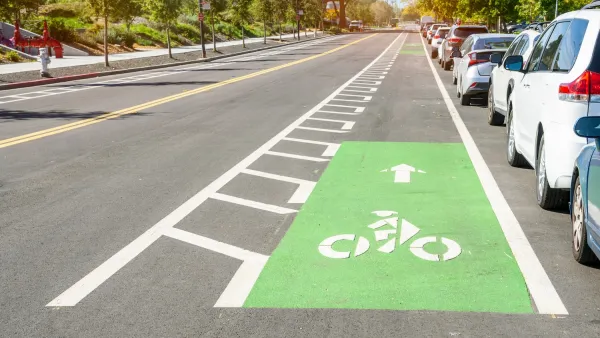
Why Bike Lanes Are Good: An Explainer for the US Transportation Secretary
Sean Duffy says there’s no evidence that bike lanes have benefits. Streetsblog — and federal agencies’ own data — beg to differ.

Planetizen Federal Action Tracker
A weekly monitor of how Trump’s orders and actions are impacting planners and planning in America.

California plans to bury El Niño’s downpour
If the state plays its cards right, it may be able to store a billion acre-feet of El Niño’s water in aquifers.

Desperate measures: Advocates weigh draining Lake Powell to fill Colorado River
Draining the reservoir could reduce evaporation losses by a couple hundred thousand acre-feet.

Metra may invest $9.1 billion in regional rail
The agency released a draft of a study examining potential ways to offer more frequent train service.

California city breaks ground on transit connector
The project includes three mobility hubs and a pedestrian bridge.

After public outcry, Massachusetts city releases housing development tracker
Cambridge’s tracker currently shows 250 housing projects in various stages of development.

FREE Course: Walkable City 1: Why Walkability?
After describing his path towards focusing on walkability as the essence of good planning, Jeff Speck marches through his five principal reasons for making more walkable places.
Reinventing Malls: Planning Alchemy—Turning Gray Fields Into Gold
The course focuses on the opportunities and imperatives that shape reinvention of mall sites.


City of Rosemead
Rutgers University, Edward J. Bloustein School of Planning and Public Policy
One Hundred Miles
Hunter College, City University of New York (CUNY)
The Architects Foundation
University of Cincinnati Online
City of Cambridge
Montrose County
The Pocatello Development Authority