The mayor of Cleveland expressed the goal to become the first “15-minute city” in America at his State of the City speech. Experts say it’s possible.


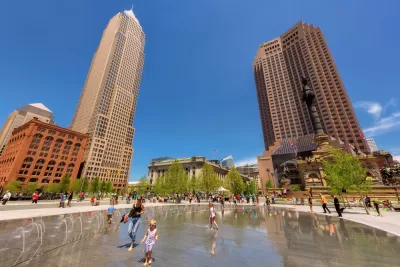
As reported in an article by Sara Shookman, “Mayor Justin Bibb says Cleveland wants to be the first 15-minute city in North America, introducing the concept during his State of the City speech Wednesday.”
Matt Moss, a planner with Cleveland City Planning Commission, said “It's starting out with the city we have now, … and then asking residents how they might want their community to grow or change in ways that, again, make things accessible or provide them with more opportunities to access the things they want to get to in their day to day lives.”
City planners will develop a list of existing amenities and assess what different neighborhoods are lacking in terms of walkability. “In some neighborhoods, they find it's more quality that's lacking due to busted sidewalks or lack of bike lanes or bus stops. In others, when it comes to green space or food justice, neighborhoods are lacking altogether.”
Dr. Darcy Freedman, director of the Mary Ann Swetland Center for Environmental Health, highlighted the importance of access to healthy food and affordable basic staples. “Freedman's team is launching a new study in June called ‘Nourishing Neighborhoods, Empowering Community,’ examining how investing in people rather than just infrastructure can transform the food system.”
The “15-minute city” concept, first introduced in Europe, has become a shorthand for walkable, livable cities that put residents within easy reach of jobs, transit, commerce, and other daily needs. While proponents of the idea argue that it provides a useful vision for improving the day-to-day conditions of urban neighborhoods, the movement has received criticism for not taking into account specific historical conditions in American cities and the ways in which they exacerbate inequality and car-centric development. Economist Edward Glaeser has called it a “dead end.” To Glaeser, the 15-minute city describes a neighborhood, not a city. “All cities should be archipelagos of neighbourhoods, but these neighbourhoods must be connected.” In a recent example illustrating this contradiction, a “15-minute city” being built from scratch in Utah will nevertheless include around 40,000 parking spots.
Read the full story: Can Cleveland become a '15-minute city'? Experts say it's a real possibility


Cleveland: The Nation’s Most Equitably Walkable City
A new study assesses which cities have the broadest access to walkable neighborhoods.
Which US cities have the most housing near transit?
Concentrating housing near frequent, reliable transit offers advantages to both residents and transit agencies, who can serve more riders more efficiently.

Study: Nearly Half of Portland TOD Residents Commute by Transit
People living in transit-oriented developments are more likely to ditch the car and opt for transit or walking, new research shows.

Planetizen Federal Action Tracker
A weekly monitor of how Trump’s orders and actions are impacting planners and planning in America.

Northwest rail fans eager for Sept. 30 debut of Amtrak’s Airo fleet
Get ready for that new train smell and more seats. But they won’t go faster or run more frequently on the Cascades route in Washington and Oregon.
Alabama scores up to $2.5 billion federal loan for largest infrastructure project in state’s history
The Mobile River Bridge and Bayway Project aims to ease congestion at Alabama’s worst bottleneck.

Novel study finds extreme state-by-state disparity in housing construction timelines
The first comprehensive working paper on U.S. construction timelines also found that the permitting process for multi-family projects has slowed nationwide.

California may destroy its beaches trying to save homes from El Niño
Boulders and seawalls can protect homes from waves, but ultimately destroy sandy beaches.

California high-speed rail accomplishes only one legislative goal in 2026
The majority of the agency's failed pitches were never developed into written proposals.

FREE Course: Walkable City 1: Why Walkability?
After describing his path towards focusing on walkability as the essence of good planning, Jeff Speck marches through his five principal reasons for making more walkable places.
Reinventing Malls: Planning Alchemy—Turning Gray Fields Into Gold
The course focuses on the opportunities and imperatives that shape reinvention of mall sites.

City of Thousand Oaks
City of Wisconsin Rapids
Harvard University Graduate School of Design
The Architects Foundation
University of Cincinnati Online
Northern Illinois Transit Authority (NITA)
The Pocatello Development Authority
The Urban Renewal Agency of the City of Pocatello