Subways in Kyiv and Kharkiv are performing as bomb shelters, including the world's deepest station, after the full-scale Russian invasion of Ukraine began on Wednesday night.


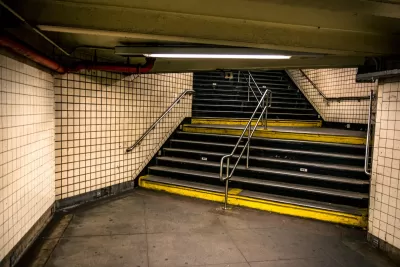
"As Russian forces launched several missiles at the Ukrainian capital of Kyiv the night of Feb. 23, thousands of citizens hunkered down in subway stations," writes Camille Squires, a global cities reporter for Quartz.
On Thursday, Feb. 24, Kyiv mayor Vitali Klitschko imposed a curfew and halted public transit so that subway stations could be used as round-the-clock shelters.
Klitschko, a former heavyweight boxing champion, had announced late last month that the subway would be the capital city's "key shelter", wrote breaking news reporter Jake Epstein for Business Insider on January 26.
"The key bomb shelter in the city of Kyiv will also be the Kyiv subway, which, in the event of — God forbid — zero hour, will be ready to accommodate people who can take shelter in case of a possible attack," Mayor Vitali Klitschko said in an interview with the Current Time television network on Tuesday.
The Kyiv Metro, initially 5 stations and 3.25 miles, opened in 1960 as Ukraine's first rapid transit system. "The Arsenalna Metro Station ... lies nearly 350 feet beneath the city, making it the deepest station in the world," according to Atlas Obscura.
Residents of Kyiv, the nation's most populous city with nearly 3 million people, were not the only urban residents seeking shelter in their city's metro system, wrote BuzzFeed News reporter Clarissa-Jan Lim on Feb. 24.
Crowds swelled in subway stations in Kharkiv, the second-largest city in Ukraine. Its mayor, Ihor Terekhov, was himself sheltering in a subway station.
He told residents to seek cover. "The subway is the safest place," he said.
The Kharkiv Metro opened in 1975 and is the second of four systems in Ukraine, a nation of over 43 million people that claimed independence from the former Soviet Union in 1991.
Additional reading/viewing:
- Crowds of Ukrainian people are hiding from airstrikes in [Kharkiv] subway station (with 4-minute CNN video), Business Insider, Feb. 24, 2022
- Pics: Underground metro stations in Kyiv serve as bomb shelters amid Russian invasion, World is One –WION, Feb. 24, 2022
Related in Planetizen:
- Pipeline Politics Ruffle NATO Summit (Nord Stream 2), July 15, 2018
- How Defensive Fortifications Shaped Cities, December 31, 2014
- Natural Gas Dependence Hobbles Western Response to Crimean Crisis, March 11, 2014
- Public Space Enables, or Prohibits, Protest (Ukraine’s Independence Square), February 25, 2014
- Friday Funny: A Winter Wonderland on Kiev's Subway, December 28, 2012
- Soviet Era Infrastructure is Crumbling, August 21, 2009
- Friday Funny: The Citywide Crossword Puzzle (Lvov, Ukraine), January 9, 2009
Read the full story: Kyiv’s subway stations were built for an invasion

The Missing Sanctions on Russia
President Biden took aim at Russia in his State of the Union address for the war it has started in Ukraine, vowing that they will "pay a price" which so far has yet to extend to their oil and gas exports.

Hooked on Russian Gas
The EU relies on Russia for 45% of its natural gas imports and 27% of its crude oil imports. Germany's dependency is a major reason why it won't ban these imports despite Russia's war in Ukraine. Two natural gas pipelines explain part of the problem.

European Union Takes Initial Step to Ban Russian Energy Imports
After a second day of talks in Brussels, ambassadors to the European Union agreed to ban coal imports from Russia as evidence of widescale atrocities committed by Russian troops in Ukraine surfaced after their withdrawal from the outskirts of Kyiv.

Planetizen Federal Action Tracker
A weekly monitor of how Trump’s orders and actions are impacting planners and planning in America.

The state-sanctioned urbicide of Austin
People don’t kill cities. Freeways do.

Colorado’s Largest Data Center Could Rise Next to Homes — Without a Public Hearing
The proposed campus would consume 11 times the power of Denver International Airport; as it has across the country, opposition mounts.

Nation's most wind-powered state turns to coal as data centers increase energy demand
For the first time in decades, Iowa has increased its generation of coal power.

NYC cools commuters with city's first rain garden above a bus stop
New York City officials say the plants in the rain garden can absorb 16 gallons of rainwater during heavy storms.

Brightline West’s future may rely on $6 billion federal loan
The company has until Nov. 2 to make a $400 million equity investment into its proposed high-speed rail line.

FREE Course: Walkable City 1: Why Walkability?
After describing his path towards focusing on walkability as the essence of good planning, Jeff Speck marches through his five principal reasons for making more walkable places.
Reinventing Malls: Planning Alchemy—Turning Gray Fields Into Gold
The course focuses on the opportunities and imperatives that shape reinvention of mall sites.

Greater Baltimore Committee
Eagle County Government
Harvard University Graduate School of Design
The Architects Foundation
University of Cincinnati Online
The Pocatello Development Authority
The Urban Renewal Agency of the City of Pocatello
Journal of the American Planning Association