An updated 'walk audit toolkit' lets you assess pedestrian safety in your neighborhood and advocate for improvements.


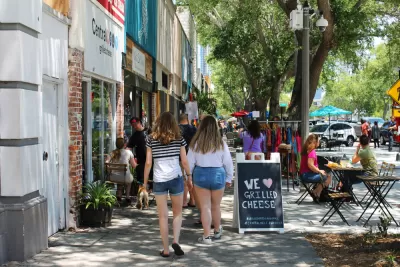
As reported by Melanie Curry, a toolkit published by the AARP provides a template for evaluating pedestrian safety in any community.
"The 'kit' is a 28-page booklet that can be downloaded as a PDF (or ordered from AARP) to guide teams or individuals in conducting an audit of pedestrian facilities – or the lack thereof – in their communities. By simply walking around, observing, and noting features that allow people to walk safely, anyone can advocate for better conditions for everyone in their neighborhood," writes Curry.
The organization wants their Walk Audit Toolkit to serve as a catalyst for discussion and a tool that can help residents, advocates, and policymakers figure out their community's needs "and advocate for better planning so that people can get where they want to go safely and comfortably without having to drive."
"The kit includes ten free worksheets that can be printed out and shared separately. They include checklists for evaluating the safety of streets, sidewalks, intersections, and crossings; transit access; driver behavior; a grid for drawing a map; and questions to help think about who is using the street now, how they are, and why."
FULL STORY: Do-It-Yourself Walk Audit: Identify Ways to Improve Walking Where You Live


The Vicious Cycle at the Heart of Pedestrian Safety
When people feel unsafe, they walk less; with fewer pedestrians, walking becomes less safe.
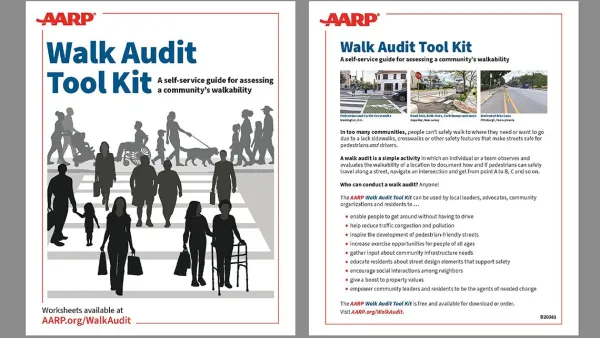
Free From AARP: Walk Audit Tool Kit and Worksheets
AARP recently published an all new, 28-page, image-filled guide—and 11 downloadable worksheets—for how to assess and report on the safety and walkability of a street, intersection, or neighborhood.
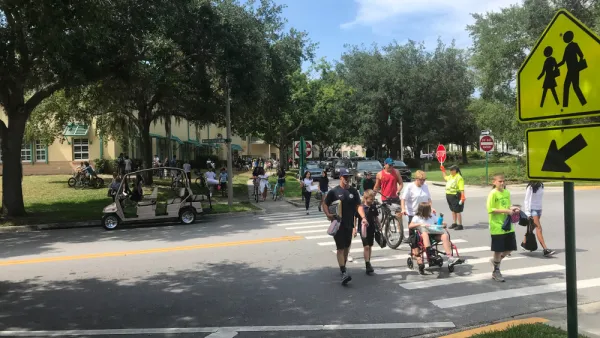
Opinion: Road Safety Data Should Include Close Calls
Even in the absence of lethal collisions, the experience of repeated near-misses can discourage pedestrians from walking and degrade public perception of road safety.

Planetizen Federal Action Tracker
A weekly monitor of how Trump’s orders and actions are impacting planners and planning in America.

The state-sanctioned urbicide of Austin
People don’t kill cities. Freeways do.

US to reduce Colorado River water deliveries to Mexico
A new Colorado Treaty amendment reduces Mexico’s Colorado River water allocation by 250,000 acre feet.

5 New England states march closer to 800 megawatt wind energy project
Securing federal approval for the project may be complicated under the Trump administration, which has historically been hostile towards domestic wind power.

Baltimore to break ground on $50 million Transit Priority Project
The project will bring faster bus trips, safer streets and better bike connections to Baltimore.

Airbnb launches $250 million 'last-dollar financing' housing accelerator, makes first investment in Austin
The company will put $6.4 million towards affordable housing development in Texas’ capital.

FREE Course: Walkable City 1: Why Walkability?
After describing his path towards focusing on walkability as the essence of good planning, Jeff Speck marches through his five principal reasons for making more walkable places.
Reinventing Malls: Planning Alchemy—Turning Gray Fields Into Gold
The course focuses on the opportunities and imperatives that shape reinvention of mall sites.

Eagle County Government
Harvard University Graduate School of Design
Nashville Planning Department
The Architects Foundation
University of Cincinnati Online
The Pocatello Development Authority
The Urban Renewal Agency of the City of Pocatello
Journal of the American Planning Association