The parking reform movement has a major new feather in its cap: the Toronto City Council has this week adopted sweeping changes to the parking requirements of the city's zoning bylaws.



The Toronto City Council this week adopted Zoning Bylaw Amendments that will remove most minimum parking requirements for new developments, according to a press release published by the city of Toronto. Parking maximums have also been added.
The city reports that the changes to the city's parking requirements align with goals set by its climate action strategy, TransformTO, approved in 2017, and the Provincial Policy Statement and the Growth Plan, adopted in 2019.
An article by Erin Nicole Davis for Storeys provides more details about the expected impact of the drastic parking reforms adopted by the fourth-most-populous city in North America.
Part of the reasoning behind the reforms is a pattern of overbuilt parking in new residential developments. According to Davis, "The Residential Construction Council of Ontario (RESCON) says data shows that in new condo projects, an average of 33% of parking stalls were left unsold. One builder, according to RESCON, had 90% still available for sale as a building neared construction."
RESCON also estimates that the price of building a parking spot has increased dramatically in recent years—from $80,000 to $165,000 in three years.
Planetizen shared news that Toronto was heading toward a historic moment in parking reform in November, but Toronto announced the potential for parking reforms [paywall] back in February.
Toronto becomes the latest city to roll back parking requirements in 2021, joining San Diego, Boston, Denver, Minneapolis, and Berkeley—although Toronto's reforms are far more universal than many, but not all, of the cities on that list. Planners in Raleigh, St. Paul, and Dallas are also working on parking reforms, and could have legislation for approval relatively soon.
There's also a crowd sourced map of all the cities that have adopted parking reforms.
Read the full story: Toronto Removes Parking Minimums for New Residential Developments

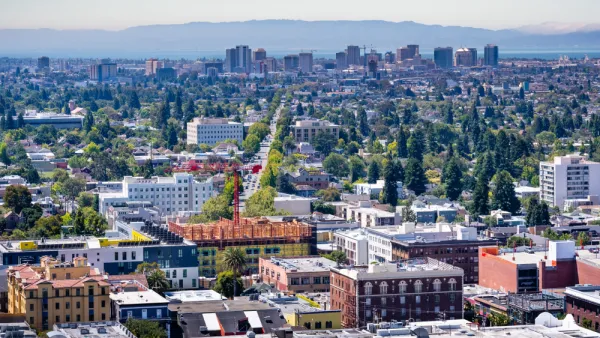
Berkeley to Remove Parking Requirements for Residential Properties
Berkeley is the second city in Northern California to approve landmark zoning reforms so far in 2021.

Major Parking Reform Effort Moving Forward in San Diego
Civic San Diego and San Diego planning commissioners approved new parking standards that would eliminate minimums and set maximums of one space per multifamily unit. Those reforms and more must still be approved by the City Council.

Richmond Weighing How to End Parking Requirements
A series of town hall meetings will allow the public a chance to give feedback about zoning changes in Richmond, Virginia that would include the end of parking requirements.

Amtrak, CN end decades-long dispute with eight-year agreement
The new operating agreement establishes an updated framework for the companies to work together, including processes to resolve disputes.

Judges permit Denver to divert 77,000 acre feet from the Colorado River for reservoir expansion
Overuse and climate change have caused the Colorado River’s water levels to plummet.

Nation's most wind-powered state turns to coal as data centers increase energy demand
For the first time in decades, Iowa has increased its generation of coal power.

Boston has spent millions making the Green Line more accessible — and there’s no end in sight
While the city has invested millions into expanding and adding platforms to the Green Line to make it more accessible, new train cars set to arrive next year will be too tall for disabled passengers to board without raising the current platforms.

Idaho may see an 18% drop in federal surface transit funding — the largest estimated cut in the US
Transit systems in rural communities are much more reliant on federal funding to provide their services.

How ‘post-disaster gentrification’ alters neighborhoods after natural calamities
After hurricanes, fires or other calamities, the original residents of a community are often replaced by younger, wealthier residents.

FREE Course: Walkable City 1: Why Walkability?
After describing his path towards focusing on walkability as the essence of good planning, Jeff Speck marches through his five principal reasons for making more walkable places.
Reinventing Malls: Planning Alchemy—Turning Gray Fields Into Gold
The course focuses on the opportunities and imperatives that shape reinvention of mall sites.

City of Wisconsin Rapids
Harvard University Graduate School of Design
KFH Group Inc.
The Architects Foundation
University of Cincinnati Online
The Pocatello Development Authority
The Urban Renewal Agency of the City of Pocatello