While the city has invested millions into expanding and adding platforms to the Green Line to make it more accessible, new train cars set to arrive next year will be too tall for disabled passengers to board without raising the current platforms.


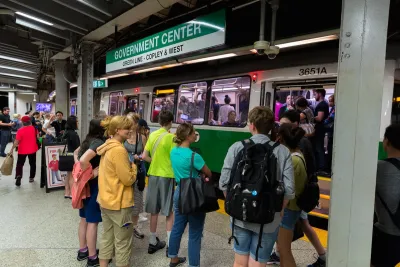
The MTBA is investing hundreds of millions of dollars into expanding and adding platforms along the Green Line to make them ADA-accessible. However, the platforms’ accessibility will again fall short as soon as 2027: the Green Line is expecting 100 new “supercars,” some of which will hit the tracks in 2027, and all of which are too tall for disabled passengers to board without the MBTA also raising every Green Line platform to meet the new cars.
“Eventually, Green Line riders will have to live through an additional bout of construction and shutdowns as the T reworks the platforms to make their height compatible with the so-called Type 10 cars,” Diti Kohli writes for the Boston Globe. “It’ll require another pool of public money, and riders with disabilities who can board Green Line trains independently at some stations this year may later again need drivers’ assistance getting on and off with powered ramps, until the T can lift its platforms another 6 inches to align with the new trolleys.”
Laura Brelsford, the agency’s assistant general manager of systemwide accessibility, said her team is focused on making the Green Line accessible sooner, even with additional construction expected in the future, the Boston Globe reports.
Read the full story: The T is spending millions to make the Green Line more accessible. Soon, it may have to redo its work.

MBTA extends commuter rail discounts and lowers express bus fare to keep passengers riding into the fall
Boston-area commuters can access half-price monthly passes through November.
MBTA threatens to use eminent domain to pedestrianize Boston streets during World Cup
Boston city hall has been unusually reluctant to align with MassDOT and MBTA's proposed crowd management plans.
Boston’s Free Buses are Also its Slowest
Two fare-free bus lines have seen a sharp increase in travel times.

Planetizen Federal Action Tracker
A weekly monitor of how Trump’s orders and actions are impacting planners and planning in America.

Amtrak, CN end decades-long dispute with eight-year agreement
The new operating agreement establishes an updated framework for the companies to work together, including processes to resolve disputes.

Judges permit Denver to divert 77,000 acre feet from the Colorado River for reservoir expansion
Overuse and climate change have caused the Colorado River’s water levels to plummet.

Boston has spent millions making the Green Line more accessible — and there’s no end in sight
While the city has invested millions into expanding and adding platforms to the Green Line to make it more accessible, new train cars set to arrive next year will be too tall for disabled passengers to board without raising the current platforms.

Idaho may see an 18% drop in federal surface transit funding — the largest estimated cut in the US
Transit systems in rural communities are much more reliant on federal funding to provide their services.

How ‘post-disaster gentrification’ alters neighborhoods after natural calamities
After hurricanes, fires or other calamities, the original residents of a community are often replaced by younger, wealthier residents.

FREE Course: Walkable City 1: Why Walkability?
After describing his path towards focusing on walkability as the essence of good planning, Jeff Speck marches through his five principal reasons for making more walkable places.
Reinventing Malls: Planning Alchemy—Turning Gray Fields Into Gold
The course focuses on the opportunities and imperatives that shape reinvention of mall sites.

Harvard University Graduate School of Design
KFH Group Inc.
Greater Baltimore Committee
The Architects Foundation
University of Cincinnati Online
The Pocatello Development Authority
The Urban Renewal Agency of the City of Pocatello