Health care workers in New York will be required to be vaccinated against COVID-19 after the Supreme Court voted 6-3 to reject hearing an appeal brought by workers who had sought a religious exemption. Also, an update on the federal vaccine mandate.


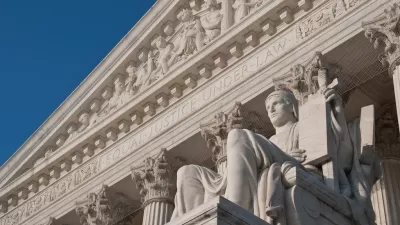
When it comes to vaccine mandates issued by governments, a key issue is to look at the level of government. Mandates issued by states and lower levels of government are faring far better than those by the federal government.
"The Supreme Court on Monday refused to block New York’s requirement that health care workers be vaccinated against the coronavirus even when they cite religious objections," reported Adam Liptak, who covers the United States Supreme Court for The New York Times, on Dec. 13.
As is often the court’s practice in rulings on emergency applications, its unsigned order [pdf] included no reasoning. But Justice Neil M. Gorsuch filed a 14-page dissent saying that the majority had betrayed the court’s commitment to religious liberty.
In fact, all but three sentences in those 14 pages are written by Gorsuch. More on his dissent below, followed by a ruling by the U.S. 5th Circuit Court of Appeals in New Orleans on Dec. 15 on one of two preliminary injunctions applied by federal district courts on the Biden administration's health care worker COVID-19 vaccine mandate.
The vote was 6-3, reports Nina Totenberg, legal affairs correspondent for NPR, in a briefer article on the ruling that includes a two-minute audio version.
The six-justice majority included the court's three liberals and three of its conservative justices, too — Justices Brett Kavanaugh, Amy Coney Barrett and Chief Justice John Roberts.
The ruling is similar to one in October where the court "refused to provide relief to health care workers in Maine who had made an essentially identical request in a challenge to a similar state requirement, over the dissents of the same three justices," adds Liptak. Justice Samuel A. Alito Jr. joined in Gorsuch's dissent on Dec. 13 and Justice Clarence Thomas "also said he would have blocked the vaccine requirement, but he gave no reasons."
The court has also rejected challenges to vaccination requirements at Indiana University [see related post below], for personnel in New York City’s school system and for workers at a Massachusetts hospital. The court also rejected a challenge to a federal mandate requiring masks for air travel.
Those rulings were all issued by only one justice, which can be a sign that the legal questions involved were not considered substantial. But those rulings did not involve religion.
Role of religion
"The ruling from the Supreme Court came in a pair of challenges brought by doctors, nurses and other health care workers who said the requirement violated their right to the free exercise of religion," adds Liptak.
A federal judge in Brooklyn ruled against the challengers in the case before him, but another federal judge, in Utica, N.Y., ruled for the challengers in a second case.
In a consolidated appeal in the two cases, the United States Court of Appeals for the Second Circuit, in New York, refused to block the requirement [pdf].
In his dissent [pdf], Justice Gorsuch wrote:
These applicants are not ‘anti-vaxxers’ who object to all vaccines. Instead, the applicants explain, they cannot receive a COVID–19 vaccine because their religion teaches them to oppose abortion in any form, and because each of the currently available vaccines has depended upon abortion-derived fetal cell lines in its production or testing.
"In its brief, the state...agreed that where possible, federal law requires employers to provide reasonable accommodations for religious objectors, but it noted that does not require employers to offer objectors their preferred accommodation — namely a blanket religious exemption allow," added Totenberg of NPR.
Health care worker shortage
"New York State estimates that about 4 percent of its health care work force — or 37,000 workers — have left their jobs as a result of the vaccine mandate, which was issued by Gov. Kathy C. Hochul on Aug. 26 and went into effect about a month later," adds Liptak. Hochul, who had served seven years as lieutenant governor under Gov. Andrew Cuomo, took office on Aug. 24 after Cuomo resigned.
Because of the pending court cases, workers who had requested religious exemptions were permitted to work until Nov. 22, but then had to get vaccinated, go on leave or resign.
Ms. Hochul has since declared a state of emergency in light of a serious shortage of medical workers in upstate New York exacerbated by these job losses.
Federal health care worker vaccine mandate
The ruling by the Fifth Circuit Court of Appeals was mixed. Technically a loss, there was good news in the ruling for the Biden administration, reports Kelly Gooch for Becker's Hospital Review on Dec. 16.
The 5th Circuit Court of Appeals in New Orleans on Dec. 15 denied the Biden administration's request to lift a district court's injunction that blocked the mandate in 14 states that had challenged the mandate, but granted a stay on the injunction's application to any other jurisdiction.
As posted earlier, Federal district court Judge Terry A. Doughty on Nov. 30 had gone beyond the 14 states that filed the lawsuit against the Centers for Medicare and Medicaid (CMS), part of the Department of Health and Human Services (HHS), who had issued the rule and applied the ruling nationwide.
A day before Doughty issued his ruling from Louisiana, U.S. District Judge Matthew Schelp in St. Louis had blocked the same CMS rule in 10 states.
"The 8th Circuit Court of Appeals in St. Louis upheld the Missouri court's order on Dec. 13," adds Gooch. [See "vaccination scorecard" at base of "Biden's 'Path Out of the Pandemic' Imperiled by Multiple Court Decisions," posted Dec. 5.]
The result of the 5th Circuit's ruling [pdf] is that the CMS vaccination mandate "has effectively [been] revived in 26 states...for eligible staff at healthcare facilities participating in Medicare and Medicaid programs."
Related in Planetizen:
- Another Biden COVID Vaccine Mandate on Hold [affecting health care workers], December 1, 2021
- Supreme Court Allows Indiana University's Vaccine Mandate to Remain in Place, August 16, 2021
- SCOTUS: Freedom of Religion Trumps Public Health in a Pandemic, November 29, 2020
- U.S. Supreme Court Rules on State-Imposed Social Distancing Restrictions [in religious services], June 1, 2020
FULL STORY: Supreme Court Allows Vaccine Mandate for New York Health Care Workers

Another Biden COVID Vaccine Mandate on Hold
Last month, a court stayed Biden's large private employer mandate that requires workers to be vaccinated or test-and-mask. On Tuesday, a federal district court judge stayed the vaccine mandate that applies nationwide to most health care workers.
Federal Vax-or-Test Mandate for Large Employers Reinstated
Judges of the U.S. Sixth Circuit Court of Appeals decided, 2-1, to allow the Biden administration's vax-or-test mandate for private sector employers, removing a stay placed on the OSHA rule by the Fifth Circuit. Enforcement begins Feb. 9.
Supreme Court: OSHA Exceeded its Public Health Authority
The Supreme Court ruled that the Occupational Safety and Health Administration had overreached its authority to protect the health of workers in large private companies. In a separate decision, it upheld a vaccine mandate for most healthcare workers.

The state-sanctioned urbicide of Austin
People don’t kill cities. Freeways do.

US to reduce Colorado River water deliveries to Mexico
A new Colorado Treaty amendment reduces Mexico’s Colorado River water allocation by 250,000 acre feet.

New Jersey’s second-largest city bans standalone data centers
Jersey City will continue to allow co-location facilities, such as those meant for research institutions that store their own data.

Amtrak not solely to blame for New Jersey commuter rail's unreliability, report finds
A new study from the Garden State Initiative found that NJ Transit’s budget grew 20% across a 4 year period, but reliability declined significantly over the same period.

EPA erases limits on planet-warming pollution from power plants
Under Monday’s plan, power plants would still have some limits on how much mercury, arsenic and other contaminants they can emit.

Phoenix announces new on-demand transit service, more frequent RAPID buses
Both new services will launch in October, and are part of Phoenix's Project Effective Access Solutions for Easing Congestion.

FREE Course: Walkable City 1: Why Walkability?
After describing his path towards focusing on walkability as the essence of good planning, Jeff Speck marches through his five principal reasons for making more walkable places.
Reinventing Malls: Planning Alchemy—Turning Gray Fields Into Gold
The course focuses on the opportunities and imperatives that shape reinvention of mall sites.

Eagle County Government
Harvard University Graduate School of Design
Nashville Planning Department
The Architects Foundation
University of Cincinnati Online
The Pocatello Development Authority
The Urban Renewal Agency of the City of Pocatello
Journal of the American Planning Association