The Biden administration this week took ambitious steps toward a new era of automobile transportation in the United States.


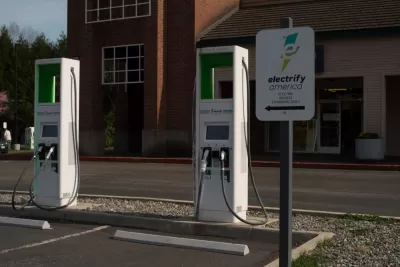
"The Biden administration today released a road map for building out a national network of 500,000 electric vehicle charging stations as part of its plan to combat climate change," reports Arianna Skibell for E&E News.
The Infrastructure Investment and Jobs Act, approved by Congress in November, enabled the charging station plan, according to Skibell. Two packages of money will fund the cause: $5 billion for state transportation departments to support the expansion and an "additional $2.5 billion is also available in grant opportunities to help connect rural and marginalized communities to electric vehicles," according to Ley.
At the federal level, a new electric vehicle office, shared between the U.S. Department of Transportation and U.S. Department of Energy, will coordinate the work. "Energy Secretary Jennifer Granholm and Transportation Secretary Pete Buttigieg are expected to sign [December 14] an agreement authorizing their offices to leverage resources to expand EV infrastructure across the country," reports Ley.
Additional coverage of the electric vehicle charging bill is available from an article by Matthew Daly for the Associated Press.
Read the full story: White House rolls out $7.5B electric vehicle charging plan

New York State Finances $60M Loan for EV Charging Infrastructure
Gov. Hochul announced the investment just as a federal program for EV charging infrastructure was halted by administration officials.

Rivian Joins Movement Toward Universal EV Charging
As more automakers like Tesla, Ford, and Rivian make their charging infrastructure compatible, the shift could lead to the faster development of a nationwide EV charging network.
Florida Law Bars Cities From Regulating EV Chargers
Under the new law, cities cannot require charging infrastructure in local codes.

Planetizen Federal Action Tracker
A weekly monitor of how Trump’s orders and actions are impacting planners and planning in America.

California plans to bury El Niño’s downpour
If the state plays its cards right, it may be able to store a billion acre-feet of El Niño’s water in aquifers.

Chicago breaks ground on $3 billion megadevelopment
The new neighborhood, titled Foundry Park, will one day host 3,700 residences.

California High-Speed Rail Authority CEO resigns after $600,000 scandal
Under Ian Choudri, the authority used taxpayer dollars to fund first class flights and trips to nightclubs.

Want to study the Missouri River? Soon, you may need unanimous approval from 10 states
Legislation would require 10 governors’ permission to study or build projects moving water outside the basin.

Desperate measures: Advocates weigh draining Lake Powell to fill Colorado River
Draining the reservoir could reduce evaporation losses by a couple hundred thousand acre-feet.

FREE Course: Walkable City 1: Why Walkability?
After describing his path towards focusing on walkability as the essence of good planning, Jeff Speck marches through his five principal reasons for making more walkable places.
Reinventing Malls: Planning Alchemy—Turning Gray Fields Into Gold
The course focuses on the opportunities and imperatives that shape reinvention of mall sites.

City of Rosemead
Rutgers University, Edward J. Bloustein School of Planning and Public Policy
One Hundred Miles
Hunter College, City University of New York (CUNY)
The Architects Foundation
University of Cincinnati Online
City of Cambridge
Montrose County
The Pocatello Development Authority