The time to start preparing for mass migration spurred by climate change is already here.


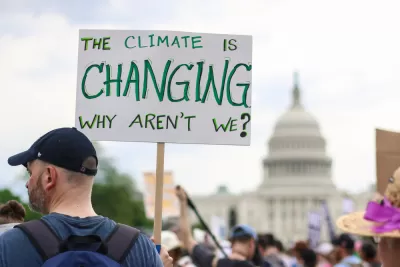
"Climate change impacts are projected to displace 216 million people in developing regions by 2050," reports Tim McDonnell.
That's the conclusion of a new report from the World Bank, which predicts that sea-level rise and water scarcity will be the primary driving force of climate-related displacement—some of which will occur within the borders of existing countries and even within city limits.
"As early as 2030, cities like Cairo, Hanoi, Dhaka, Tashkent could become climate immigration hotspots. The latest report, which focuses primarily on North Africa, East Asia, and Central Asia, builds on a document from 2018 that focused on sub-Saharan Africa, Latin America, and South Asia," explains McDonnell.
The World Bank report echoes the findings of the Intergovernmental Panel on Climate Change report from August of this year, saying that every degree of warming that can be mitigated through emission reductions will have an impact on the number of migrants later in the century—and the conditions they will face as they move around their countries.
"People move around anyway, and urbanization has been growing for decades," writes McDonnell. "The challenge, highlighted by the report, is to ensure that destination locations are ready, with safe, affordable housing, employment opportunities, and sufficient public services for a growing population."
Read the full story: The World Bank says climate change could displace more than 200 million people

Sea Level Rise is Drowning This Pacific Island Nation; They Have a Plan
The nation of Tuvalu has created an ambitious plan to relocate its entire population and preserve key cultural and historic resources as rising seas threaten to wipe it out within three decades.
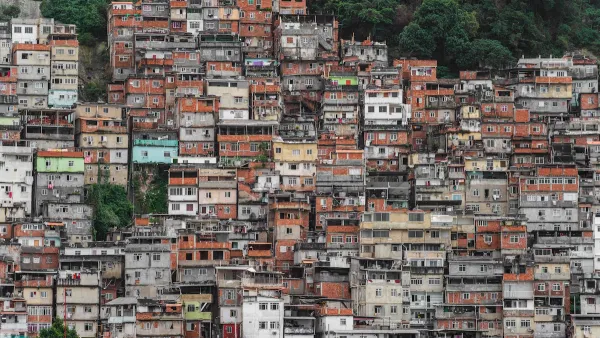
Housing as a Climate Resilience Strategy
Ensuring that housing, including in informal settlements, is safe and healthy for its residents is a key tool in the fight to build more sustainable and equitable communities in the face of climate migration.
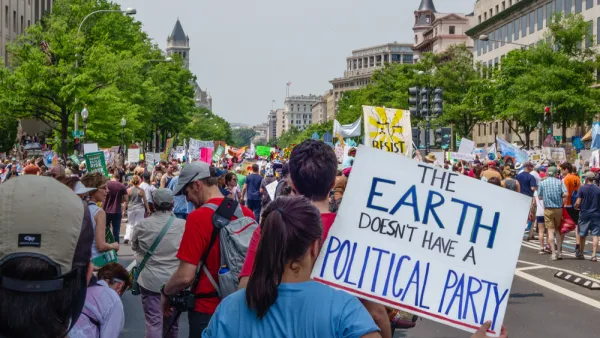
Preparing for Climate Migration
Billions of people will have to relocate in the next decades. Are governments prepared?

Planetizen Federal Action Tracker
A weekly monitor of how Trump’s orders and actions are impacting planners and planning in America.

California plans to bury El Niño’s downpour
If the state plays its cards right, it may be able to store a billion acre-feet of El Niño’s water in aquifers.

Desperate measures: Advocates weigh draining Lake Powell to fill Colorado River
Draining the reservoir could reduce evaporation losses by a couple hundred thousand acre-feet.

US buildings threatened, destroyed by fires set to triple by 2060
Researchers found a high fire risk for socioeconomically vulnerable neighborhoods in the American West.

LA residents may be allowed to paint their own crosswalks
Councilwoman Katy Yaroslavsky put out a motion instructing the Los Angeles Department of Public Transportation to study the feasibility of allowing volunteers to paint crosswalks.

Dallas moves to overhaul its zoning code
The city's zoning reform will allow more multi-family and mixed-use developments.

FREE Course: Walkable City 1: Why Walkability?
After describing his path towards focusing on walkability as the essence of good planning, Jeff Speck marches through his five principal reasons for making more walkable places.
Reinventing Malls: Planning Alchemy—Turning Gray Fields Into Gold
The course focuses on the opportunities and imperatives that shape reinvention of mall sites.

City of Rosemead
Rutgers University, Edward J. Bloustein School of Planning and Public Policy
One Hundred Miles
Hunter College, City University of New York (CUNY)
The Architects Foundation
University of Cincinnati Online
City of Cambridge
Montrose County
The Pocatello Development Authority