Texas' costliest natural disaster will be the subject of a congressional investigation by a House Oversight subcommittee thanks to Rep. Ro Khanna, D-Calif., who is concerned about ERCOT's lack of preparation for extreme winter weather.


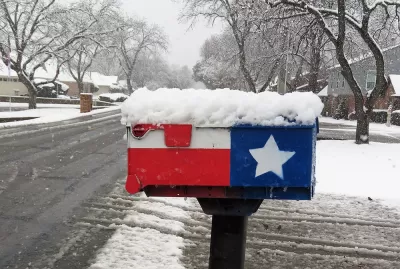
Winter storm 2021, as The Texas Tribune has dubbed it, "which killed dozens around the state, is expected to be the costliest natural disaster in Texas' history, even costlier than Hurricane Harvey, which inflicted $125 billion in damage," writes Bryan Mena, the D.C. reporting fellow for The Texas Tribune, on March 3. "It is still too early to tally the total cost of the destruction."
Contrary to what has been written by some in the mainstream media and by some in the energy industry on the extreme weather event that caused an epic grid failure in Texas during the third week of February, the Arctic freeze was not unprecedented but foreseeable and the power failure was preventable, as noted by Rep. Ro Khanna (D-Calif.), chair of the environment subcommittee for the U.S. House Committee on Oversight and Reform, in his March 3 letter to Bill Magness, president and CEO of the Electric Reliability Council of Texas (ERCOT):
Extreme winter weather events in Texas have occurred repeatedly over decades, and ERCOT has been unprepared for them. ERCOT’s own consultant has predicted that such extreme winter weather events will continue to occur every decade.
The Subcommittee is concerned that the loss of electric reliability, and the resulting human suffering, deaths, and economic costs, will happen again unless ERCOT and the State of Texas confront the predicted increase in extreme weather events with adequate preparation and appropriate infrastructure.
"Khanna is requesting from ERCOT all documents related to preparations, a description of every power generator that experienced failures and old documents that address the outages the state experienced in 1989 and 2011," adds Mena. "The subcommittee asked ERCOT to hand over documents by March 17."
Will the subcommittee go beyond 'blaming ERCOT?'
As posted here recently, ERCOT, the nonprofit, independent power grid operator for 90 percent of the nation's second-largest state, has become the convenient fall guy for the epic power failure:
Rather than blaming the grid operator for what Austin American-Statesman reporter, Asher Price, called "the most calamitous week in modern Texas history," the roots of the power failure rest with the power plant owners and operators who opted not to winterize their equipment for a very simple reason – they weren't required to.
"Dan Woodfin, a senior director at ERCOT, told The Texas Tribune a few weeks ago that winterizing the grid is 'not mandatory' and is instead part of 'a voluntary guideline,'" adds Mena.
The subcommittee's investigation will also consider one of the 'four converging crises' identified by President Joe Biden on Inauguration Day and on page 4 of Khanna's 7-page letter [pdf].
Increased Extreme Weather Events are Connected to Climate Change
The consensus view among climate scientists is that the Earth is warming due to human-caused activities and that extreme weather events are the predictable result. The extreme winter weather experienced by Texas is a known risk of global warming. [See footnote #18 at bottom of page.]
On a related issue, the letter addresses the misinformation given by Texas officials and some in the media on the role that green energy played in the power failure.
Despite false claims from Texas officials that the power outages were attributable to renewable sources like wind turbines, the vast majority of the dip in electricity supply came from fossil fuel generation. Renewable sources of energy only make up roughly 10% of power in Texas, while over half of the energy comes from fossil fuels such as power plants fired by natural gas. [See footnotes 3-4 on bottom of pg. 2]
ERCOT CEO ousted
While a spokesperson for ERCOT told The Texas Tribune that the grid operator "will be providing responses" to the subcommittee, it may not come from CEO Magness. The Tribune reported separately on March 3 that the board that oversees ERCOT had voted to terminate him.
Magness' absence will leave the 16-person ERCOT board with a mix of vacancies and temporary members. Both ERCOT and the Public Utilities Commission (PUC) of Texas, the regulatory body that oversees it, have been lambasted in recent weeks for failures in preparing for and responding to the winter storm that left millions of people in the dark for days and claimed the lives of dozens.
Hopefully, Khanna's subcommittee will resist the 'blame ERCOT' perspective that seems to have pervaded the state's leadership. As the Tribune noted, "Magness defended ERCOT as an entity that carries out what state lawmakers and the PUC direct."
“The commission approves the policy, we implement it,” Magness said.
Related in Planetizen:
-
Lone Star Grid, February 24, 2021
-
Blaming ERCOT, February 22, 2021
- California-Style Rolling Blackouts Come to Texas, Feb. 18, 2021
-
2020 Sets Record for Billion-Dollar Disasters, January 10, 2021
Hat tip to Chris Cillizza.
Read the full story: U.S. House Oversight Committee investigating operator of Texas’ power grid

Blaming ERCOT
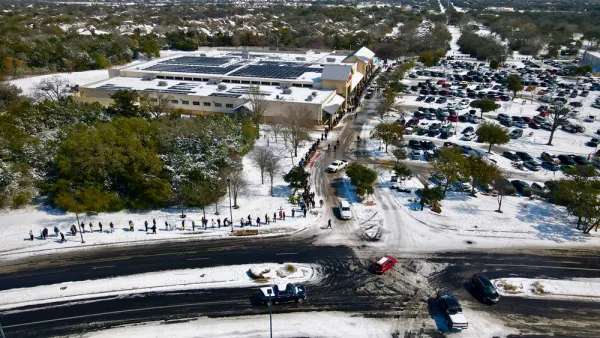
The Electric Reliability Council of Texas (ERCOT), the nonprofit, independent power grid operator for 90 percent of the nation's second-largest state, has become the convenient fall guy for the epic power failure caused by an extreme weather event.
California-Style Rolling Blackouts Come to Texas
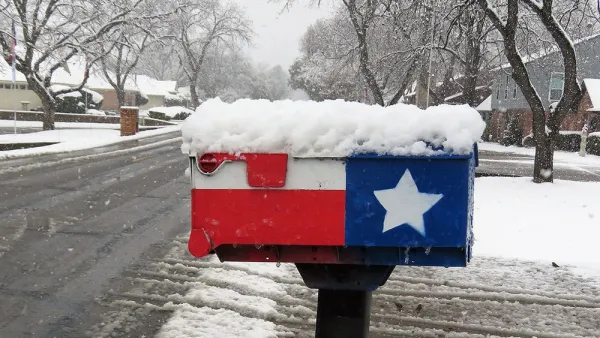
As bad as the power outages are in Texas, they would be much worse if the independent energy grid operator hadn't initiated rolling blackouts. In an extensive interview with CBS Austin, Bill Magness, the head of ERCOT, explains what went wrong.
Lone Star Grid
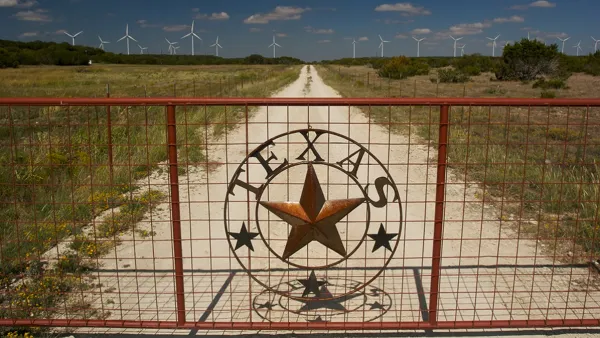
The Arctic blast that shut down power to millions of Texas households last week has brought renewed attention to the isolated Texas power grid that prevented the operator from importing out-of-state electricity.

Planetizen Federal Action Tracker
A weekly monitor of how Trump’s orders and actions are impacting planners and planning in America.

California plans to bury El Niño’s downpour
If the state plays its cards right, it may be able to store a billion acre-feet of El Niño’s water in aquifers.

Chicago breaks ground on $3 billion megadevelopment
The new neighborhood, titled Foundry Park, will one day host 3,700 residences.

California High-Speed Rail Authority CEO resigns after $600,000 scandal
Under Ian Choudri, the authority used taxpayer dollars to fund first class flights and trips to nightclubs.

Want to study the Missouri River? Soon, you may need unanimous approval from 10 states
Legislation would require 10 governors’ permission to study or build projects moving water outside the basin.

Desperate measures: Advocates weigh draining Lake Powell to fill Colorado River
Draining the reservoir could reduce evaporation losses by a couple hundred thousand acre-feet.

FREE Course: Walkable City 1: Why Walkability?
After describing his path towards focusing on walkability as the essence of good planning, Jeff Speck marches through his five principal reasons for making more walkable places.
Reinventing Malls: Planning Alchemy—Turning Gray Fields Into Gold
The course focuses on the opportunities and imperatives that shape reinvention of mall sites.

City of Rosemead
Rutgers University, Edward J. Bloustein School of Planning and Public Policy
One Hundred Miles
Hunter College, City University of New York (CUNY)
The Architects Foundation
University of Cincinnati Online
City of Cambridge
Montrose County
The Pocatello Development Authority