A $435 billion "economic justice" bill proposed by Democrats in the U.S. Senate includes $10 billion for projects that remove highways and build community-oriented assets in their place.



Kea Wilson reports: "Shortly before the holiday recess, then-Senate minority leader Chuck Schumer and a coalition of 25 Democratic senators introduced a $435 billion economic justice bill called S5065 that included a $10-billion pilot program aimed at helping communities tear down urban highways, and rebuild the surrounding neighborhoods with the needs of underserved communities in mind."
The "Restoring Neighborhoods and Strengthening Communities Program," known among advocates as the "Highways to Boulevards" initiative, would only be available in areas with large numbers of low-income residents and people of color.
The program is designed to avoid a top-down planning approach to the process of rebuilding. "Perhaps most critically, the initiative would make significant funds available specifically for the 'community engagement and capacity building' necessary to identify what underserved residents actually want to do with all the valuable land freed up when freeways are torn down," according to Wilson.
The program would also enable the creation of community land trusts. "[A]dvocacy groups, like Transportation for America, have heralded community land trusts as an essential companion to tear-down grants," according to Wilson.
The article includes a lot more detail about the benefits of tearing down urban highways and includes some speculation about how much progress can be made to advance the cause under the Biden administration and with Pete Buttigieg at the helm of the U.S. Department of Transportation.
FULL STORY: Senate Considering $10B for Highway Removal

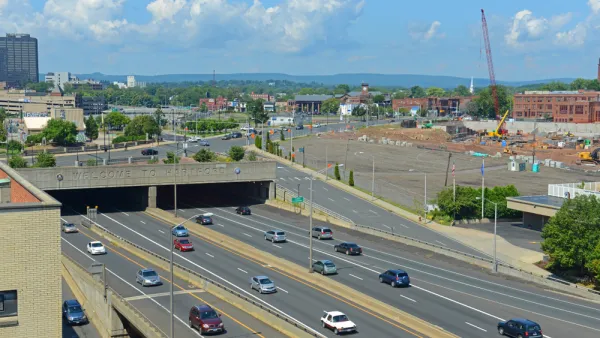
Undoing the Destructive Legacy of Hartford's Interstates
A new plan would spend an estimated $17 billion to remove a huge chunk of the Interstate Highway System's footprint in Hartford, Connecticut.
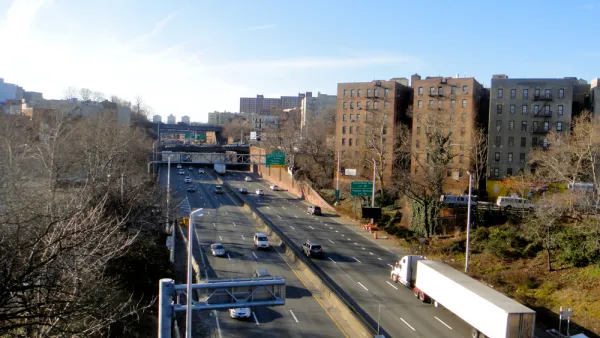
The Case for Urban Highway Removal
Instead of removing urban freeways, which have proven to be destructive to communities and economies—in some cases deliberately so—many cities are expanding freeways in and around cities.

Planning for Congestion Relief
The third and final installment of Planetizen's examination of the role of the planning profession in both perpetuating and solving traffic congestion.

The state-sanctioned urbicide of Austin
People don’t kill cities. Freeways do.

US to reduce Colorado River water deliveries to Mexico
A new Colorado Treaty amendment reduces Mexico’s Colorado River water allocation by 250,000 acre feet.

New Jersey’s second-largest city bans standalone data centers
Jersey City will continue to allow co-location facilities, such as those meant for research institutions that store their own data.

Amtrak not solely to blame for New Jersey commuter rail's unreliability, report finds
A new study from the Garden State Initiative found that NJ Transit’s budget grew 20% across a 4 year period, but reliability declined significantly over the same period.

EPA erases limits on planet-warming pollution from power plants
Under Monday’s plan, power plants would still have some limits on how much mercury, arsenic and other contaminants they can emit.

Phoenix announces new on-demand transit service, more frequent RAPID buses
Both new services will launch in October, and are part of Phoenix's Project Effective Access Solutions for Easing Congestion.

FREE Course: Walkable City 1: Why Walkability?
After describing his path towards focusing on walkability as the essence of good planning, Jeff Speck marches through his five principal reasons for making more walkable places.
Reinventing Malls: Planning Alchemy—Turning Gray Fields Into Gold
The course focuses on the opportunities and imperatives that shape reinvention of mall sites.

Eagle County Government
Harvard University Graduate School of Design
Nashville Planning Department
The Architects Foundation
University of Cincinnati Online
The Pocatello Development Authority
The Urban Renewal Agency of the City of Pocatello
Journal of the American Planning Association