New pop-up bus lanes on two of the most heavily traveled bus routes in Chicago will help move essential workers more efficiently during the pandemic.


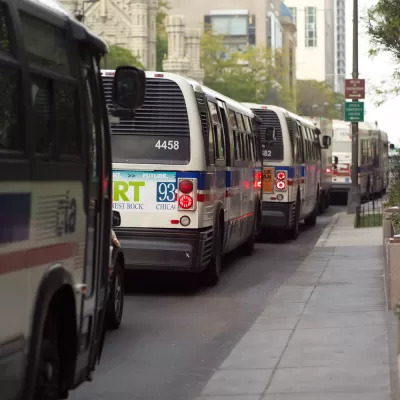
"The Chicago Department of Transportation (CDOT) and the Chicago Transit Authority (CTA) announced a 'pop-up essential bus lanes' program that will temporarily designate 24-hour bus-only lanes along two city routes to expand bus service for essential workers," reports Katie Pyzyk.
Mike Claffey, a spokesperson for the CDOT is quoted in the article providing more details about the implementation of the new pop-up bus lanes, which will be marked with striping and signs rather than the usual red paint treatment.
"The city intends to install the lanes within the next several weeks and run the pilot for at least six months to evaluate any changes with ridership and operations," according to Pyzyk.
The two routes have already received upgrades as part of the city's Bus Priority Zones program announced in 2019. "The city first announced planned improvements along these two bus corridors in 2018," according to Pyzyk. "Last year it provided $20 million in funding for CDOT and CTA to improve bus travel times and reliability along core routes as part of the Bus Priority Zone Program, and the two routes that will receive the new pop-up lanes received upgrades as part of the larger initiative."
Read the full story: Chicago adds pop-up bus lanes to support COVID-era commutes

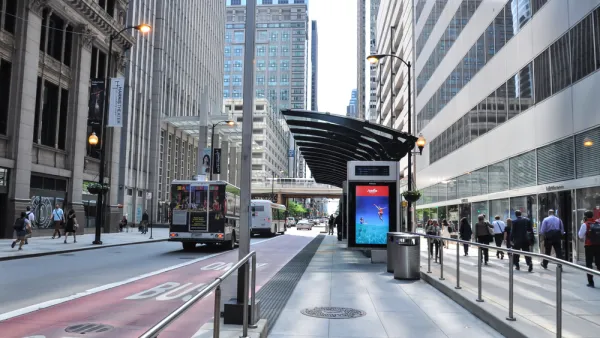
Chicago Makes ‘Pop-Up’ Bus Lanes Permanent
Even with the addition of 3.5 miles of permanent bus-only lanes, Chicago trails other cities in miles of dedicated bus lanes.
Chicago's New Strategic Plan for Transportation Prioritizes Equity and Accountability
The plan calls for safer streets, more equitable distribution of resources, and expanded community engagement.

Bus/Bike Lanes Find Support in Chicago
A temporary bus/bike lane experiment could lead to permanent additions around the city.

Planetizen Federal Action Tracker
A weekly monitor of how Trump’s orders and actions are impacting planners and planning in America.

California plans to bury El Niño’s downpour
If the state plays its cards right, it may be able to store a billion acre-feet of El Niño’s water in aquifers.

Chicago breaks ground on $3 billion megadevelopment
The new neighborhood, titled Foundry Park, will one day host 3,700 residences.

Satanic place names
From streams and lakes to valleys and canyons, I mapped more than 1,000 places named after the Devil.

California High-Speed Rail Authority CEO resigns after $600,000 scandal
Under Ian Choudri, the authority used taxpayer dollars to fund first class flights and trips to nightclubs.

Want to study the Missouri River? Soon, you may need unanimous approval from 10 states
Legislation would require 10 governors’ permission to study or build projects moving water outside the basin.

FREE Course: Walkable City 1: Why Walkability?
After describing his path towards focusing on walkability as the essence of good planning, Jeff Speck marches through his five principal reasons for making more walkable places.
Reinventing Malls: Planning Alchemy—Turning Gray Fields Into Gold
The course focuses on the opportunities and imperatives that shape reinvention of mall sites.

City of Rosemead
Rutgers University, Edward J. Bloustein School of Planning and Public Policy
One Hundred Miles
Hunter College, City University of New York (CUNY)
The Architects Foundation
University of Cincinnati Online
City of Cambridge
Montrose County
The Pocatello Development Authority