The San Francisco Municipal Transportation Agency announced that it would shift resources away from light rail, starting Monday, and then the Valley Transportation Authority announced it was suspending light rail service in the South Bay immediately.


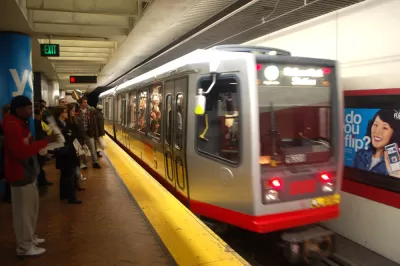
"Starting Monday, March 30, there will be no more subway or light rail service in San Francisco," reports Alexa Mae Asperin.
"SFMTA announced Thursday that the new changes are happening in response to a decline in ridership amid the virus pandemic and to 'help us focus resources on routes outside of the downtown area.'"
Bus service will replace light rail service on the J, KT, L, M, and N. Full details of the scheduling changes can be found on the Muni website.
While other transit agencies around the country have reduced service in response to decreased demand, Muni was, to our knowledge, the first system in the country to completely suspend operations of rail transit, but, in fact, the Valley Transportation Authority had already suspended light rail service in the South Bay the night before, after a "person being trained as an operator tested positive for the coronavirus," reports Michael Cabanatuan.
"As of Thursday morning, 60 light rail operators and dozens more maintenance staff were placed on leave as the transit agency works to determine more information about the infected employee," according to a separate article by Julian Glover.
FULL STORY: San Francisco’s Muni Metro, light rail service to shut down amid pandemic

Post-Pandemic Transit Plan Announced in San Francisco
The recently announced post-COVID plan for public transit in San Francisco looks a lot different than the pre-COVID days.
Light Rail Service Restored in South Bay Area
The Santa Clara Valley Transportation Authority (VTA) will start running trains again today, two weeks after shutting down service.
Transit Almost Entirely Shut Down in San Francisco
Only 17 of San Francisco's 89 Muni transit routes will still operate by the middle of the week.

Planetizen Federal Action Tracker
A weekly monitor of how Trump’s orders and actions are impacting planners and planning in America.

The state-sanctioned urbicide of Austin
People don’t kill cities. Freeways do.

US to reduce Colorado River water deliveries to Mexico
A new Colorado Treaty amendment reduces Mexico’s Colorado River water allocation by 250,000 acre feet.

Airbnb launches $250 million 'last-dollar financing' housing accelerator, makes first investment in Austin
The company will put $6.4 million towards affordable housing development in Texas’ capital.

Guerilla urbanists are building DIY bus stop benches in Chicago
A before-and-after of one of the bus stops with a new bench. The new benches are not officially sanctioned or permitted, but the residents who placed them hope they will be the start of a network of DIY benches across the city.

Mamdani overhauls NYC's Vision Zero plan with 100 new policy goals
The overhaul aims to reduce traffic deaths and make streets safer for pedestrians, cyclists and drivers through lower speed limits, new safety infrastructure and more.

FREE Course: Walkable City 1: Why Walkability?
After describing his path towards focusing on walkability as the essence of good planning, Jeff Speck marches through his five principal reasons for making more walkable places.
Reinventing Malls: Planning Alchemy—Turning Gray Fields Into Gold
The course focuses on the opportunities and imperatives that shape reinvention of mall sites.

Eagle County Government
Harvard University Graduate School of Design
Nashville Planning Department
The Architects Foundation
University of Cincinnati Online
The Pocatello Development Authority
The Urban Renewal Agency of the City of Pocatello
Journal of the American Planning Association