Advocates say an upgraded Hance Park could be a great success for the city, but the move forward has been slow.


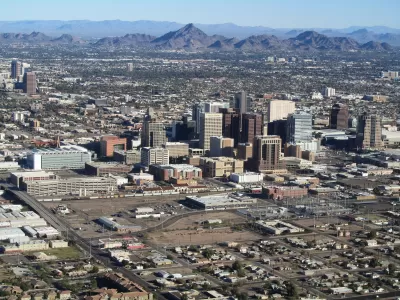
Jessica Boehm reports on efforts to revitalize Margaret T. Hance Park in downtown Phoenix. Construction of the park over an Interstate 10 tunnel in the 1980s was part of a big plan that never came to fruition, and community advocates have been pushing over the last decade for major improvements.
A year ago, the city released design concepts for Hance Park that include more shade and trees, new playgrounds, and water features, and the city council recently approved $150,000 for a contract with a construction company to plan the upgrade. "But still, no improvements have been made at the park, no timeline released for when users of the park will see changes and little shared about fundraising efforts," says Boehm.
Funding for the project, which will cost $80 million to $100 million, is still up in the air. Supporters say they are confident they can raise the money, most of which will come from private donations. "[Tim] Sprague would not speculate on the timeline of the project, but said there is a drive to move quickly with the Super Bowl coming back to Phoenix in 2023 and the NCAA Final Four returning in 2024," notes Boehm.
Read the full story: Hance Park could be Phoenix's equivalent of Central Park, advocates say. Is the money there?
In Tucson, Sweltering Heat Threatens the Most Vulnerable
When the temperatures become dangerous in this desert city, not everyone has the option to retreat to air-conditioned spaces to wait it out.
Walking in Phoenix Can Mean Taking Your Life in Your Hands
Phoenix's roads are the most dangerous in the state for pedestrians, but the city is taking little action to make them safer.
Waterline Breaks Plague Phoenix as City Struggles to Keep Up
Pipeline breaks are a daily occurrence in the city, but funding for an expanded pipe-replacement program has been a contentious issue.

Planetizen Federal Action Tracker
A weekly monitor of how Trump’s orders and actions are impacting planners and planning in America.

California plans to bury El Niño’s downpour
If the state plays its cards right, it may be able to store a billion acre-feet of El Niño’s water in aquifers.

Desperate measures: Advocates weigh draining Lake Powell to fill Colorado River
Draining the reservoir could reduce evaporation losses by a couple hundred thousand acre-feet.

Los Angeles just elected an urban planner as its mayor
Transportation analysts are optimistic that Raman will be more aggressive in addressing transit issues than Bass.

Mamdani’s pied-à-terre tax survives legal challenge
A panel of judges found that the plaintiffs failed to demonstrate injury as a result of New York City's implementation of the tax.

Eastern Nebraska is running out of electricity
Data centers and electrification are straining eastern Nebraska’s grid, throttling economic development.

FREE Course: Walkable City 1: Why Walkability?
After describing his path towards focusing on walkability as the essence of good planning, Jeff Speck marches through his five principal reasons for making more walkable places.
Reinventing Malls: Planning Alchemy—Turning Gray Fields Into Gold
The course focuses on the opportunities and imperatives that shape reinvention of mall sites.


City of Rosemead
Rutgers University, Edward J. Bloustein School of Planning and Public Policy
One Hundred Miles
University of Michigan School for Environment and Sustainability (SEAS)
Hunter College, City University of New York (CUNY)
The Architects Foundation
City of Cambridge
Montrose County
The Pocatello Development Authority