A program in New York brings artists into public agencies to work on collaborative projects that take creative approaches to problem solving.


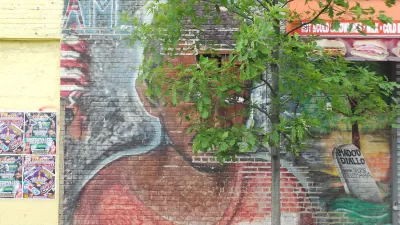
New York City’s Public Artists in Residence program, started in 2015, pairs artists with city agencies to explore creative solutions to social issues. The Department of Cultural Affairs oversees the program and recently announced the four participating artists for 2019.
"Taja Lindley, a Brooklyn-based interdisciplinary artist and activist, will spend the next year doing an unconventional residency — she’ll be collaborating with the New York City Department of Health and Mental Hygiene, working on a project that deals with unequal birth outcomes and maternal mortality for pregnant and parenting black people in the Bronx," reports Sophie Haigney.
Laura Nova will be in residence at the Department for the Aging, Julia Weist will be in residence at the Department of Records and Information Services, and Janet Zweig will be in residence at the Mayor’s Office of Sustainability. Each twelve-month residency will start with a research phase where the artist meets with agency staff and develops a proposal for a participatory project to be completed in partnership with the agency.
Read the full story: Artists as ‘Creative Problem-Solvers’ at City Agencies
Post-Cuomo Penn Station Updates Could Move Project Forward
The controversial renovation of Penn Station could move forward with a scaled-back plan.

Electric Bikes and Scooters Legalized in New York City
The City Council has legalized electric scooters and bikes. A citywide shared electric scooter pilot program is expected by early 2021.

Signal Priority in N.Y.C. to Make Streets Safer for Cyclists
New York City will create green waves by adjusting traffic signals to keep cyclists moving, even when drivers will have to slow down.

Planetizen Federal Action Tracker
A weekly monitor of how Trump’s orders and actions are impacting planners and planning in America.

California plans to bury El Niño’s downpour
If the state plays its cards right, it may be able to store a billion acre-feet of El Niño’s water in aquifers.

Desperate measures: Advocates weigh draining Lake Powell to fill Colorado River
Draining the reservoir could reduce evaporation losses by a couple hundred thousand acre-feet.

Mamdani’s pied-à-terre tax survives legal challenge
A panel of judges found that the plaintiffs failed to demonstrate injury as a result of New York City's implementation of the tax.

Eastern Nebraska is running out of electricity
Data centers and electrification are straining eastern Nebraska’s grid, throttling economic development.

Seattle passes record-breaking transit services expansion
Proposition 1 will double the city’s transit tax to add 95,000 more bus trips and preserve 180,000 bus trips annually.

FREE Course: Walkable City 1: Why Walkability?
After describing his path towards focusing on walkability as the essence of good planning, Jeff Speck marches through his five principal reasons for making more walkable places.
Reinventing Malls: Planning Alchemy—Turning Gray Fields Into Gold
The course focuses on the opportunities and imperatives that shape reinvention of mall sites.


City of Rosemead
Rutgers University, Edward J. Bloustein School of Planning and Public Policy
One Hundred Miles
University of Michigan School for Environment and Sustainability (SEAS)
Hunter College, City University of New York (CUNY)
The Architects Foundation
City of Cambridge
Montrose County
The Pocatello Development Authority