Pete Buttigieg, in his eighth and final year as mayor of South Bend, Indiana, a formerly shrinking Rust Belt city, is on a roll in his bid to capture the Democratic nomination to challenge President Trump next year. The Indy Star looks at his record.


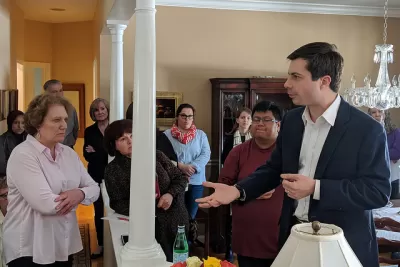
"Democrat Pete Buttigieg said Monday that his presidential exploratory committee raised over $7 million in the first quarter of 2019," reports Daniel Strauss for POLITICO. "The number is likely to put Buttigieg in the upper echelon of 2020 Democratic presidential hopefuls as they publicize their first-quarter fundraising numbers over the next two weeks."
When Mayor Pete Buttigieg (pronounced Boot-a-judge or Buddha-judge or Boot-edge-edge) of South Bend, Indiana, began his first term in 2012, he became the youngest mayor of a city over 100,000. Now in his final year as mayor of the state's fourth largest city, the 37-year-old candidate hopes to become America's youngest president. He launched his presidential exploratory committee on January 23.
"He’s the 'hottest candidate in the 2020 race,' according to CNN," writes Lisa Lerer in her "On Politics" column in The New York Times on March 28. "New Yorkers love him more than their own mayor. "
The year before Buttigieg took office, Newsweek listed South Bend as one of the top 10 dying cities in America, notes an August 2017 post by Planetizen managing editor James Brasuell about Buttigieg's efforts to transform what Mayor Pete calls "the beating heart of our entire region," the aging Studebaker factory that shut its doors in 1963, into a center of high-tech innovation. [Listen to the source article on Public Radio International.]
Unlike many, if not most medium-to-large coastal cities, Buttigieg doesn't measure progress by how many homes have been built – it's the opposite. Until 2014, South Bend, like many a Midwestern rust belt city, has been shrinking.
"Back in 2011, when Buttigieg was a 29-year-old knocking on doors to ask for votes, he heard the same question time and time again: What are you going to do about all of the vacant homes?" reports Chris Sikich for The Indianapolis Star in a deep-dive on the mayor's efforts to examine Buttigieg's claims that South Bend is now a "turnaround city."
Studebaker employed more than 24,000 workers at its height in the 1950s. As South Bend's population shrank by roughly a quarter over the five decades following its demise, large swaths of neighborhoods were left abandoned and crumbling.
Sikich describes Buttigieg's strategy to demolish or have homeowners repair dwellings. "Buttigieg decided to promote an aggressive timetable — 1,000 homes in 1,000 days [pdf]. The goal was surpassed, with 60 percent demolished and 40 percent repaired, and continues to this day.
Sikich continues his deep dive into the mayor's claims that South Bend is a "turnaround city." As with any city that is now experiencing investment, the fear of gentrification in the city "which is roughly 54 percent white, 26 percent black and 14 percent Hispanic" is real.
Complete streets initiative
"During his second term, he constructed safer, more appealing 'Smart Streets' as part of downtown placemaking," according to his city government mayoral webpage. A photo in Indy Star shows "bike-friendly paths and roads are the result of an infrastructure initiative by Mayor Pete Buttigieg in downtown South Bend."
In fact, "Smart Streets, which has eliminated one-way streets, narrowed them to slow traffic, widened and beautified sidewalks with new trees and decorative brickwork, and created new bike paths," was a factor in the downtown's revival, reported Jeff Parrott for the South Bend Tribune.
First mayor to be president?
Should Buttigieg win his party's nomination, not only would he be the first openly gay candidate of a major party for president, he would also be the first sitting mayor to receive the nomination, according to Nathaniel Rakich, FiveThirtyEight’s elections analyst. However, Anthony Williams, who served as the mayor of Washington, D.C. from 1999 until 2007, writes in CityLab that DeWitt Clinton was nominated in 1812 by the Fusion Party and lost to incumbent James Madison.
Sorry, this correspondent can't determine whether Clinton was mayor of New York City at the time or lieutenant governor of New York State. In any case, both writers agree that a sitting mayor has never been elected to president.
Additional reading:
- 'Turnaround city': Pete Buttigieg pushes theme of South Bend revival in run for president, South Bend Tribune, Jan 23, 2019
Related in Planetizen:
-
South Bend Has Big Innovation District Plans, August 30, 2017
-
South Bend Reactivating Vacant Lots, April 13, 2016
FULL STORY: Pete Buttigieg says he’s mayor of a turnaround city. Here’s how that claim stands up.

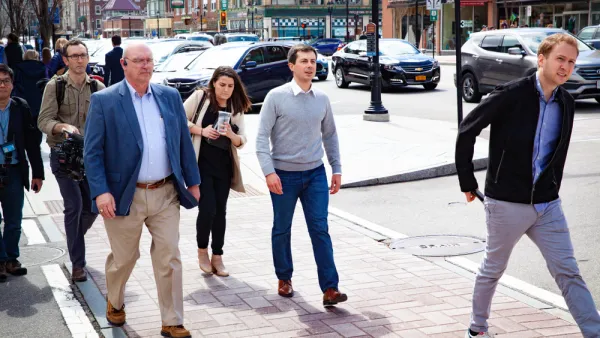
Mayor Pete Is Biden's Pick for Transportation Secretary
President-elect Joe Biden is expected to nominate a former rival in the Democratic presidential primary and the former two-term mayor of South Bend, the fourth largest city in Indiana, to head the Transportation Department.
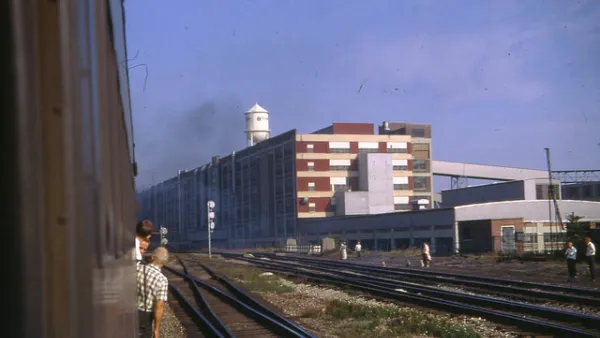
South Bend Has Big Innovation District Plans
Public Radio International (PRI) surveys the keys to an ambitious plan to restore the industrial "temples" of South Bend, Indiana.
Placekeeping: Setting a New Precedent for City Planners
How a preservation-based approach to redevelopment and urban design can prevent displacement and honor legacy communities.

The state-sanctioned urbicide of Austin
People don’t kill cities. Freeways do.

US to reduce Colorado River water deliveries to Mexico
A new Colorado Treaty amendment reduces Mexico’s Colorado River water allocation by 250,000 acre feet.

New Jersey’s second-largest city bans standalone data centers
Jersey City will continue to allow co-location facilities, such as those meant for research institutions that store their own data.

Amtrak not solely to blame for New Jersey commuter rail's unreliability, report finds
A new study from the Garden State Initiative found that NJ Transit’s budget grew 20% across a 4 year period, but reliability declined significantly over the same period.

EPA erases limits on planet-warming pollution from power plants
Under Monday’s plan, power plants would still have some limits on how much mercury, arsenic and other contaminants they can emit.

Phoenix announces new on-demand transit service, more frequent RAPID buses
Both new services will launch in October, and are part of Phoenix's Project Effective Access Solutions for Easing Congestion.

FREE Course: Walkable City 1: Why Walkability?
After describing his path towards focusing on walkability as the essence of good planning, Jeff Speck marches through his five principal reasons for making more walkable places.
Reinventing Malls: Planning Alchemy—Turning Gray Fields Into Gold
The course focuses on the opportunities and imperatives that shape reinvention of mall sites.

Eagle County Government
Harvard University Graduate School of Design
Nashville Planning Department
The Architects Foundation
University of Cincinnati Online
The Pocatello Development Authority
The Urban Renewal Agency of the City of Pocatello
Journal of the American Planning Association