The developers of the Hudson Yards development in New York want to change its deal with union employees as it moves into the second phase of construction.


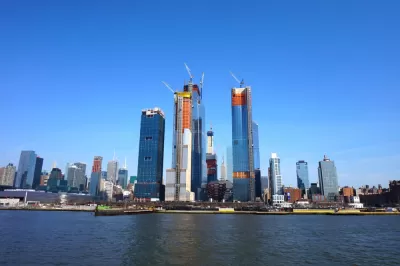
Daniel Geiger reports: "The Related Cos., the developer behind the $20 billion Hudson Yards complex on the Far West Side, and the Building and Construction Trades Council of Greater New York, the umbrella union group that represents roughly 100,000 union construction workers, said Wednesday they have a framework to return to the bargaining table."
Geiger describes the feud leading up to the deal as bitter. "Related used union construction workers exclusively to build the first part of Hudson Yards, which is scheduled to formally open March 15. But the partnership fractured a year ago as Related sought to use some nonunion workers for the second phase."
Geiger details the acrimonious back and forth that ensued, which finally broke this week: "It wasn't immediately clear who blinked first, but the framework appears to grant Related leeway on a key issue: the freedom to hire less-expensive, nonunion workers for lower-skill jobs such as site cleanup."
FULL STORY: Hudson Yards deal ends nastiest fight in NYC real estate

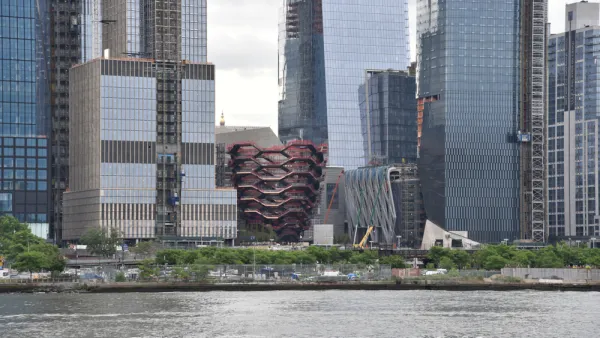
Review: The Hudson Yards Mega-Development, Open to the Public Today
Curbed Architecture Critic Alexandra Lange provides everything you need to know about the $25 billion, "city within the city" that opened to the public in Manhattan today. Also, the review isn't exactly positive.
Hudson Yards Will Redefine Manhattan
The size and scale of Hudson Yards in the skyline of Manhattan will match the size and scale of public and private investment in the project. The project's effect in the city's economy will be just as conspicuous.
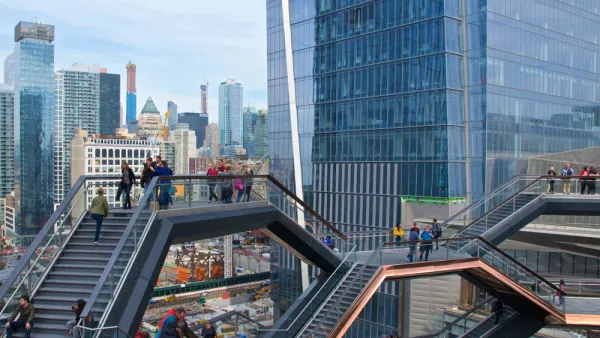
Suicides Prompt New Public Access Rules for the Vessel at Manhattan's Hudson Yards
The Vessel is reopening after closing for four months due to a rash of suicides.

Planetizen Federal Action Tracker
A weekly monitor of how Trump’s orders and actions are impacting planners and planning in America.

The state-sanctioned urbicide of Austin
People don’t kill cities. Freeways do.

US to reduce Colorado River water deliveries to Mexico
A new Colorado Treaty amendment reduces Mexico’s Colorado River water allocation by 250,000 acre feet.

5 New England states march closer to 800 megawatt wind energy project
Securing federal approval for the project may be complicated under the Trump administration, which has historically been hostile towards domestic wind power.

Baltimore to break ground on $50 million Transit Priority Project
The project will bring faster bus trips, safer streets and better bike connections to Baltimore.

Airbnb launches $250 million 'last-dollar financing' housing accelerator, makes first investment in Austin
The company will put $6.4 million towards affordable housing development in Texas’ capital.

FREE Course: Walkable City 1: Why Walkability?
After describing his path towards focusing on walkability as the essence of good planning, Jeff Speck marches through his five principal reasons for making more walkable places.
Reinventing Malls: Planning Alchemy—Turning Gray Fields Into Gold
The course focuses on the opportunities and imperatives that shape reinvention of mall sites.

Eagle County Government
Harvard University Graduate School of Design
Nashville Planning Department
The Architects Foundation
University of Cincinnati Online
The Pocatello Development Authority
The Urban Renewal Agency of the City of Pocatello
Journal of the American Planning Association