Cities across the country have ambitious goals to move to renewable energy, but support at the federal level is lacking. A new program will assist cities with procurement and regulation of renewables.



The American Cities Climate Challenge Renewables Accelerator will provide technical resources and tools to U.S. cities to help them reach their renewable energy goals. "The program will help cities procure and deploy large-scale, off-site renewable energy and navigate any regulations and laws that might impede progress," reports Chris Teale.
The Renewables Accelerator is a collaborative effort related to the American Cities Climate Challenge, a Bloomberg Philanthropies effort. "The 2.8 gigawatts of renewable capacity it aims to build is more than the existing solar capacity in Nevada, Florida or Texas, so cities will need to be creative in their procurement and deployment strategies," notes Teale.
The United States withdrew from the Paris climate accord in 2017. These programs reflect the desire of city leaders to be proactive in addressing climate change, particularly with what they see as a lack of national leadership.
FULL STORY: Bloomberg-backed accelerator to help cities meet renewable energy goals

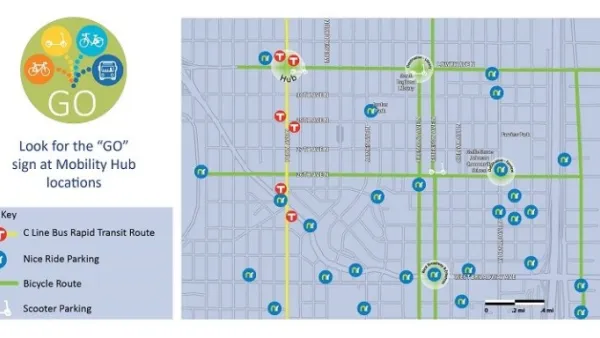
A Test Ride for Mobility Hubs
Offering multiple, non-automobile options for transportation in one place is the idea behind mobility hubs. The city of Minneapolis is now testing the concept at four locations.

2019 Certification for Cities Harnessing Data to Govern
The What Works Cities Certification recognizes cities across the country using data to inform local governance.

No Good News for Climate Stabilization From a New Worldwide Energy Report
Last month, the Paris-based International Energy Agency released its annual "Global Energy & CO2 Status Report." Energy consumption grew 2.3 percent with fossil fuels accounting for 70 percent on the increase. CO2 emissions jumped 1.7 percent.

The state-sanctioned urbicide of Austin
People don’t kill cities. Freeways do.

US to reduce Colorado River water deliveries to Mexico
A new Colorado Treaty amendment reduces Mexico’s Colorado River water allocation by 250,000 acre feet.

New Jersey’s second-largest city bans standalone data centers
Jersey City will continue to allow co-location facilities, such as those meant for research institutions that store their own data.

Amtrak not solely to blame for New Jersey commuter rail's unreliability, report finds
A new study from the Garden State Initiative found that NJ Transit’s budget grew 20% across a 4 year period, but reliability declined significantly over the same period.

EPA erases limits on planet-warming pollution from power plants
Under Monday’s plan, power plants would still have some limits on how much mercury, arsenic and other contaminants they can emit.

Phoenix announces new on-demand transit service, more frequent RAPID buses
Both new services will launch in October, and are part of Phoenix's Project Effective Access Solutions for Easing Congestion.

FREE Course: Walkable City 1: Why Walkability?
After describing his path towards focusing on walkability as the essence of good planning, Jeff Speck marches through his five principal reasons for making more walkable places.
Reinventing Malls: Planning Alchemy—Turning Gray Fields Into Gold
The course focuses on the opportunities and imperatives that shape reinvention of mall sites.

Eagle County Government
Harvard University Graduate School of Design
Nashville Planning Department
The Architects Foundation
University of Cincinnati Online
The Pocatello Development Authority
The Urban Renewal Agency of the City of Pocatello
Journal of the American Planning Association