Offering multiple, non-automobile options for transportation in one place is the idea behind mobility hubs. The city of Minneapolis is now testing the concept at four locations.


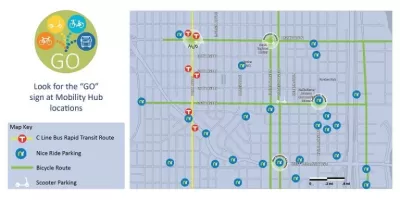
Tim Harlow reports on a new pilot program to launch mobility hubs around the city of Minneapolis. Goals of the program include such lofty aspirations of decreasing driving and carbon emissions while increasing use of alternative transportation modes like transit, walking, and biking.
The new mobility hubs offer several alternative transportation options in one location, according to Harlow: "Each one has a bus stop, a bench and parking for Nice Ride bicycles and scooters that can be checked out by smartphone app."
The city opened four such mobility hubs around north Minneapolis in September, using funding supplied by the Bloomberg Philanthropies' American Cities Climate Challenge.
"As part of the pilot, city staff and representatives from the bike and scooter companies have been on site to show people how to access and use alternative transportation modes, and 'getting people to understand what we are doing here,' [Josh Johnson, the city’s advanced mobility manager,] said. The hubs also feature colorful signs with directions and travel time by mode to nearby destinations."
Hat tip to Katie Pyzyk for sharing news of the mobility hubs pilot program and for providing additional context on the mobility hubs concept.
Read the full story: Minneapolis pilots mobility hubs combining transit, scooters and bicycles

Transportation Tech Innovation Zone Launched in Los Angeles
Urban Movement Labs (UML) is working with the office of Mayor Eric Garcetti to undertake a series of pilot programs to entice private companies to Los Angeles to develop and test innovation transportation technology.
Scooter Pilot Comes to a Close in Chicago
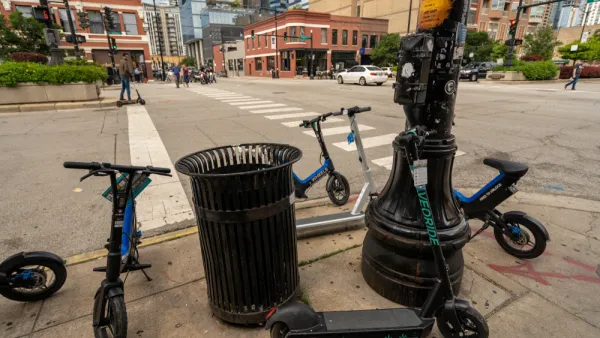
Chicago's heavily debated electric scooter rental pilot comes to a close today. The debate about how to treat electric scooter rentals in the future also begins today.
NACTO to Help Five Cities Design and Build Low-Carbon Transportation Infrastructure
Five cities will help the National Association of City Transportation Officials (NACTO) prove that urban streets can provide the location for a drastic shift in the carbon emissions status quo.

Planetizen Federal Action Tracker
A weekly monitor of how Trump’s orders and actions are impacting planners and planning in America.

Eastern Nebraska is running out of electricity
Data centers and electrification are straining eastern Nebraska’s grid, throttling economic development.

Washington state to charge fee to drivers with fuel-efficient cars
Revenue from the fee will go towards supporting the state’s highways.

How a Massachusetts city used laser beams to find the root of its tree loss
Cambridge discovered that the most tree loss was occurring on residential lots rather than city-owned property.

Instead of building new housing, LA developers are turning mansions into mega-mansions
In the richest areas, the number of houses valued at $30 million with demolition permits has skyrocketed since 2018.

Illinois considers spending $1 billion in taxpayer money on data center
A quantum computing campus and data center are currently under construction in Chicago.

FREE Course: Walkable City 1: Why Walkability?
After describing his path towards focusing on walkability as the essence of good planning, Jeff Speck marches through his five principal reasons for making more walkable places.
Reinventing Malls: Planning Alchemy—Turning Gray Fields Into Gold
The course focuses on the opportunities and imperatives that shape reinvention of mall sites.

City of Charlotte
City of Rosemead
Rutgers University, Edward J. Bloustein School of Planning and Public Policy
University of Michigan School for Environment and Sustainability (SEAS)
Hunter College, City University of New York (CUNY)
The Architects Foundation
University District Partnership
City of Cambridge
The Pocatello Development Authority