The city of San Antonio is working on a plan to reduce its reliance on carbon-emitting fuels.



"Even before its release, a plan that aims to put San Antonio on a steady path to reduce greenhouse gases that contribute to global climate change already is being criticized as too weak, or possibly too costly to businesses and consumers," reports Scott Huddleston.
The draft Climate Action Plan, called SA Climate Ready and released for public review this month, organizes climate goals into five categories, or "climate equity themes": 1) Access and Accessibility, 2) Affordability, 3) Cultural Preservation, 4) Health, and 5) Safety and Security. Included in those themes are goals, according to Huddleston, for changes like "greater use of electric vehicles to more energy-efficient building codes."
The largest goal of SA Climate Ready is to achieve carbon neutrality in the city by 2050.
The San Antonio Express-News supplemented this news coverage with a "heat island map" of San Antonio.
FULL STORY: San Antonio climate plan stirs support, concerns

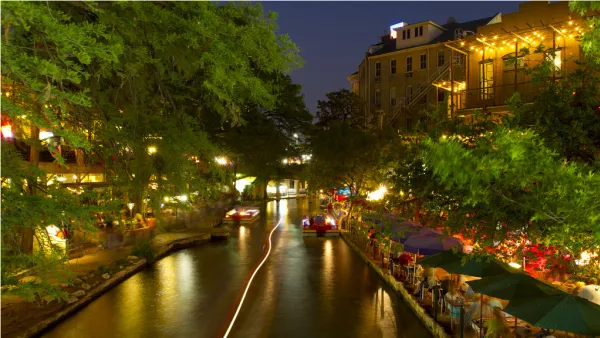
San Antonio's Draft Climate Plan Receives Relatively Warm Reception
The public had its first chance to weigh in on a draft climate plan released in January, sending signals about the political viability of climate change action in the state of Texas.

$1 Billion Carbon Neutrality Plan Paused in Ann Arbor
The Ann Arbor City Council wants a more specific consideration of expenses before it will hold a final vote on the A2Zero carbon neutrality plan.

Boise Aims to Go Carbon-Neutral by 2050, Adopts New Climate Plan
City leaders expressed enthusiastic support for the Climate Action Roadmap, a detailed plan for reducing carbon emissions, protecting the environment, and meeting other climate goals.

The state-sanctioned urbicide of Austin
People don’t kill cities. Freeways do.

US to reduce Colorado River water deliveries to Mexico
A new Colorado Treaty amendment reduces Mexico’s Colorado River water allocation by 250,000 acre feet.

New Jersey’s second-largest city bans standalone data centers
Jersey City will continue to allow co-location facilities, such as those meant for research institutions that store their own data.

Amtrak not solely to blame for New Jersey commuter rail's unreliability, report finds
A new study from the Garden State Initiative found that NJ Transit’s budget grew 20% across a 4 year period, but reliability declined significantly over the same period.

EPA erases limits on planet-warming pollution from power plants
Under Monday’s plan, power plants would still have some limits on how much mercury, arsenic and other contaminants they can emit.

Phoenix announces new on-demand transit service, more frequent RAPID buses
Both new services will launch in October, and are part of Phoenix's Project Effective Access Solutions for Easing Congestion.

FREE Course: Walkable City 1: Why Walkability?
After describing his path towards focusing on walkability as the essence of good planning, Jeff Speck marches through his five principal reasons for making more walkable places.
Reinventing Malls: Planning Alchemy—Turning Gray Fields Into Gold
The course focuses on the opportunities and imperatives that shape reinvention of mall sites.

Eagle County Government
Harvard University Graduate School of Design
Nashville Planning Department
The Architects Foundation
University of Cincinnati Online
The Pocatello Development Authority
The Urban Renewal Agency of the City of Pocatello
Journal of the American Planning Association