A three-day global summit on climate action in San Francisco, hosted by Gov. Jerry Brown, is unlike other international climate summits in that it features "non-state actors," such as governors, mayors, and businesses, rather than nations.


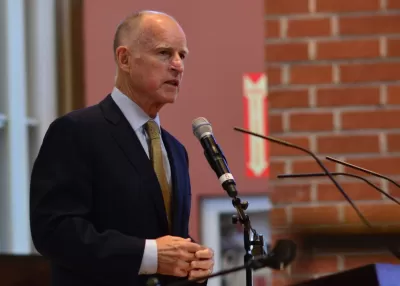
"At the international climate summit Gov. Jerry Brown will kick off Wednesday in San Francisco, the state is playing a role none ever has, pushing the rest of the country to join other nations in enforcing a landmark agreement on climate change that President Trump has quit," reports Evan Halper for the Los Angeles Times.
Put simply, the three-day environmental summit will test whether California can bring the country to a place Congress and the White House won’t.
Indeed, as the Trump administration prepared this week to ease regulations on methane, one of the most potent greenhouse gases, many states are looking to follow California and Colorado in pursuing policies that require energy firms to capture the methane their drilling operations release and convert it into electricity.
California’s new law — signed Monday — putting the state on a path to 100% renewable energy could motivate others to make similar pledges this week.
"This summit, which Brown is co-hosting with former New York Mayor Michael Bloomberg and a bevy of international officials, aims to advance that staid model [in which political figures discuss what can be done to address climate change, sign declarations, adjourn and meet again later, somewhere else] by including a broad group of 'non-state actors'—mayors, governors and leaders representing regions rather than entire countries," reported Julie Cart for CALmatters.
Brown’s extensive networking will come into play, as will two organizations he helped found. One is the Under2 Coalition, a group of more than 200 governments vowing to prevent global temperatures from rising more than two degrees Celsius.
A second grew out of his partnership with Bloomberg: America’s Pledge, a mix of states, cities and businesses that vow to adhere to the emission reductions set out in the Paris climate accord.
A new report prepared for the summit, "Global Climate Action from Cities, Regions, and Businesses" [pdf] "projects that despite a retreat by the federal government, a serious push from the bottom-up could put the U.S. within reach of its Paris emissions goals by 2025," reports Craig Miller for KQED, the Bay Area NPR affiliate (audio available).
"That still leaves a long way to go," adds Halper. "The summit will test how much cities, states and the private sector can do to fill the gap."
Nonpartisan even in Trump era
"Although many summit attendees may view Trump as a villain, Los Angeles Mayor Eric Garcetti said climate change should not be seen as a partisan issue," adds Halper
More than a few Republicans will attend. And he notes that the largest American city running on 100% renewable power now is Georgetown, Texas, a conservative community of 67,000 people with a Republican mayor.
Ultimately the summit will be "a test of how much cities, states and the private sector can do to fill the gap" left by President Trump's withdrawal from the Paris Climate Agreement, adds Halper.
Miller, KQED's science editor, reports that commitments to climate action from those non-state actors and sub-national governments who are central to doing the work of meeting the goals of the Paris Agreement have been rolling in even before the summit convened.
FULL STORY: How far can California push the nation — and the world? Jerry Brown's climate summit may provide the answer

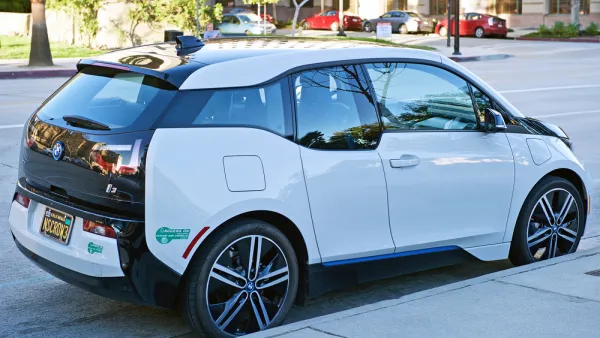
Gov. Jerry Brown Signs 16 Bills to Spur Sales of New and Used Electric Vehicles
On the second day of the Global Climate Action Summit, co-host Gov. Jerry Brown signed 16 bills onboard a new plug-in hybrid electric ferry in San Francisco Bay to spur sales of zero-emission vehicles and reduce greenhouse gas emissions.
Keep it in the Ground – 2018
As climate hawks gather in San Francisco for the Global Climate Action Summit that convenes Wednesday, Gov. Jerry Brown, host of the summit, is dogged by critics who can't distinguish between oil production and consumption.
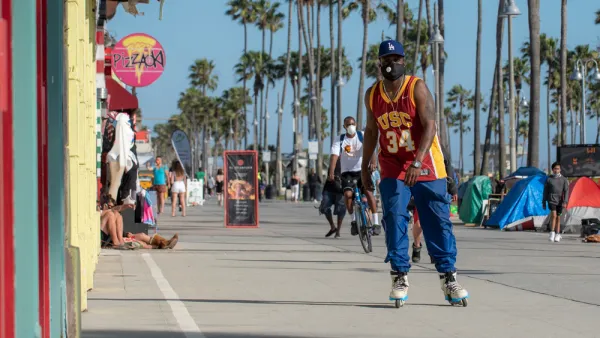
Los Angeles Mayor Blames COVID Outbreak on Density
Appearing on a Sunday news show, Mayor Eric Garcetti noted that the Los Angeles metropolitan region is the nation's densest and one of two primary reasons why "we're seeing a person every six seconds contract COVID-19 here in Los Angeles County."

Planetizen Federal Action Tracker
A weekly monitor of how Trump’s orders and actions are impacting planners and planning in America.

The state-sanctioned urbicide of Austin
People don’t kill cities. Freeways do.

US to reduce Colorado River water deliveries to Mexico
A new Colorado Treaty amendment reduces Mexico’s Colorado River water allocation by 250,000 acre feet.

5 New England states march closer to 800 megawatt wind energy project
Securing federal approval for the project may be complicated under the Trump administration, which has historically been hostile towards domestic wind power.

Baltimore to break ground on $50 million Transit Priority Project
The project will bring faster bus trips, safer streets and better bike connections to Baltimore.

Airbnb launches $250 million 'last-dollar financing' housing accelerator, makes first investment in Austin
The company will put $6.4 million towards affordable housing development in Texas’ capital.

FREE Course: Walkable City 1: Why Walkability?
After describing his path towards focusing on walkability as the essence of good planning, Jeff Speck marches through his five principal reasons for making more walkable places.
Reinventing Malls: Planning Alchemy—Turning Gray Fields Into Gold
The course focuses on the opportunities and imperatives that shape reinvention of mall sites.

Eagle County Government
Harvard University Graduate School of Design
Nashville Planning Department
The Architects Foundation
University of Cincinnati Online
The Pocatello Development Authority
The Urban Renewal Agency of the City of Pocatello
Journal of the American Planning Association