That's not all folks….The studio says they'll pay for the project too.



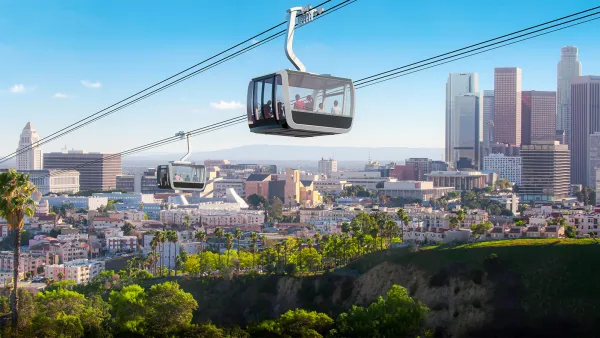
Warner Bros. wants to build a high-speed tram from its studio lot in Burbank to the Hollywood sign in Los Angeles, reports Ryan Faughnder.
"The 95-year-old studio on Monday told city officials it would foot the bill for an aerial tramway to transport visitors to and from the Hollywood sign, starting from a parking structure next to its Burbank lot," according to Faughnder.
The proposal has a name, the Hollywood Skyway, and an estimated price tag, $100 million. "The tramway would take visitors on a 6-minute ride more than 1 mile up the back of Mt. Lee to a new visitors center near the sign, with pathways to a viewing area," adds Faughnder.
While a tram to one of the most conspicuous and recognizable locations in the second largest city in the United States might seem newsworthy for its own sake, Faughnder leads the story by mentioning the ongoing controversies surrounding vehicle and foot traffic to the sign.
The Warner Bros. plan is not to be confused with a previous plan to build a gondola from the L.A. Zoo to the Hollywood sign, as proposed by Barry Diller and Diane von Fursterberg in December 2017.
Read the full story: Warner Bros. wants to build a $100-million aerial tramway to the Hollywood sign

LA Metro Approves Controversial Dodger Stadium Gondola Plan
The vote came after a contentious meeting in which dozens of speakers, including three city council members, spoke against the proposed aerial taxi.

California TOD Law Gives NIMBYs a new Weapon Against Bus Lanes
A new law that allows rezoning for higher density near transit lines is fueling opposition to a Burbank bus rapid transit line.
Dodger Stadium Gondola Completes Draft Environmental Impact Report
No World Series? At least Dodger fans can imagine themselves soaring over the traffic jams on the way to and from Dodger stadium in a new gondola.

Planetizen Federal Action Tracker
A weekly monitor of how Trump’s orders and actions are impacting planners and planning in America.

California plans to bury El Niño’s downpour
If the state plays its cards right, it may be able to store a billion acre-feet of El Niño’s water in aquifers.

Chicago breaks ground on $3 billion megadevelopment
The new neighborhood, titled Foundry Park, will one day host 3,700 residences.

California High-Speed Rail Authority CEO resigns after $600,000 scandal
Under Ian Choudri, the authority used taxpayer dollars to fund first class flights and trips to nightclubs.

Want to study the Missouri River? Soon, you may need unanimous approval from 10 states
Legislation would require 10 governors’ permission to study or build projects moving water outside the basin.

Desperate measures: Advocates weigh draining Lake Powell to fill Colorado River
Draining the reservoir could reduce evaporation losses by a couple hundred thousand acre-feet.

FREE Course: Walkable City 1: Why Walkability?
After describing his path towards focusing on walkability as the essence of good planning, Jeff Speck marches through his five principal reasons for making more walkable places.
Reinventing Malls: Planning Alchemy—Turning Gray Fields Into Gold
The course focuses on the opportunities and imperatives that shape reinvention of mall sites.

City of Rosemead
Rutgers University, Edward J. Bloustein School of Planning and Public Policy
One Hundred Miles
Hunter College, City University of New York (CUNY)
The Architects Foundation
University of Cincinnati Online
City of Cambridge
Montrose County
The Pocatello Development Authority