The Resilient By Design Bay Area Challenge has produced nine designs to address sea-level rise and flooding around the San Francisco Bay Area.


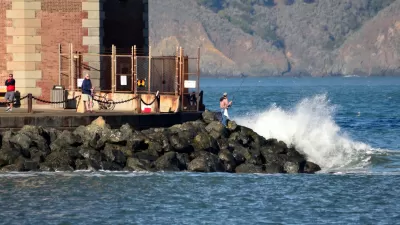
"The Resilient By Design Bay Area Challenge brought together nine multi-disciplinary design teams to develop resilient solutions to climate change-induced sea level rise and severe flooding, and seismic impacts at various sites around the San Francisco Bay," according to an article by Grace Mitchell.
The Bay Area Challenge differed from the previous iteration of Resilient By Design, which designed for New York City with funding on the line and support from the U.S. Department of Housing and urban Development.
"While there is no funding laid out to implement the Bay Area projects, several teams will continue efforts with communities to realize them," adds Mitchell. "The success of the competition lies in the ideas generated. Bay Area jurisdictions will then need to decide how, when, and what to move forward."
Mitchell examines the resulting design proposals in two articles (Part 1 and Part 2) that include project descriptions and lots of beautiful renderings.
Read the full story: Resilient by Design Bay Area Challenge Proposals Unveiled (Part 1)
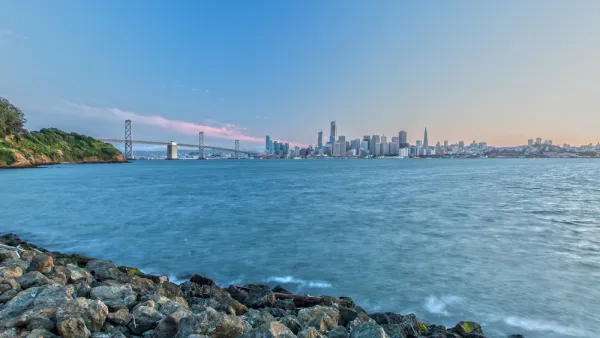
Two Coastal Areas Face Climate Change Threats, but Their Stories Are Vastly Different
In Manila and the San Francisco Bay Area, the severe impacts of rising sea levels are indisputable. But the only similarities are that both places face very uncertain futures.
Bay Area Businesses Launch Challenge to Fund Climate Resilience
A regional business association hopes to raise private funds for climate adaptation planning throughout California.
How to Fight 'Coastal Squeeze' By Engineering Nature
A Rutgers professor restores natural processes to help shorelines adapt to rising sea levels.

Washington state to charge fee to drivers with fuel-efficient cars
Revenue from the fee will go towards supporting the state’s highways.

Illinois considers spending $1 billion in taxpayer money on data center
A quantum computing campus and data center are currently under construction in Chicago.

Trump to blast ‘hydrocarbon highway’ through ‘world’s longest art gallery’
Environmental and historic preservation groups are suing to stop the project.

Boston City Council votes to no longer mandate parking in residential developments
The Boston Zoning Commission still needs to approve the proposal.

Passengers in New York, California lift off in air taxis
Two air taxi companies have received a Special Airworthiness Market Survey Certificate, which allows them to service passengers.

MTA to upgrade subway signals for entire network by 2050
This is the first time New York City has planned to modernize subway signals in the Bronx.

FREE Course: Walkable City 1: Why Walkability?
After describing his path towards focusing on walkability as the essence of good planning, Jeff Speck marches through his five principal reasons for making more walkable places.
Reinventing Malls: Planning Alchemy—Turning Gray Fields Into Gold
The course focuses on the opportunities and imperatives that shape reinvention of mall sites.

City of Charlotte
City of Rosemead
Rutgers University, Edward J. Bloustein School of Planning and Public Policy
University of Michigan School for Environment and Sustainability (SEAS)
Hunter College, City University of New York (CUNY)
The Architects Foundation
University District Partnership