A subsidiary of Alibaba, the massive online retailer, will deploy cloud computing and artificial intelligence to help relieve congestion in Kuala Lumpur, Malaysia.


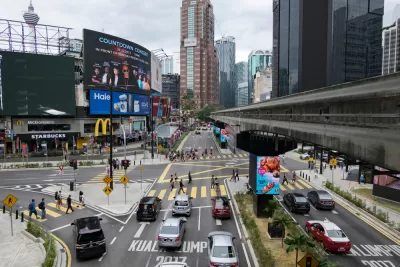
"Alibaba, China’s largest online retailer, is deploying its cloud-computing power to save Asia’s cities from their suffocating traffic," reports Karen Hao.
Here's how Hao sums up the news:
Its subsidiary AliCloud announced today (Jan. 29) that it will use artificial intelligence to help alleviate road congestion in Kuala Lumpur, Malaysia. The company deployed its traffic-management system, called City Brain, in Hangzhou, China—where Alibaba is headquartered—in September 2016. Afterwards, average traffic speed increased 15%, and traffic violations were reported with 92% accuracy Reuters reports.
The article explains more about how City Brain works, and how AliCloud will deploy the system in Kuala Lumpur. According to Hao, this is the first time the company has deployed the system outside of China. Expect City Brain to be operating on 300 traffic lights and 500 traffic cameras in Kuala Lumpur by May 2018.
FULL STORY: Alibaba is reshaping city traffic with artificial intelligence


AI for Planners Explained: Urban Digital Twins
When AI stops talking and starts showing.

In Planning, the Possibilities With AI are High. So are the Stakes.
Planning history tells us that public trust is both fragile and essential. With AI, the time to set the right course is now.

North Carolina Deploys 2,500 AI-Based Traffic Signals
The signals use AI to collect data and help traffic engineers make decisions and implement changes more quickly and effectively.

Planetizen Federal Action Tracker
A weekly monitor of how Trump’s orders and actions are impacting planners and planning in America.

The state-sanctioned urbicide of Austin
People don’t kill cities. Freeways do.

US to reduce Colorado River water deliveries to Mexico
A new Colorado Treaty amendment reduces Mexico’s Colorado River water allocation by 250,000 acre feet.

Brightline West’s future may rely on $6 billion federal loan
The company has until Nov. 2 to make a $400 million equity investment into its proposed high-speed rail line.

LA Metro’s ultimatum: no extra buses for LA28 if federal funding isn’t imminently secured
If Metro does not provide additional buses, LA28 organizers will have to find a new way to manage Olympic traffic. LA28’s budget does not include a line item for transit.

Colorado’s Largest Data Center Could Rise Next to Homes — Without a Public Hearing
The proposed campus would consume 11 times the power of Denver International Airport; as it has across the country, opposition mounts.

FREE Course: Walkable City 1: Why Walkability?
After describing his path towards focusing on walkability as the essence of good planning, Jeff Speck marches through his five principal reasons for making more walkable places.
Reinventing Malls: Planning Alchemy—Turning Gray Fields Into Gold
The course focuses on the opportunities and imperatives that shape reinvention of mall sites.

Eagle County Government
Harvard University Graduate School of Design
Nashville Planning Department
The Architects Foundation
University of Cincinnati Online
The Pocatello Development Authority
The Urban Renewal Agency of the City of Pocatello
Journal of the American Planning Association