The Free Ride Everywhere Downtown (FRED) shuttle system in San Diego is so popular that demand sometimes overwhelms the number of available shuttles. The city has redoubled its commitment to the system.


"Downtown San Diego’s 'free' shuttle service — known by the friendly acronym FRED — will get an expanded fleet that officials hope will improve the private company’s performance, after a first year when riders got a 'busy' message sometimes as much as half the time," reports Jeanette Steele.
"San Diego will spend up to $5.7 million over five years to help New York-based The Free Ride put more all-electric shuttles on downtown streets," adds Steele. "The money comes from revenue from parking meters and public garages downtown."
The article includes more details about the plans to expand the FRED system, as well as the history of The Free Ride, which was "founded in 2011 by two twentysomething entrepreneurs," and got its start "providing gratis rides around the Hamptons beach enclave in New York."
"To date, FRED has serviced 140,000 San Diego riders, with a high point of 12,500 trips in August," according to Steele.
Read the full story: Free Ride shuttle: Riders getting "busy" signal but help on way with extra funding

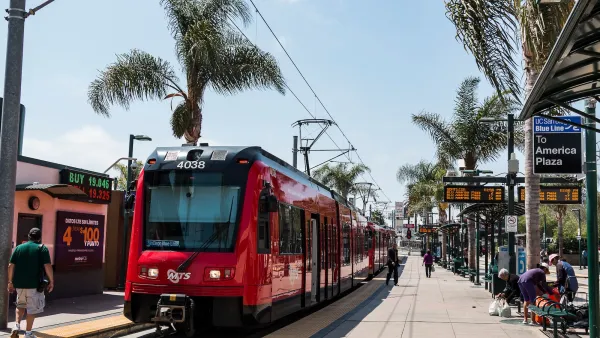
San Diego could raise fares for North County buses and trolleys
A SANDAG committee voted to raise single-ride fares from $2.50 to $3.
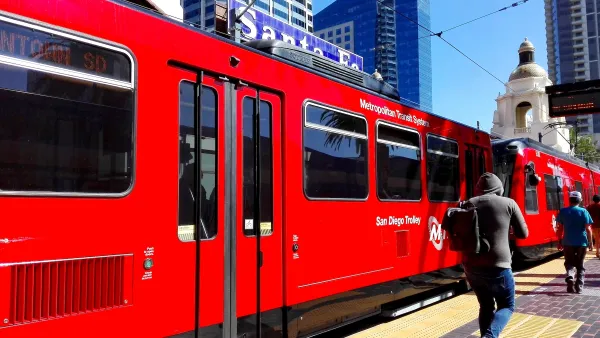
San Diego wants to limit upzoning law to just 16% of transit-adjacent parcels
The city's planning director says some areas are unfit for immediate upzoning due to a lack of resources or hazards such as wildfire risk.
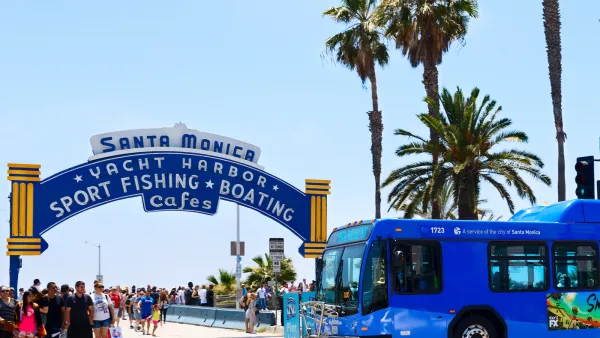
Santa Monica starts work on $56M electric bus project
Big Blue Bus plans to fully electrify its fleet by 2032.

Planetizen Federal Action Tracker
A weekly monitor of how Trump’s orders and actions are impacting planners and planning in America.

California plans to bury El Niño’s downpour
If the state plays its cards right, it may be able to store a billion acre-feet of El Niño’s water in aquifers.

Chicago breaks ground on $3 billion megadevelopment
The new neighborhood, titled Foundry Park, will one day host 3,700 residences.

Satanic place names
From streams and lakes to valleys and canyons, I mapped more than 1,000 places named after the Devil.

California High-Speed Rail Authority CEO resigns after $600,000 scandal
Under Ian Choudri, the authority used taxpayer dollars to fund first class flights and trips to nightclubs.

Want to study the Missouri River? Soon, you may need unanimous approval from 10 states
Legislation would require 10 governors’ permission to study or build projects moving water outside the basin.

FREE Course: Walkable City 1: Why Walkability?
After describing his path towards focusing on walkability as the essence of good planning, Jeff Speck marches through his five principal reasons for making more walkable places.
Reinventing Malls: Planning Alchemy—Turning Gray Fields Into Gold
The course focuses on the opportunities and imperatives that shape reinvention of mall sites.

City of Rosemead
Rutgers University, Edward J. Bloustein School of Planning and Public Policy
One Hundred Miles
Hunter College, City University of New York (CUNY)
The Architects Foundation
University of Cincinnati Online
City of Cambridge
Montrose County
The Pocatello Development Authority