When it comes to trains, trams, and buses, L.A.'s Union Station is "the most transit-accessible location in Southern California." Soon, it will finally connect to its own neighborhood.


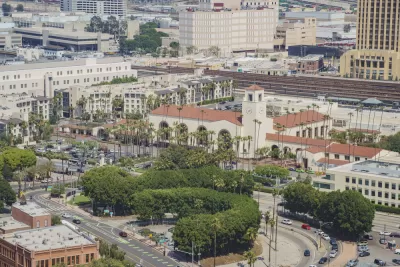
Los Angeles Metro recently released a draft environmental impact report for streetscape improvements at Union Station, with the aim of connecting the historic transit hub to the surrounding Downtown. The plan calls for turning a parking lot into a new civic plaza, widening sidewalks to create a new esplanade, and clearing a pedestrian crossing to the popular El Pueblo de Los Ángeles park.
Accommodating those changes will require some lane reductions, which recently proved hotly controversial on L.A.'s Westside. But transportation planner Elizabeth Carvajal explains to The Planning Report that public comments repeatedly described Union Station as a "moat" for pedestrians and bicyclists, who requested the multimodal improvements.
Carvajal is joined in TPR by Jenna Hornstock, deputy executive officer in countywide planning & development, who contextualizes the project's impact on the Civic Center neighborhood. "A strong active transportation network is the bones of the future for this area," she says. "Creating this connectivity not only helps people get around—it also sets the tone and stage for a world-class community that includes jobs and housing centered around transit."
The perimeter plan is one of a series of planned improvements totaling $3 billion to transform access and development at Union Station, the most transit-connected hub in Southern California. And those rail and mobility expansions are only part of the cornucopia of public investments intersecting in the Civic Center, which is anticipating changes stemming from an area Master Plan, the Downtown rezoning and community plan update, a potential tax-increment financing district, and more covered in TPR.
To integrate all those public investments into a "transit-oriented community," Metro has formed a task force with the city and county of Los Angeles and California High-Speed Rail Authority to coordinate their plans, "get out ahead of this change, make equity and sustainability part of the conversation, and leverage all the investments that we’re making as the public sector to capture some of the value we create," Hornstock explains.
"We want Union Station, and the larger Civic Center area that is directly connected to it, to be a national best practice for coming out ahead of change in a community in a way that is inclusive, equitable, and sustainable."
Read the full story: L.A. Union Station’s Perimeter Redesign is All About Access to Transit
L.A. Metro CEO Challenges Trump on Infrastructure Funding
President Trump’s most recent transportation budget is projected to cut transportation spending by 13 percent, potentially undercutting many of Los Angeles' ambitious projects to continue the build-out of a full public transportation system.
'Transit-Oriented Communities': A New Agenda For L.A. Metro
The Los Angeles County Metropolitan Transportation Authority (Metro) is implementing a new vision for "transit-oriented communities."
Connecticut Assembly to Reconsider TOD Bill
The ‘Work, Live, Ride’ bill would prioritize funding for designated transit-oriented zones to encourage denser development near transit.

Planetizen Federal Action Tracker
A weekly monitor of how Trump’s orders and actions are impacting planners and planning in America.

California plans to bury El Niño’s downpour
If the state plays its cards right, it may be able to store a billion acre-feet of El Niño’s water in aquifers.

Desperate measures: Advocates weigh draining Lake Powell to fill Colorado River
Draining the reservoir could reduce evaporation losses by a couple hundred thousand acre-feet.

In Texas, data centers are swallowing promised parkland
Residents who moved to Taylor, Texas for a rural community now have to contend with three data centers in their backyard.

How a Chicago-sized wind farm beat the odds and powered on
The project spanned five presidential administrations and a standoff with a U.S. military base.

MTA gives itself 30 days to transform pit into basketball court
The site has been under construction since 2022; the city originally estimated it would finish the court in 2024.

FREE Course: Walkable City 1: Why Walkability?
After describing his path towards focusing on walkability as the essence of good planning, Jeff Speck marches through his five principal reasons for making more walkable places.
Reinventing Malls: Planning Alchemy—Turning Gray Fields Into Gold
The course focuses on the opportunities and imperatives that shape reinvention of mall sites.

City of Rosemead
Rutgers University, Edward J. Bloustein School of Planning and Public Policy
One Hundred Miles
Hunter College, City University of New York (CUNY)
The Architects Foundation
University of Cincinnati Online
City of Cambridge
Montrose County
The Pocatello Development Authority