A high-profile controversy over a decision by the city of Los Angeles to remove a vehicle lane in either direction has finally come to an end. The vehicle lanes will be restored.


Laura J. Nelson, David Zahniser, and Alene Tchekmedyian report on the final outcome of a traffic and road diet controversy on Vista del Mar in the Westside neighborhood of Playa del Rey.
As Planetizen mentioned in a June post, City Councilmember Mike Bonin chose the side of traffic safety as he defended a new road diet to irate commuters. The city had reduced a traffic lane in each direction after the city settled $9.5 million lawsuit after a driver struck and killed a teenager on that stretch of road, and the Bonin's case for the road diet mirrored that of the city's Vision Zero goal to eliminate traffic fatalities.
Commuters didn't see it that way, according to the article:
The resulting “road diet” on Vista del Mar — combined with lane reductions on other streets in the area — sparked a wave of opposition that engulfed the Westside and the South Bay. City Hall was flooded with calls. A condo association sued. And frustrated commuters began raising money to recall Westside Councilman Mike Bonin.
And now, the final act:
After weeks of backlash, Bonin backpedaled late Wednesday night, acknowledging in a YouTube video that “most people outright hated" the Vista del Mar changes. He apologized to drivers and said lanes would be restored next month.
Bonin's apology is properly described as profuse.
The article also reports that in the wake of the failed road diet, the city negotiated a deal with the county, that will remove street parking along Vista del Mar.
The article also notes that the decision to restore a vehicle lane in either direction is a set back for the city's Vision Zero goal and it Mobility Plan 2035—which " both hinge on the elimination of vehicle lanes in an effort to reduce speeds."
Two More Road Diets Erased in Los Angeles
Traffic safety projects, and with it the city of Los Angeles' Vision Zero and Great Streets initiatives, have been dealt disappointing setbacks in recent months.

Los Angeles Councilmember Chooses the Side of Traffic Safety
Los Angeles Councilmember Mike Bonin sent a clear message to commuters upset about traffic calming projects in his district: "We don’t have to lose one more precious life."
When it Comes to Road Diets, Evidence Doesn't Matter
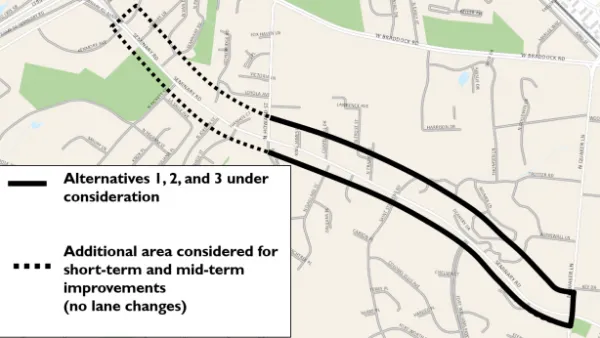
Drivers are a powerful enough lobby to overcome all evidence of the need to redesign streets for safety. Examples from Maryland and Virginia provide the latest case studies in Vision Zero futility.

Desperate measures: Advocates weigh draining Lake Powell to fill Colorado River
Draining the reservoir could reduce evaporation losses by a couple hundred thousand acre-feet.

Eastern Nebraska is running out of electricity
Data centers and electrification are straining eastern Nebraska’s grid, throttling economic development.

Move over, LA: St. Louis gears up for Olympics, invests millions in downtown redevelopment
The Missouri city will host the 2028 Olympic soccer group stage and knockout matches.

Mass. votes against statewide minimum lot size for single-family homes
Over 2 million residents voted on Question 7; it was decided by just over 30,000 votes.

Maryland’s $15 billion bridge project gains key approval
The Maryland Transit Authority said the project will create over 60,000 jobs and add $23 billion to the local economy.

‘No clear next steps’ for Chicago's permanent festival grounds
Eleventh Ward Ald. Nicole Lee has suggested Soldier Field as a possible location for the permanent event space.

FREE Course: Walkable City 1: Why Walkability?
After describing his path towards focusing on walkability as the essence of good planning, Jeff Speck marches through his five principal reasons for making more walkable places.
Reinventing Malls: Planning Alchemy—Turning Gray Fields Into Gold
The course focuses on the opportunities and imperatives that shape reinvention of mall sites.

City of Rosemead
Rutgers University, Edward J. Bloustein School of Planning and Public Policy
One Hundred Miles
University of Michigan School for Environment and Sustainability (SEAS)
Hunter College, City University of New York (CUNY)
The Architects Foundation
City of Cambridge
The Pocatello Development Authority
The Urban Renewal Agency of the City of Pocatello