Infrastructure
The Texas Miracle: Looking Beyond the Impressive Growth Numbers
Texas is booming—its growth in people and jobs puts it in a league of its own. But another set of growth data pales by comparison: Infrastructure, particularly in the water and transportation needed to accommodate the growth, is woefully lacking.
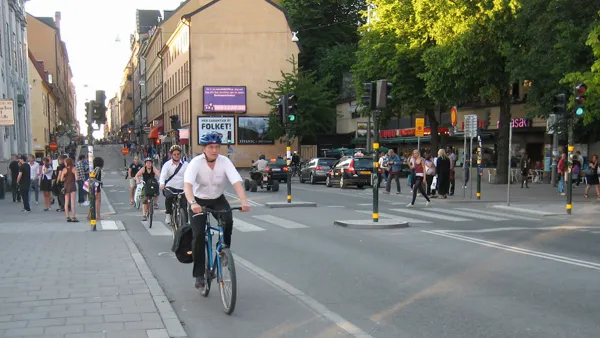
Rethinking Streets: New Report Illustrates Complete Streets Projects
"Rethinking Streets," a new report by the University of Oregon's Sustainable Cities Initiative, provides detailed information on 25 complete streets and streetscaping projects. It is available free in PDF and hard copy format.
New Hampshire Increases Gas Tax to Fund Highway, Road, and Bridge Projects
The New Hampshire Legislature recently approved a bill that would raise the gas tax in the state by 4.2 cents*. At that rate, the cost of the new tax to someone who drives 10,000 miles a year at 25 miles per gallon would total about $16 a year.
The Reviews Are In: Denver's West Rail Line
After a year of operation, Denver's 12.1-mile West Rail Line has provoked an ambivalent public response.
Moment of Truth for Cincinnati's Central Parkway
The Cincinnati City Council might vote to rescind an agreement with the Ohio Department of Transportation to complete a protected bike lane from Clifton to downtown along the Central Parkway.

Interdisciplinarity and the Equitable City
On Urban-Think Tank, a design firm working at the intersection of architecture and urbanism to further environmental justice.

Ecocity versus Duplicity
If certain elements of masterplanning are not carefully chosen—and their impacts not carefully explained to final decision makers—then there runs great risk that the cities we design from scratch perform worse than the cities we already have.
Secretary Foxx Talks Funding (and Possibly Tolling)
A recent article by Yonah Freemark details the policy agenda of Transportation Secretary Anthony Foxx, the former mayor of Charlotte and successor of well-regarded Transportation Secretary Ray La Hood.
Policy First; Then Technology
Civic leaders chime in on how policy should guide technology and smart cities initiatives.
'Kit of Parts' Streamlines the Process of Converting Streets into Parks
An Atlantic Cities article details how the Los Angeles Department of Transportation’s People St program is making it easier for communities to design and build plazas, parklets, and bike facilities on their streets.
Canada Acts while U.S. Lags on Rail Oil Tank Car Safety
Transport Canada jumped past U.S. DOT on April 23 by taking decisive action on "exploding" oil tank cars that are traveling throughout North America due largely to an insufficient oil pipeline network. Within three years, the older cars must go.
Renewables Account for 92 Percent of New Power in the United States
Although the United States built less new energy capacity than in the same time period last year, renewable energy dominated the capacity to come online so far in 2014.
'Sticks' and 'Carrots' Required to Build a Mature Transportation System
Gabe Klein says cities can do a better job providing mobility by focusing on the sticks and carrots of transportation—improving transportation options and creating disincentives to driving, respectively.
Transportation Considerations for Aging Populations
An article on PlannersWeb details the considerations relevant to the needs of people over 65, who are growing more multi-modal and car-independent every year.
Will Tampa Bay Solve its Transit Equation?
Robert Trigaux wonders if the Tampa Bay metro area will be wake up to the country’s changing demands of transportation and end “the parochial arm wrestling over what kind (if any) of mass transit lies in its future.”
Pitching a Queens-Brooklyn Streetcar
Michael Kimmelman resurrects an old plan by Alex Garvin to build a light rail connection between the waterfront neighborhoods of Queens and Brooklyn, except Kimmelman would build a streetcar line.
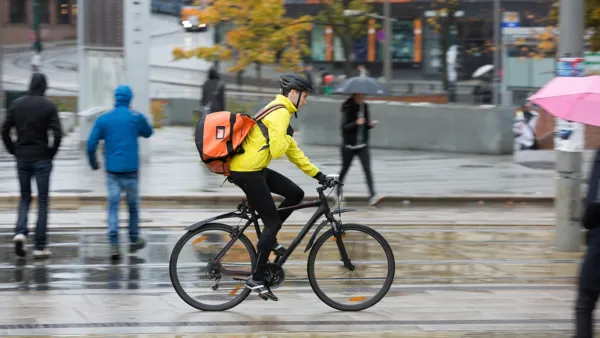
Which States Best Prioritize Walking and Biking?
The most recent coverage of the Alliance for Biking and Walking’s 2014 Benchmark report compares each of the states for how much federal transportation funding they devote to active transportation.
Atlanta Streets Alive Hopes to Shift City’s Perceptions
Maria Saporta reviews the latest Atlanta Streets Alive event, which shuts down streets to vehicle traffic and turns them over to people, held over the past weekend in the historic neighborhood of West End.
Which Way, Dallas?
Architecture critic Mark Lamster describes Dallas as a city at a defining moment in its history. He poses the following questions: “What are our goals, and how do we achieve them? What exactly do we want Dallas to be?”

Ranking the Most Resilient Cities
Resilience has entered into the planning and urbanism lexicon as a large challenge for all places pursuing prosperous, sustainable futures. A new study examines the world’s leading cities for lessons in resilience.

FREE Course: Walkable City 1: Why Walkability?
After describing his path towards focusing on walkability as the essence of good planning, Jeff Speck marches through his five principal reasons for making more walkable places.
Reinventing Malls: Planning Alchemy—Turning Gray Fields Into Gold
The course focuses on the opportunities and imperatives that shape reinvention of mall sites.

City of Thousand Oaks
City of Wisconsin Rapids
Harvard University Graduate School of Design
The Architects Foundation
University of Cincinnati Online
Northern Illinois Transit Authority (NITA)
The Pocatello Development Authority
The Urban Renewal Agency of the City of Pocatello