Infrastructure
Great Streets? How about Healthy, Safe Streets?
Advocates and citizens in Boyle Heights, a historic and predominantly Latino neighborhood on the Eastside of Los Angeles, are hoping for more than economic development from the city's Great Streets initiative.
How to Improve America's Infrastructure in Four Easy Steps
Rob Palter shares insights from a recent round of interviews with "government leaders, private investors, and private operators in the field of infrastructure" about how the United States can improve the poor state if its infrastructure.
Multi-Modal Trip Planning in Chicago? There Ought to Be an App for That
Samuel Baron makes the case that Divvy, Chicago's "newest transportation system," should be better integrated with the city's other public transport systems.
No Little Plans for Private Passenger Rail Service Between Miami and Orlando
The last private passenger rail in the United States closed in 1983, but a private company is working on a 240-mile service between Orlando and Florida. CityLab recently detailed how a relic of the past could transform the Florida of the future.
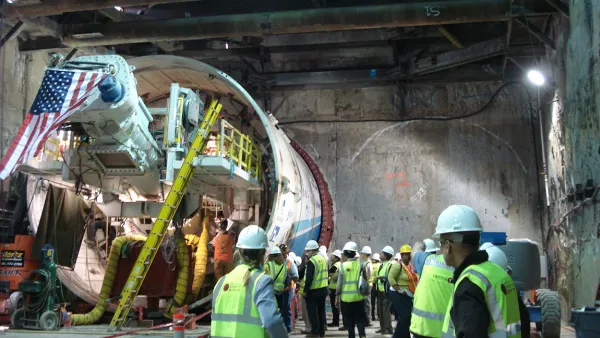
Seattle's Envy? San Francisco's Big Alma Outperforms Big Bertha
Big Alma is one of two boring machines used to tunnel under the streets of San Francisco to construct the new Central Subway to Chinatown. Big Bertha, Seattle's infamous tunnel borer, has been stalled since December. Big Alma emerged on June 11.
Who Should Pay for Highways: Motorists or Oil Companies?
A new transportation funding option proposed by Rep. Peter DeFazio (D-Ore.) would repeal the 18.4-cent gas tax, unchanged since 1993, with a "small" tax levied against oil companies on each barrel of oil used to make gasoline.
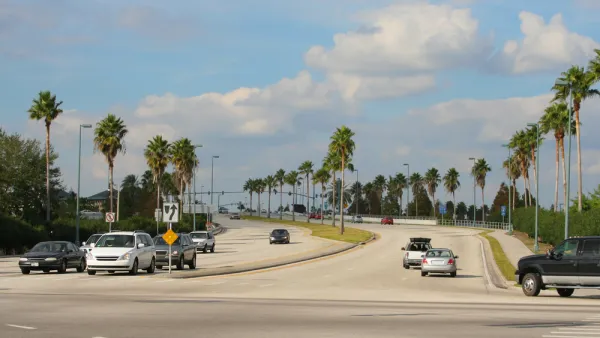
Nation's Most Dangerous City for Pedestrians Becoming Safer
A Smart Growth America report put the spotlight on Orlando and the entire state of Florida as leading the nation in pedestrian deaths per capita. NPR investigate what is being done to lose the infamous title.
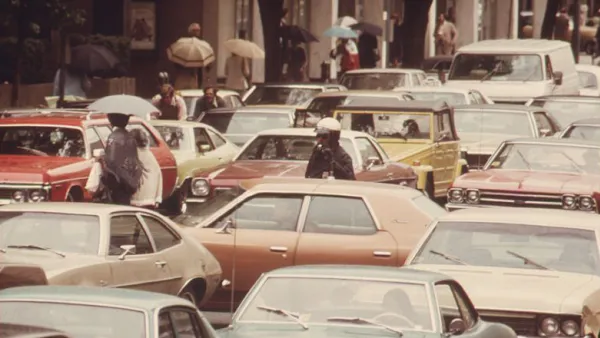
Study: Traffic Forecasts Are Often Inaccurate
In a recent review of the state-of-the-art, two planning researchers conclude that traffic forecasts often fail to accurately predict that demand for new transportation infrastructure.
Straight Talk in Maine on Roads, Bridges, and Rail Maintanence
A Democrat and a Republican who serve on Maine's Joint Standing Committee on Transportation make a strong case for "finding the money" to keep roads, bridges, rail lines, and ports in good repair. They skirt around the issue of raising taxes though.
Will Manufacturing and Trade Work for Florida's Recovery?
Adie Tomer challenges local and state leaders in Florida to leverage its strengths in trade and logistics for a more production-oriented economy—to the benefit of the long-term economic prosperity of the state.
States Address Impending Cut-off of Federal Transportation Funds
With federal highway funds likely to be cut off in August unless Congress can reach an agreement on a stopgap solution, some states, e.g., MO, VT, GA, AR have taken matters into their own hands to ensure that vital construction projects continue.
Double-Checking Chicago's Ambitious Bike Lane Plans
Checking in on the status of Chicago's ambitious plans to add 645 miles of bike lanes by 2020, one journalist finds a number of bikers who are questioning some of the choices made by planners.
The Death of a Bridge in Los Angeles
The demolition of the Riverside-Figueroa Bridge spanning the Los Angeles River between Elysian Valley and Cypress Park has commenced. Advocates lament a lost opportunity for open space as well as the car-centric design of the replacement span.
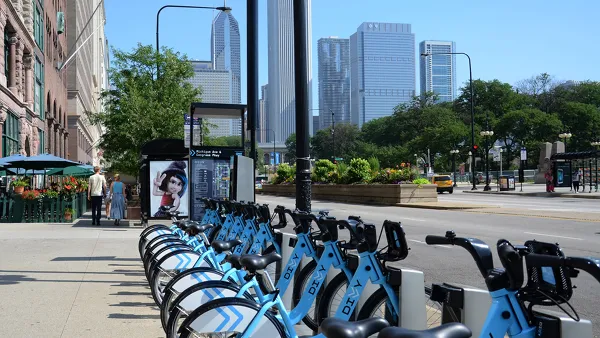
Chicago Accumulating Bike-Friendly Bonafides
Chicago officials hope that nearly 5 percent of the city's commutes will be by bike in 2020. The goal requires a lot more work (biking's share of daily trips rose to 1.3 percent in 2012 from 0.5 percent in 2000), but there are many signs of a shift.
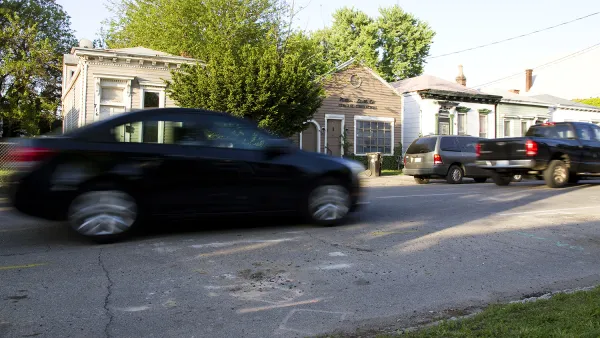
Two-Way Streets Can Fix Declining Downtown Neighborhoods
America’s multi-lane one-way streets are a disaster for neighborhoods. A recent study, released at the International Making Cities Livable Conference and led by John Gilderbloom, finds benefits to converting such streets to two-way traffic flows.
Water Resources Reform and Development Act of 2014 Signed into Law
President Obama has signed "a bipartisan $12.3 billion water bill that will help improve harbors, waterways, levees, and ecosystems across the United States," according to an article by Adie Tomer and Joseph Kane.
Tolls vs. Taxes: Wisconsinites Choose Their Preference
All taxes are not equally disliked—some are more tolerated than others. Jack Craver of The Cap Times examines an academic poll and speaks with policy makers and one advocate about the least objectionable options to pay for roads in Wisconsin.
Rhode Island's 'Blue State' Policies Criticized
Aaron M. Renn has written a scathing review of the state of affairs in Rhode Island, which he describes as a result of decades of unfettered "blue state" policies.
250-Mile Trail Loop Proposed in Dallas
A Dallas News editorial supports the Dallas Integrated Trail Circuit—a plan to link existing trails in the city into a 250-mile continuous loop.
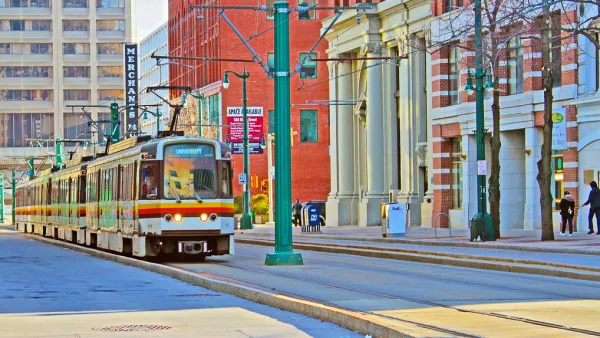
Urbanists Soak Up Buffalo: PlaceMakers Empty Their Notebooks
Many of you attended CNU in Buffalo last week, but for those of you who couldn't make it, here's a quick collection of a few of the ideas shared.

FREE Course: Walkable City 1: Why Walkability?
After describing his path towards focusing on walkability as the essence of good planning, Jeff Speck marches through his five principal reasons for making more walkable places.
Reinventing Malls: Planning Alchemy—Turning Gray Fields Into Gold
The course focuses on the opportunities and imperatives that shape reinvention of mall sites.

City of Thousand Oaks
City of Wisconsin Rapids
Harvard University Graduate School of Design
The Architects Foundation
University of Cincinnati Online
Northern Illinois Transit Authority (NITA)
The Pocatello Development Authority
The Urban Renewal Agency of the City of Pocatello