Supported by imagery of human urban conduct, Chuck Wolfe argues that walkable is good, but sit-able is better—and that "it’s time for the next big focal point and the next big idea, the 'Sit-able City'."


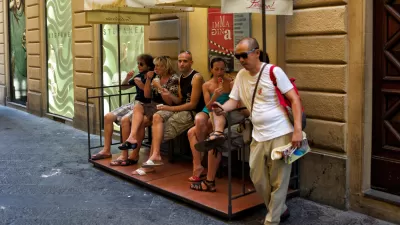
Drawing on the tradition of observers of urban, human conduct, Wolfe suggests that complementing the "walkable" with a more purposeful focus on the "sit-able" would lead to a more holistic and enhanced understanding of place, over and above implementation of pop-up and tactical urbanism tools:
[S]it-able places are key, interdisciplinary focal points where the delight of “placemaking” and cultural traditions of “watching the world go by” merge with the sometimes conflicting domains of law and politics, economic development, public safety, gentrification and the homeless.
Noting how perceptions of public safety, "sit and lie" ordinances, and related social justice issues are often at the center of political and downtown revitalization debates, Wolfe concludes:
[A] greater focus on the sit-able is an invitation to rich discussion and ready illustration based on human tradition... A focus on “sit-abilty” could be a game-changer, and encourage a richer conversation about why, ironically, we sometimes have second thoughts about a rest stop in the reinvented, walkable cities of today.
Read the full story: why the "sit-able city" is the next big idea

Why You Can Never Find a Bench in San Francisco
Over the last two decades the city of San Francisco has systematically removed its public benches to fight homelessness. Now citizens are clamoring for their return.
Planning for Love, Part 3: Enhancing human connection through walkability
In the third and final installment of this series, author Hannah Kosoff examines what her research findings say about modern dating and urban form.

Planning for Love, Part 2: What happens to dating in a car-centric world?
A survey of over 150 adults about their dating lives reveals stark differences based on their neighborhood's walkability.

Planetizen Federal Action Tracker
A weekly monitor of how Trump’s orders and actions are impacting planners and planning in America.

Amtrak, CN end decades-long dispute with eight-year agreement
The new operating agreement establishes an updated framework for the companies to work together, including processes to resolve disputes.

Colorado’s Largest Data Center Could Rise Next to Homes — Without a Public Hearing
The proposed campus would consume 11 times the power of Denver International Airport; as it has across the country, opposition mounts.

'This is going to be painful:’ Virginia stares down $1.7 billion funding gap for highway maintenance
The state may address the deficit by shifting $290 million from its construction budget to maintenance projects.

Judges permit Denver to divert 77,000 acre feet from the Colorado River for reservoir expansion
Overuse and climate change have caused the Colorado River’s water levels to plummet.

Amtrak, CN end decades-long dispute with eight-year agreement
The new operating agreement establishes an updated framework for the companies to work together, including processes to resolve disputes.

FREE Course: Walkable City 1: Why Walkability?
After describing his path towards focusing on walkability as the essence of good planning, Jeff Speck marches through his five principal reasons for making more walkable places.
Reinventing Malls: Planning Alchemy—Turning Gray Fields Into Gold
The course focuses on the opportunities and imperatives that shape reinvention of mall sites.

KFH Group Inc.
Greater Baltimore Committee
Eagle County Government
The Architects Foundation
University of Cincinnati Online
The Pocatello Development Authority
The Urban Renewal Agency of the City of Pocatello