Musing on the discussion at last week's Citylab conference, Jarrett Walker finds a surprising convergence with the ideology of America's Tea Party: "Big and active national government may not be the answer." Would cities be better off going it alone?


At last week's Citylab conference, a gathering of some of the world's leading urban thinkers, Walker heard an unexpected refrain: "A full-throated demand, from several surprising voices, for an urbanist revolt against the power of national governments."
Recent articles and books have touched on the growing influence of cities, and diminishing power of nation-states, amid our globalizing, urbanizing world. "Follow this logic and you might arrive at a radical urban Federalism, perhaps even one that could meet tea-party demands to 'Abolish the IRS!'" suggests Walker. "Pay taxes to your city or state, and let them send a bit of it on to central government to do the few things that only a central government can do. Push power downward to the scale where problems can be solved."
"In the US itself, it's easy to see the current cuts in Federal spending as a disaster for urbanism and infrastructure. It is, but it could also be something else: an invitation to governments that are closer to the people to have their own conversations that lead to local consensus about funding and solutions."
Read the full story: time for an urbanist "tea party"?


CityLab Sold to Bloomberg
A major shakeup of the urbanism media landscape was announced this week.
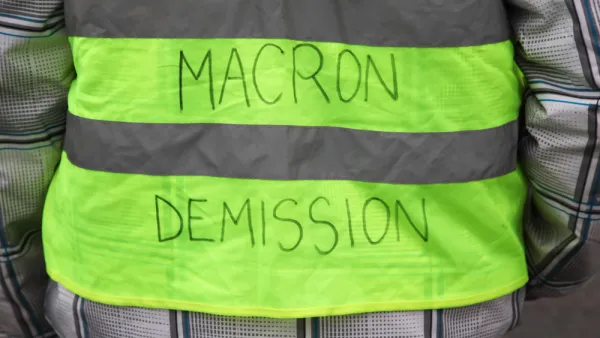
President Macron Acquiesces to Yellow Vests' Demands on Fuel Tax Hike
Despite statements to the contrary just a week ago, Macron reversed position and caved to the demonstrators' demands that upcoming fuel tax hikes be suspended.

Georgia's Conservative Path to a Solar Power Boom
Georgia politics haven't usually been friendly to renewable energy. But some unlikely alliances, and a healthy dose of economics, can go a long way.

Planetizen Federal Action Tracker
A weekly monitor of how Trump’s orders and actions are impacting planners and planning in America.

Amtrak, CN end decades-long dispute with eight-year agreement
The new operating agreement establishes an updated framework for the companies to work together, including processes to resolve disputes.

Judges permit Denver to divert 77,000 acre feet from the Colorado River for reservoir expansion
Overuse and climate change have caused the Colorado River’s water levels to plummet.

Boston has spent millions making the Green Line more accessible — and there’s no end in sight
While the city has invested millions into expanding and adding platforms to the Green Line to make it more accessible, new train cars set to arrive next year will be too tall for disabled passengers to board without raising the current platforms.

Idaho may see an 18% drop in federal surface transit funding — the largest estimated cut in the US
Transit systems in rural communities are much more reliant on federal funding to provide their services.

How ‘post-disaster gentrification’ alters neighborhoods after natural calamities
After hurricanes, fires or other calamities, the original residents of a community are often replaced by younger, wealthier residents.

FREE Course: Walkable City 1: Why Walkability?
After describing his path towards focusing on walkability as the essence of good planning, Jeff Speck marches through his five principal reasons for making more walkable places.
Reinventing Malls: Planning Alchemy—Turning Gray Fields Into Gold
The course focuses on the opportunities and imperatives that shape reinvention of mall sites.

City of Wisconsin Rapids
Harvard University Graduate School of Design
KFH Group Inc.
The Architects Foundation
University of Cincinnati Online
The Pocatello Development Authority
The Urban Renewal Agency of the City of Pocatello