Have you ever noticed that the image of little man (it's usually a man) in pedestrian traffic icons differs depending on which country you're in? Artist Maya Barkai has, and her new project seeks to explore what these guys say about their culture.


Jessica Yu looks at the work of Israeli-born, New York-based artist Maya Barkai, whose latest project, Walking Men worldwide™ uses a photographic collage of pedestrian traffic icons presented in human scale to probe the cultural beliefs infused into crosswalk signals.
"Ubiquitous as safe-crossing symbols are, the pictograms used for them are surprisingly diverse across the globe—in color, shape, detail, direction and even gender," notes Yu. "Their various forms can be seen on the streets of Sydney as a part of the ongoing Art & About Sydney art festival, which runs through Oct. 20."
"From the sparsely dotted Chinese walking man to the top-hat-wearing, cane-bearing Dane, almost a hundred 'walking men' are displayed life-size on banners that line the sidewalk."
Read the full story: What Do Pedestrian Traffic Icons Say About Your Culture?

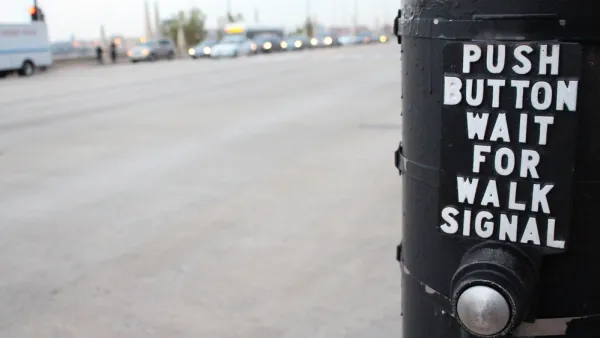
What Walk Buttons Do (and Don't Do)
Are pedestrian walk buttons effective, or do they only give us the illusion of control? It can vary.
North Carolina Deploys 2,500 AI-Based Traffic Signals
The signals use AI to collect data and help traffic engineers make decisions and implement changes more quickly and effectively.

Austin Left Turn Improvements Cut Serious Crashes by Half
Changes to left turn infrastructure and signal timing led to a 47 to 72 percent drop in fatal and serious injury crashes.

Planetizen Federal Action Tracker
A weekly monitor of how Trump’s orders and actions are impacting planners and planning in America.

‘Going backwards:’ Baltimore mayor, students rally against state's transit funding plan
Maryland's proposed six-year plan provides no funding for Baltimore’s BMORE bus program and reduces its road maintenance funding.
Mamdani sent nearly 6,000 pied-à-terre tax warnings to homes that didn’t qualify
A judge has ordered the administration to cancel thousands of pied-à-terre tax notices after it sent 35% of them erroneously.

Newsom vetoes high-speed rail supervision bill after agency receives condemnatory audit
The audit found the CHSRA approved almost $600,000 in unallowable travel expenses.

Nation sees first electric plane-boat hybrid take off in public demo
The Viceroy Seaglider can fly at speeds of 180mph for up to 180 miles.

One of nation’s poorest counties to receive $6 billion data center
The developers estimate the project will create 200 permanent jobs and 1,000 temporary construction jobs.

FREE Course: Walkable City 1: Why Walkability?
After describing his path towards focusing on walkability as the essence of good planning, Jeff Speck marches through his five principal reasons for making more walkable places.
Reinventing Malls: Planning Alchemy—Turning Gray Fields Into Gold
The course focuses on the opportunities and imperatives that shape reinvention of mall sites.

City of Thousand Oaks
City of Wisconsin Rapids
Harvard University Graduate School of Design
The Architects Foundation
University of Cincinnati Online
Northern Illinois Transit Authority (NITA)
The Pocatello Development Authority
The Urban Renewal Agency of the City of Pocatello