The most recent coverage of the Alliance for Biking and Walking’s 2014 Benchmark report compares each of the states for how much federal transportation funding they devote to active transportation.


“Obviously, no state is really rolling out the red carpet for active transportation. While walking and biking account for about 11.5 percent of all trips, on average states devote only 2.1 percent of their federal funding to active modes,” writes Angie Schmitt.
The article includes a chart taken from the Alliance for Biking and Walking's 2014 Benchmark report, which compares each state’s spending on active transportation, as a percentage of total expenditures from federal transportation dollars. Delaware, Florida, and Minnesota lead the list, while West Virginia, North Dakota, and South Carolina bring up the rear.
Read the full story: How Does Your State Stack Up on Funding for Walking and Biking?

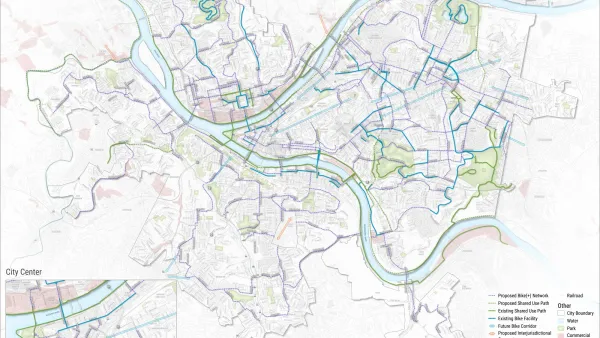
Hundreds of Miles of New Bike Lanes Coming to Pittsburgh
Checking in with the Bike(+) Plan in Pittsburgh.
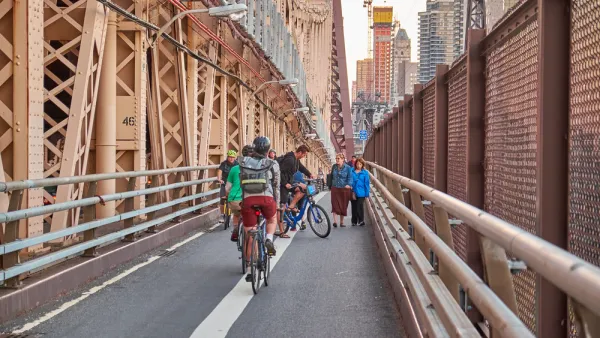
New Bike Lanes Planned for Two New York City Bridges
The de Blasio administration is offering a parting gift to the city's cyclists.
Resources for Safe, Convenient Pedestrian and Bike Infrastructure
Despite the stated goals of state and federal agencies to encourage active modes of transportation, there's still a long way to go to make sure that all cities and communities have safe, convenient sidewalks and bike lanes.

Planetizen Federal Action Tracker
A weekly monitor of how Trump’s orders and actions are impacting planners and planning in America.

Amtrak, CN end decades-long dispute with eight-year agreement
The new operating agreement establishes an updated framework for the companies to work together, including processes to resolve disputes.

Judges permit Denver to divert 77,000 acre feet from the Colorado River for reservoir expansion
Overuse and climate change have caused the Colorado River’s water levels to plummet.

NYC DOT wants faster, more permanent street upgrades
The city is examining ways to build more concrete infrastructure without getting entangled in 'decades-long' projects.

'Something we’ve never seen before:' rising utility rates could strain city finances nationwide
Data centers, climate change and other factors have caused utility rates in the United States to increase by 38% since 2020.

Trump to overrule local leaders, lease millions of acres of America’s Pacific Island territories’ seafloors to mining companies
International law says that the Indigenous people of America’s territories have a right to prior and informed consent regarding projects that impact their countries.

FREE Course: Walkable City 1: Why Walkability?
After describing his path towards focusing on walkability as the essence of good planning, Jeff Speck marches through his five principal reasons for making more walkable places.
Reinventing Malls: Planning Alchemy—Turning Gray Fields Into Gold
The course focuses on the opportunities and imperatives that shape reinvention of mall sites.

Harvard University Graduate School of Design
KFH Group Inc.
Greater Baltimore Committee
The Architects Foundation
University of Cincinnati Online
The Pocatello Development Authority
The Urban Renewal Agency of the City of Pocatello