Community / Economic Development
Non-White Gentrification Changes a Neighborhood, But Not Its Perception
Chicago's Bronzeville neighborhood has seen a dramatic rise in incomes and property values over the past decade. Emily Badger examines the historically black neighborhood's non-white gentrification, and how it's viewed differently than other areas.
Who Gets Left Behind in the Pursuit of 'Livability'?
Richey Piiparinen explores the "original sin" of the quest for urban “livability” - economic development - and examines what the pitfalls are when cities are designed for high-valued consumers rather than people.
California's Environment Bears the Cost of Growing the Economy
Over a long career in public office, Gov. Jerry Brown has earned a reputation as a pioneer in the modern environmental movement. Now, in the twilight of that career, some see him forsaking that path for the pragmatism of economic growth.
10 Urban Trends to Leave Behind with 2012
As they reflect on a year of exciting advances in urbanism, and look forward to the next, the writers at The Atlantic Cities discuss the most loathed trends they hope will die in 2013.
Memphis Pedals Cycling as Economic Salve
One of the America's most unhealthy, auto-centric cities has seen the light - the handlebar headlight that is - with a push to improve its bicycling infrastructure as a means of economic development.
A New Year's Eve Call to Action for Urbanists
We've known for decades the better ways to do things, for greater urban health, sustainability, resiliency, vibrancy and economic success. So this year, let's resolve to have the will and skill to get past the short-term politics, the rhetoric, the market momentum, and the financial self-interest that has kept our better solutions from being realized.
Downtown Pittsburgh: Back and Better Than Ever
Mark Belko traces downtown Pittsburgh's rejuvenation since bottoming out three decades ago. The area's recent comeback, marked by a surging office market and residential renaissance, has some claiming that Downtown is better than ever.
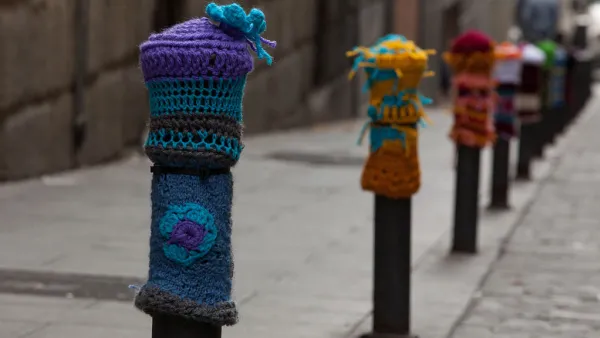
Tactical Urbanism: A Look Back at 2012
From guerrilla wayfinding to future-tising, these are my top five, perhaps lesser known, highlights of a banner year for Tactical Urbanism.
'Smart Screens' to Provide City Data in New York
Can 250 high-def, touch-screen kiosks make New York City more user-friendly, personalized and safe?
Is Columbia University Snubbing Harlem Architects?
Arch527, a coalition of African-American architects from Harlem with an impressive portfolio, says Columbia University is failing to include them in its $6.3 billion campus expansion into West Harlem, in violation of a community benefits agreement.
What Will be Rio's Olympic Legacy?
Flavie Halais cautions that urban development projects boosted by the 2014 World Cup and 2016 Olympic Games could threaten Rio de Janeiro's historic port.
'Star Apartments' Beget New Universe of Homeless Housing
In Los Angeles, the Skid Row Housing Trust is breaking past precedent by building modular, but vibrant, housing aimed at emulating city-life; giving residents a sense of community, and a new lease on life.
From 'Wasteland' to Mixed-Use 'Mosaic'
Alison M. Rice looks at the transformation of the Washington D.C. suburb of Merrifield, Va. from an industrial-suburban wasteland to a $542 million mixed-use development.
Reduce, Reuse, Recycle Housing
South Front, in Wilmington, NC, made use of an abandoned and decayed, 40s-era public housing project, salvaging and renovating every building rather than scraping the site. Scott Doyon talks about several of the reasons that's cool.
Why are Americans Preferring to Stay Put?
Americans are less mobile than they were decades ago and it's unclear why. Possible explanations include the recession, habits based on family make-up, as well as telecommuting and job trends, but none of these proposed reasons can be easily proven.
For Wal-Mart, Coveted Permits Were Just a Bribe Away
An investigation by the New York Times, following up on earlier reporting, has unveiled Wal-Mart's widespread use of bribes to circumvent democratic governance and regulatory safeguards to construct controversial projects throughout Mexico.
Design to Support the Homeless
How might planners advance the dialogue with politicians and citizens for design that supports the 633,782 homeless people in the US? Howard Blackson offers some insights for San Diego, the 3rd largest population of homeless among US cities.
BIDs: Big Brother or Benevolent Boosters?
Should a business improvement district have an expiration date? That's the question some property owners in downtown Los Angeles are beginning to ask as they chafe at the "aggressive cleaning up" and additional tax assessments that fund them.
Creative Corridor Plan Puts Little Rock on the Urban Design Map
Lindsey Millar reports on a proposed Creative Corridor plan for Little Rock, calling it “vivid and grandiose, full of all the sorts of things New Urbanists salivate over - a pedestrian promenade, rain gardens, street furniture, [and] LED lighting.."
Wilmington NC Lives Outdoors
When a city's tightly-gridded, walkable streets are developed with connected, convivial, complete neighborhoods, the temptation to walk, bike, and run overcome the lethargy of our modern lifestyle. See an inspiring photo essay from Wilmington, NC.

FREE Course: Walkable City 1: Why Walkability?
After describing his path towards focusing on walkability as the essence of good planning, Jeff Speck marches through his five principal reasons for making more walkable places.
Reinventing Malls: Planning Alchemy—Turning Gray Fields Into Gold
The course focuses on the opportunities and imperatives that shape reinvention of mall sites.

Greater Baltimore Committee
Eagle County Government
Harvard University Graduate School of Design
The Architects Foundation
University of Cincinnati Online
The Pocatello Development Authority
The Urban Renewal Agency of the City of Pocatello
Journal of the American Planning Association