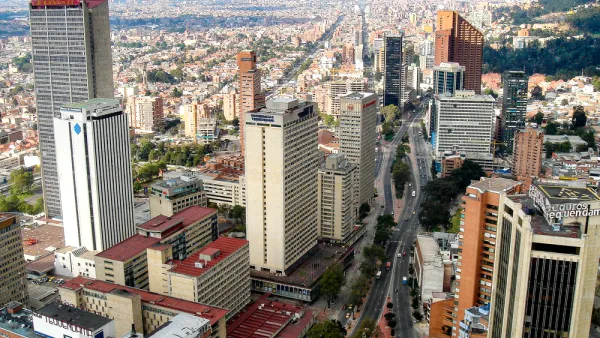
A new skyscraper is set to grace skies over Bogota, Colombia. Instead of one wealthy developer, the tower is being funded by thousands of people, each with their own stake in the property.


Colombia's tallest building when completed, the structure will rise to 853 feet at 66 stories. Called BD Bacatá Downtown, it will be "the first skyscraper built by famous common people" say its developers. "Bogota's tallest building is rising with $145 million supplied by 3,000 investors," writes Fast Company's Michael J. Coren.
"BD Bacata's backers say they will expand this model 'to the 99%' by developing amusement parks, clubs, malls, and resorts with capital from small investors (although most of those '99%' do not have $20,000 in investment capital, twice the annual income of the average Colombian)."
A similar approach to financing urban development is being pioneered in the U.S. by Fundrise, a Washington D.C.-based startup that is currently attracting investors for a building in the city's H Street Corridor.
Read the full story: A Crowdfunded Skyscraper Rises In Colombia

Bogota's next big urban innovation: Equity for working women
The city that brought BRT and Ciclovía to the world is at the forefront of a new revolution.
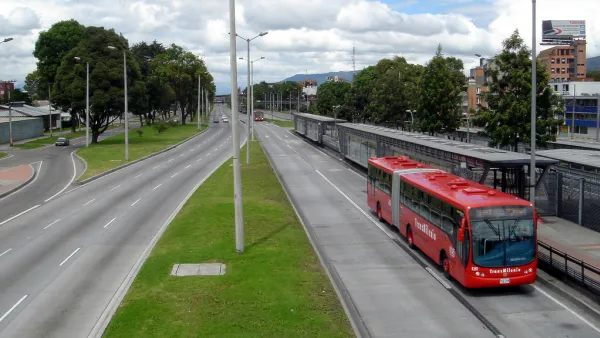
Looking to the Future as TransMilenio Turns 20
The world's most famous, and influential, bus rapid transit system, which served 2.4 million riders a day in Bogotá in the days before the pandemic, offers lessons in transit planning and management as it enters its third decade.
Bogotá Uses 7,000 Public Design Proposals to Redesign its Main Artery
To reimagine the city's most important artery, Bogotá sought community input via an innovative online platform.

Planetizen Federal Action Tracker
A weekly monitor of how Trump’s orders and actions are impacting planners and planning in America.

Eastern Nebraska is running out of electricity
Data centers and electrification are straining eastern Nebraska’s grid, throttling economic development.

Study reveals best places in the U.S. for cycling, walking
New research from Streetlight Data examines bicycle and pedestrian miles per capita in the 100 largest U.S. cities by population.

Next-generation nuclear reactors are coming to Texas
The reactors will not require towering containment structures thanks to new safety features.

California distributes $1.3 billion to prevent transit service cuts, bolster projects
Twenty-eight projects across California received a portion of the funding.

Pennsylvania Democrats have 15 affordability, clean energy bills for flipped state Senate
Bills in consideration include a bill supporting geothermal energy and a bill supporting solar on warehouses.

FREE Course: Walkable City 1: Why Walkability?
After describing his path towards focusing on walkability as the essence of good planning, Jeff Speck marches through his five principal reasons for making more walkable places.
Reinventing Malls: Planning Alchemy—Turning Gray Fields Into Gold
The course focuses on the opportunities and imperatives that shape reinvention of mall sites.

City of Charlotte
City of Rosemead
Rutgers University, Edward J. Bloustein School of Planning and Public Policy
University of Michigan School for Environment and Sustainability (SEAS)
Hunter College, City University of New York (CUNY)
The Architects Foundation
City of Cambridge
The Pocatello Development Authority
The Urban Renewal Agency of the City of Pocatello