Social / Demographics

Architecture's Identity Problem
The recent kerfuffle over Denise Scott Brown’s non-receipt of the Pritzker Prize is just a symptom of a larger problem within the field of architecture, says Sam Lubell. The poor rate of diversity among practitioners reduces its relevance.
The Three Elements That Attract People to Place
Addressing Minneapolis business leaders last week, Katherine Loflin, lead consultant to the Knight Foundation's Soul of the Community Project, explained the key factors that drive people's attachment to a city and how to lure young professionals.

Why Pedestrian Safety is a Social Justice Issue
A recent report from the Centers for Disease Control analyzing America's last decade of traffic-related pedestrian deaths reveals the inequitable impacts of the country's "public health epidemic."
Culture Influences Pedestrian Behavior at Crosswalks, Study Says
The results of a recent study of pedestrian road crossing behavior suggests that the risks we take as walkers depend largely on our cultural context.
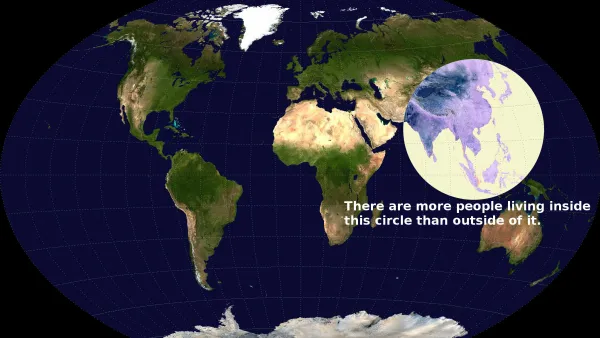
Asia's Emergence in One Stunning Map
A simple graphic posted to Reddit recently shows that more than half of the world's total population resides within a circle drawn over Asia. For Matthew Yglesias, it "underscores the fundamental truth of 21st-century economics."
What's in a Name? Los Angeles Embraces Its Hispanic Heritage
As Midwesterners flocked to Southern California in the first decades of the last century, place names associated with the region's Spanish settlers were anglicized. A return to proper pronunciations reflects the area's changing demographics.
The Ominous Side of America's Urban Comeback
"The comeback of the urban core is a striking reversal of long-term trends," proclaims Richard Florida. Although this rebound is good for urban growth and prosperity, it hasn't been able to solve enduring problems of poverty and disadvantage.
Kotkin Crushes His (Imaginary) Enemies
Many planners these days are promoting higher densities, especially in urban cores. Urban scholar Joel Kotkin inexplicably takes this trend to mean that a "cult" of planners favors bone-crushing crowds that would turn US cities into slums.
Slackers No More, Generation X Redefines Governance and Outreach
As they move into positions of leadership in their communities and in the public sector, a generation once labelled as "slackers" is helping to change the relationship between governments and their citizens, reports Rob Gurwitt.
Segregation Doesn't Only Harm the Poor
Emily Badger looks at recent research that shows that racial and economic segregation harms not only minority and low-income families, but also those that've fled to affluent areas.
Multifamily Home Construction Outpaces Single-Family for the First Time in CA
California's population grew by nearly 1 percent last year, driven by growth in the Bay Area and the state's other urban areas. In a significant milestone, the state built more multifamily dwellings than single-family homes for the first time.
Urbanization Brings Eradication of Extreme Poverty in Sight
The elimination of extreme poverty - daily income below $1.25 - has long been a goal of the U.N., the World Bank, and development experts. The world's mass urbanization is a leading reason that quixotic goal may actually be achievable by 2030.
Innovative Model Expands the Sharing Economy to Underserved Areas
Expanding car and bike share services beyond America's big cities and affluent demographics requires adaptability and old economy technologies. Buffalo CarShare is providing a model for success that even the big boys could learn from.
'Quantitative Urbanism' Reduces Cities to a Formula
Jerry Adler examines the emerging field of “quantitative urbanism,” which aims to use mathematical formulas to unveil and explain the universal properties shared by cities.
To Discern D.C.'s Haves and Have-Nots, Look to the Trees
In Washington D.C., double the amount of residents in affluent areas live among plentiful green spaces. Lessening the disparity will require the cooperation of private property owners, not all of whom see more trees as a good thing.
Sierra Club Changes Position on Immigration
Ever since the divisive, internecine battles almost a decade ago, Sierra Club has steered clear of taking decisive postions on immigration - until April 24 when their board unanimously endorsed a pathway to citizenship for undocumented immigrants.
America's Biggest Bookworms
Amazon.com has compiled its third annual list of the 20 'most well-read' cities in America. The results may surprise you.
'Stroller Index': A Thermometer for Measuring the Health of Your Neighborhood
According to Mark Funkhouser, former mayor of Kansas City, there may be no better measure of a city's livability than whether parents want to raise children there. He explains why everyone benefits when sidewalks are filled with baby strollers.
Do Immigrants Help or Hurt America's Urban Economies?
As Congress debates immigration reform, Richard Florida explains why more liberal policies could be a boon for America's cities by examining the connection between foreign-born populations and economic outcomes.
Impacts of Redlining Live On in Home Price Disparity
According to a new study by the National Bureau of Economic Research, historical biases lead to minority homebuyers paying an average of 3.5 percent more for their homes than whites, reports Matt Bevilacqua.

FREE Course: Walkable City 1: Why Walkability?
After describing his path towards focusing on walkability as the essence of good planning, Jeff Speck marches through his five principal reasons for making more walkable places.
Reinventing Malls: Planning Alchemy—Turning Gray Fields Into Gold
The course focuses on the opportunities and imperatives that shape reinvention of mall sites.

City of Charlotte
City of Rosemead
Rutgers University, Edward J. Bloustein School of Planning and Public Policy
University of Michigan School for Environment and Sustainability (SEAS)
Hunter College, City University of New York (CUNY)
The Architects Foundation
University District Partnership









