Matt Bevilacqua found much to cheer in the 'renewed focus on urbancentric topics' that President Obama delivered in his second inaugural address. Climate change, immigration, and inequality were among the speech's primary topics.


"During this morning’s inauguration ceremony, Obama touched upon several domestic topics — including investments into sustainable industries — that should have urbanists and urban dwellers perking up their ears," says Bevilacqua. "Though light on specifics, the issues spotlighted today will likely set at least part of the executive agenda for the next four years."
He identified immigration as one issue given attention by Obama that could have significant policy implications for cities. "In a much more direct way than at the last inauguration," notes Bevilacqua, "Obama took a pro-immigration stance, casting it as a workforce development issue."
By far though, the specific issue getting the most attention in his address was climate change, answering questions about whether the issue was among the President's priorities for his second term, write Richard W. Stevenson and John M. Broder in The New York Times. " made addressing the most prominent policy vow of his second Inaugural Address on Monday, setting in motion what Democrats say will be a deliberately paced but aggressive campaign built around the use of his executive powers to sidestep Congressional opposition."
“'We will respond to the threat of climate change, knowing that failure to do so would betray our children and future generations,' Mr. Obama said, at the start of eight full sentences on the subject, more than he devoted to any other specific area. 'Some may still deny the overwhelming judgment of science, but none can avoid the devastating impact of raging fires, and crippling drought, and more powerful storms.'”
Stevenson and Broder previewed some of the administrative maneuvers the President plans to utilize to avoid going through Congress. These include: "[reducing] emissions from power plants, [increasing] the efficiency of home appliances and [having] the federal government itself produce less carbon pollution."
Another good sign for environmentalists: Vice President Joe Biden made a surprise appearance at the Green Inaugural Ball, to say thanks and declare that his "green dream" is that "we finally face up to climate change."
Read the full story: For Obama, A Renewed Focus on Urbancentric Topics

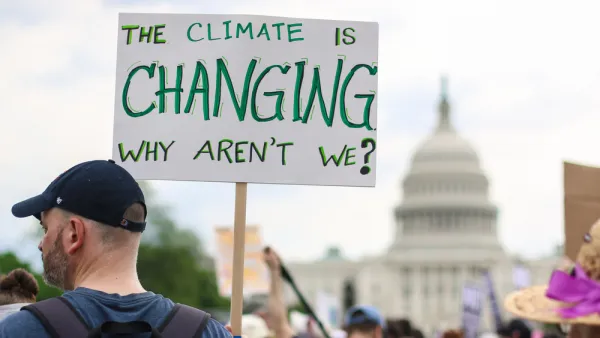
A Somber Earth Day Finding
Polling from CBS News/YouGuv shows an inverse relationship between the economy and the environment. A year ago, 56% of respondents rated climate change as an urgent issue. Today's Earth Day finding shows it at 49% as doubts grow about the economy.
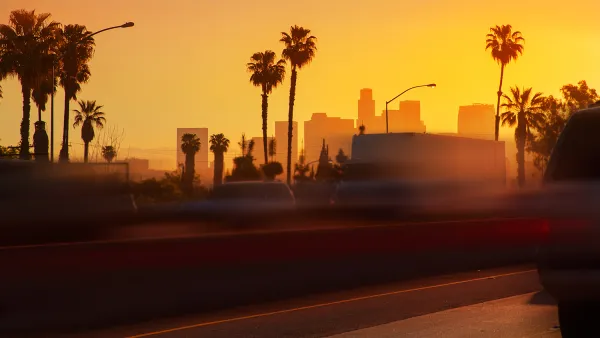
Unequal Distribution of Shade Is Environmental Injustice
A longread, written by Sam Boch and published by Places Journal, has been creating a stir online and is highly recommended for those with an interest in intersections between social justice and urban design.
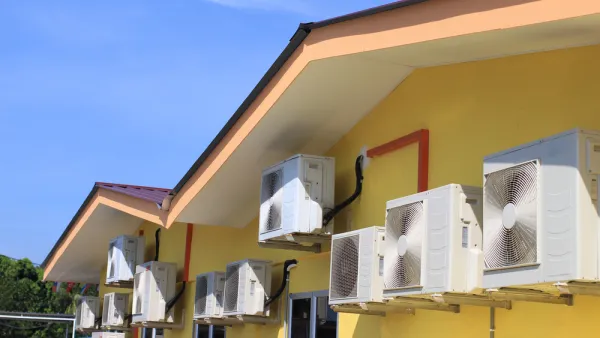
Extreme Heat Is an Inequality Issue
The Guardian sounds the alarm about deadly heat exposure in poor communities around the world.

Planetizen Federal Action Tracker
A weekly monitor of how Trump’s orders and actions are impacting planners and planning in America.

Amtrak, CN end decades-long dispute with eight-year agreement
The new operating agreement establishes an updated framework for the companies to work together, including processes to resolve disputes.

Judges permit Denver to divert 77,000 acre feet from the Colorado River for reservoir expansion
Overuse and climate change have caused the Colorado River’s water levels to plummet.

NYC DOT wants faster, more permanent street upgrades
The city is examining ways to build more concrete infrastructure without getting entangled in 'decades-long' projects.

'Something we’ve never seen before:' rising utility rates could strain city finances nationwide
Data centers, climate change and other factors have caused utility rates in the United States to increase by 38% since 2020.

Trump to overrule local leaders, lease millions of acres of America’s Pacific Island territories’ seafloors to mining companies
International law says that the Indigenous people of America’s territories have a right to prior and informed consent regarding projects that impact their countries.

FREE Course: Walkable City 1: Why Walkability?
After describing his path towards focusing on walkability as the essence of good planning, Jeff Speck marches through his five principal reasons for making more walkable places.
Reinventing Malls: Planning Alchemy—Turning Gray Fields Into Gold
The course focuses on the opportunities and imperatives that shape reinvention of mall sites.

Harvard University Graduate School of Design
KFH Group Inc.
Greater Baltimore Committee
The Architects Foundation
University of Cincinnati Online
The Pocatello Development Authority
The Urban Renewal Agency of the City of Pocatello