Should plans to toll Interstates 5 and 205 in Portland get the go-ahead from the Oregon Transportation Commission and the Federal Highway Administration, they would still be subject to a state referendum.


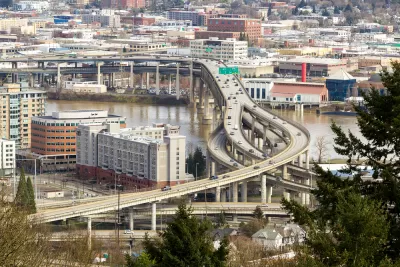
As posted earlier this month, the Portland Metro Area Value Pricing Policy Advisory Committee issued its final recommendation to reduce congestion on Interstates 5 and 205 in the Portland region on July 5 to the Oregon Transportation Commission as required by congestion pricing legislation included in House Bill 2017.
According to the Oregon Department of Transportation [see FAQ on the Portland Metro Area Value Pricing Feasibility Analysis (pdf)], the committee had to choose between two congestion pricing tools:
- Priced lanes, in which drivers can choose to pay to use a managed lane and save time, or use an adjacent, unpriced lane. [If the priced lane allows free access for carpools, it is termed a high occupancy toll, or HOT lanes]
- Priced roadways, a concept under which all lanes would be priced to manage congestion. [Once again, free access for carpools can be considered.]
The committee chose the second approach: price the roadways, rather than individual lanes, but in phases—in two pilot projects, as posted July 9. The recommendation was sent to the Oregon Transportation Commission which will submit the final proposal to the Federal Highway Administration by year's end.
Citizens' Initiative
Les Poole, a planning commissioner from Gladstone, Clackamas County, 12 miles south of Portland, and state Rep. Mike Nearman, R-Independence (Polk County, Salem metro area), "have filed Initiative Petition 9, 'Tolls Need Voter Approval,' for the 2020 ballot," reports Paris Achen, capital bureau reporter for The Portland Tribune on July 24.
The initiative would amend the Oregon Constitution to require a vote of the people to implement tolls. Poole said he received notice from the secretary of state on Tuesday authorizing petitioners to begin gathering signatures for the initiative.
"Regardless of the validity of that concept, the (tolling) recommendations by ODOT (the Oregon Department of Transportation) are full of holes," Poole wrote in an email to the Pamplin/EO Capital Bureau.
Those recommendations are included in a lengthy report [pdf] to the Oregon Transportation Commission by the value pricing committee on July 5.
Putting the plan to a vote would hold state transportation officials accountable for addressing issues such as how the revenue from tolling will be used and preventing diversion of traffic into neighborhoods, [Poole] said.
How the revenues can be spent, and mitigations to prevent traffic diversion into neighborhoods, are part of the report, and also described more simply in the FAQ [pdf]. One of the questions in that document asks:
Q: Do people living in the region get a voice in the process and proposal that the OTC develops?
A: Yes. ODOT is holding a region-wide public conversation about congestion pricing through open houses, stakeholder meetings, surveys and online engagement.
It goes on to describe the formation of the 25-member [pdf] Value Pricing Policy Advisory Committee, which includes Mayor Anne McEnerny-Ogle of Vancouver, Wash, as residents or her city, the largest suburb in the Portland metro area, will be directly affected by the tolling plan, though they won't be able to vote should Petition 9 appear on the ballot in two years. However, Oregonians living hundreds of miles from Portland near the California and Idaho borders would get a say on whether the city can apply congestion pricing to its two interstates.
Furthermore, it would appear that should the petition pass, any plan to apply highway tolling, even on individual lanes as opposed to roadways, would be subject to a state vote as the initiative amends the state constitution.
In some ways, the initiative is reminiscent of how congestion pricing in New York City was decided by the New York State legislature in 2008, rather than the New York City Council, or requiring state legislation in California to allow cities like Los Angeles and San Francisco to apply cordon area congestion pricing. Of course, a major difference in Oregon is that there is no such requirement – it's the initiative process of direct democracy at work, and the Oregon legislature already authorized the plan when it passed HB 2017 last July.
So perhaps a better analogy would be the gas tax repeal initiative, Proposition 6, in California this November?
What all these examples have in common, though, is that they show how difficult it is to increase the price of driving, be it through tolls or gas taxes, without allowing for a wider say from the people, either directly or through their representatives, or both.
Planetizen archive on Portland interstate tolling project
- "Advisory Committee Recommends Complete Tolling of Portland Interstates," July 9, 2018: A Portland regional value pricing committee recommended that the state transportation department operate two pilot programs to toll all the lanes on two interstate highways in the Portland-Vancouver metropolitan area.
- "Priced Lane or Priced Roadway?" May 17, 2018: The Pacific Northwest's Portland-Vancouver metropolitan area is studying options to add congestion pricing to one or two interstates.
-
"Oregon's $3 Billion Transportation Funding Legislation Has a Tax for Almost Everyone,"July 7, 2017: The package, which doesn't tax walking and running shoes, went to the legislature on June 30. It includes a ten cents per gallon gas tax, a 0.10 percent payroll tax, a $15 tax on new bikes costing at least $200, and a potential toll on I–205.
FULL STORY: Initiative would require vote on tolls

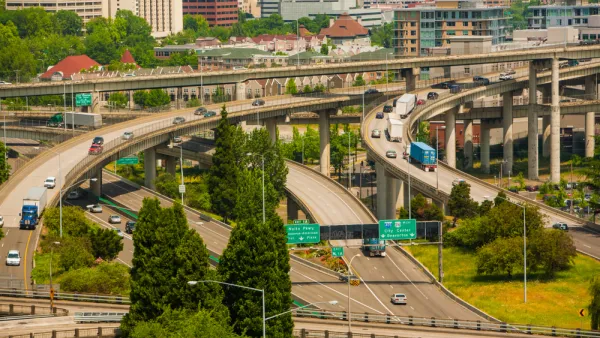
Portland's Regional Congestion Pricing Program Widens and Advances
It might be the nation's most significant but least known congestion pricing plan. The plan originally recommended tolling all lanes on segments of two interstates. Four more roads were just added to broaden the plan.
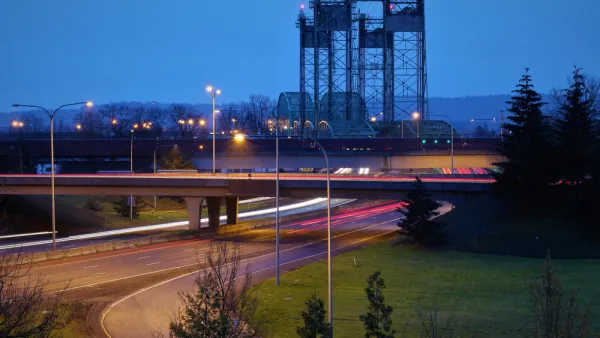
Priced Lane or Priced Roadway?
The Pacific Northwest's Portland-Vancouver metropolitan area is studying options to add congestion pricing to one or two interstates.
Interstate Highway Tolling Takes Major Step Forward in Pacific Northwest
The state that implemented the first gas tax and the first bike tax took a huge step on Thursday toward becoming the first, since 1956, to toll all lanes on an interstate highway by approving an application to the Federal Highway Administration.

The state-sanctioned urbicide of Austin
People don’t kill cities. Freeways do.

US to reduce Colorado River water deliveries to Mexico
A new Colorado Treaty amendment reduces Mexico’s Colorado River water allocation by 250,000 acre feet.

New Jersey’s second-largest city bans standalone data centers
Jersey City will continue to allow co-location facilities, such as those meant for research institutions that store their own data.

Amtrak not solely to blame for New Jersey commuter rail's unreliability, report finds
A new study from the Garden State Initiative found that NJ Transit’s budget grew 20% across a 4 year period, but reliability declined significantly over the same period.

EPA erases limits on planet-warming pollution from power plants
Under Monday’s plan, power plants would still have some limits on how much mercury, arsenic and other contaminants they can emit.

Phoenix announces new on-demand transit service, more frequent RAPID buses
Both new services will launch in October, and are part of Phoenix's Project Effective Access Solutions for Easing Congestion.

FREE Course: Walkable City 1: Why Walkability?
After describing his path towards focusing on walkability as the essence of good planning, Jeff Speck marches through his five principal reasons for making more walkable places.
Reinventing Malls: Planning Alchemy—Turning Gray Fields Into Gold
The course focuses on the opportunities and imperatives that shape reinvention of mall sites.

Eagle County Government
Harvard University Graduate School of Design
Nashville Planning Department
The Architects Foundation
University of Cincinnati Online
The Pocatello Development Authority
The Urban Renewal Agency of the City of Pocatello
Journal of the American Planning Association