End the sharrow experiment, says this columnist.



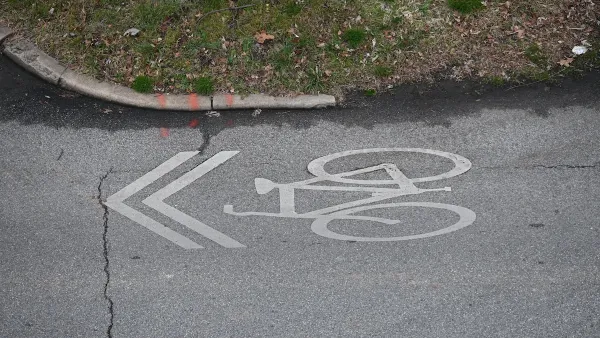
Luisa D'Amato writes: " Sharrows — those bicycle symbols on a green background that are painted on some downtown streets — are confusing and pointless. It's time for them to go."
D'Amato is writing from the Region of Waterloo, in Ontario, where a "kefluffle" recently erupted over a a public service announcement about bicycle safety. The Waterloo Regional Police created two videos, one for drivers and one for people on bikes. "They offer tips like leaving a metre of space between you and the cyclist, if you're driving. Wear a helmet and know the hand signals, if you're cycling. That sort of thing," writes D'Amato.
The problem arises in the video for people on bikes. Riders are "advised to ride to the right of the street." The cyclist show exemplifying that behavior rides right past a sharrow in the process. That raises questions about what sharrows really mean. D'Amato is sympathetic to the frustration of cyclists, and decides that sharrows are a failed experiment that should be ended.
Read the full story: D’Amato: ‘Sharrows’ are a failed cycling experiment

Sharrows Are Ineffective, Potentially Counterproductive
Research shows there’s no substitute for protected bike lanes, and sharrows may make roads more dangerous for cyclists.
Nation's Top Safety Board Recommends Protected Bike Lanes
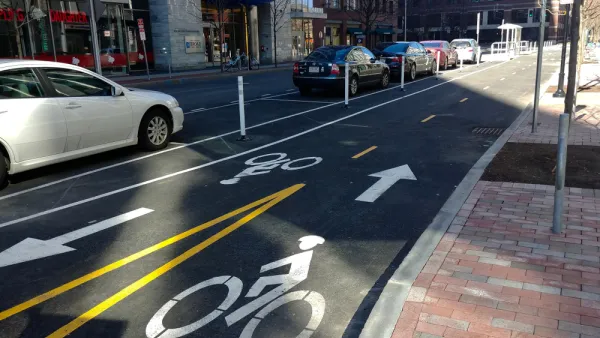
The NTSB chair issued a stark warning on Nov. 5: "If we do not improve roadway infrastructure for bicyclists, bicyclists will die who otherwise would not," stated Robert Sumwalt in introducing their first report in 47 years devoted to bike safety.

Op-ed: True bike safety requires more than the 'Dutch reach'
Making roads safe for all users takes policy and cultural changes that go beyond small behavioral interventions.

Planetizen Federal Action Tracker
A weekly monitor of how Trump’s orders and actions are impacting planners and planning in America.

California plans to bury El Niño’s downpour
If the state plays its cards right, it may be able to store a billion acre-feet of El Niño’s water in aquifers.

Chicago breaks ground on $3 billion megadevelopment
The new neighborhood, titled Foundry Park, will one day host 3,700 residences.

California High-Speed Rail Authority CEO resigns after $600,000 scandal
Under Ian Choudri, the authority used taxpayer dollars to fund first class flights and trips to nightclubs.

Want to study the Missouri River? Soon, you may need unanimous approval from 10 states
Legislation would require 10 governors’ permission to study or build projects moving water outside the basin.

Desperate measures: Advocates weigh draining Lake Powell to fill Colorado River
Draining the reservoir could reduce evaporation losses by a couple hundred thousand acre-feet.

FREE Course: Walkable City 1: Why Walkability?
After describing his path towards focusing on walkability as the essence of good planning, Jeff Speck marches through his five principal reasons for making more walkable places.
Reinventing Malls: Planning Alchemy—Turning Gray Fields Into Gold
The course focuses on the opportunities and imperatives that shape reinvention of mall sites.

City of Rosemead
Rutgers University, Edward J. Bloustein School of Planning and Public Policy
One Hundred Miles
Hunter College, City University of New York (CUNY)
The Architects Foundation
University of Cincinnati Online
City of Cambridge
Montrose County
The Pocatello Development Authority