Politics and economics win over public health in Racine County as the EPA exempted the area around the Foxconn's massive facility from meeting stricter ozone pollution standards, saving the company from investing in smog-reducing equipment.


The latest tradeoff to be exposed for Foxconn's potential $9 billion investment in a 20 million-square-foot manufacturing plant in Mount Pleasant is air quality, not only from the huge increase in traffic but by having the U.S. Environmental Protection Agency relax standards in ozone pollution.
"By dramatically reducing the size of the areas required to crack down on smog, Trump EPA Administrator Scott Pruitt overruled the agency’s career staff, a move that will save Foxconn from having to make expensive improvements as it builds a sprawling new electronics plant in Racine County, just north of the Illinois border in an area with some of the state’s dirtiest air," reports Michael Hawthorne, who focuses on environment and public health issues for the Chicago Tribune, on May 2.
Tweaking the list of counties in violation of federal smog standards is the latest attempt by Pruitt to roll back or delay environmental regulations enacted during the Obama administration.
If Pruitt had followed the EPA staff report, Foxconn and other industrial sources of smog-forming pollution in Racine County would have been required to install more effective pollution-control equipment, scale back production or broker costly emissions-trading agreements with cleaner facilities.
Political influences
"The issue 'had acquired political overtones both because of Walker’s concerns and because President Trump, who owes his surprise 2016 election victory in part to Wisconsin voters, has touted the Foxconn project,' noted the E&E News, which covers energy and environmental issues," reports Bruce Murphy for Urban Milwaukee on May 3.
Hawthorne adds that "the areas removed from the list were suggested by Republican elected officials who have sought to curb the EPA’s authority to force industries to clean up the air." The move is considered a political victory for Gov. Scott Walker who will make the Foxconn investment a centerpiece of his re-election efforts.
"We continue to search for ways to balance between environmental stewardship and a positive, pro-jobs business environment," said Walker about the move that will negatively affect the public health of southeast Wisconsin residents.
But a union leader saw it otherwise.
“Unfortunately, the people living around Foxconn in Racine and Kenosha counties in Wisconsin are the big losers,” said Michael Mikulka, president of American Federation of Government Employees Local 704. “They will have to breathe in more air pollution every day because of Pruitt’s gift to the governor.”
Nonattainment
As the Wisconsin Department of Natural Resources' (DNR) April 3 presentation on air pollution control permitting [pdf] indicates, the Clean Air Act requires the state to submit plans for areas in nonattainment in any of the six criteria pollutants, ozone being one, to comply with National Ambient Air Quality Standards. Thanks to Pruitt, that becomes much easier for Foxconn and DNR.
Average smog concentrations in all of the Wisconsin areas initially targeted by the EPA exceeded the new federal limit during the past three years, according to state monitoring data.
The 2015 federal limit for ground-level ozone [O3] is 0.070 ppm or 70 ppb. "Smog levels peaked at 83 ppb last year in Racine County and averaged 75 ppb between 2015 and 2017," adds Hawthorne.
Will move withstand litigation?
Many of Pruitt's rollbacks have not stood-up to litigation, the most relevant for this post being on smog levels. On March 12, EPA was ordered by the federal District Court for the District of Northern California to identify regions of the country that are not meeting the 2015 standards for ground-level ozone and publish their findings by April 30. A May 1 news release provides an update.
That lawsuit was filed by California Attorney General Xavier Becerra, joined by 13 other states and the District of Columbia, one of more than a dozen environmental lawsuits, and he's batting a thousand, according to the Los Angeles Times.
Addressing the Racine County smog standard exemption, John Walke, a former EPA attorney who leads the clean air program at the nonprofit Natural Resources Defense Council, told the Chicago Tribune, “This is another ridiculous attempt by Scott Pruitt and the Trump administration to violate the law. We are looking forward to seeing them in court again.”
Neighboring states were also impacted by changes
Pruitt also pared back the list of counties with dirty air in Illinois and Indiana, a decision that could add to Chicago’s chronic problems with pollution linked to asthma attacks, heart disease and early deaths.
Not helping matters is Pruitt's rollback of light-duty vehicle emissions standards, which prompted California and 16 other states and the District of Columbia to sue the Trump administration on May 1.
New air quality research reveals "unexpected slowdown" in gains
Relaxing air quality standards to benefit industry will make it more difficult to improve air quality in the U.S. A new study published in the Proceedings of the National Academy of Sciences finds that progress has been slowing, reports Doyle Rice for USA TODAY on April 30. Two precursors to ozone pollution were studied, carbon monoxide and nitrogen oxide (NOx).
The study said pollution levels from nitrogen oxide fell 7% from 2005 to 2009, but only dropped 1.7% from 2011 to 2015. That translates to a 76% slowdown between the late 2000s and early 2010s.
This contrasts sharply with a more rosy outlook from the Environmental Protection Agency, which said the slowdown in reductions was only 16%.
FULL STORY: EPA chief Pruitt overrules staff, gives Wisconsin's Walker, Foxconn big break on smog

EPA Loses Court Ruling After Failing to Identify Smog Nonattainment Regions
As a result of a federal court ruling on March 12, the Environmental Protection Administration will be compelled to do what it should have done by October 1: Identify regions of the country where the air quality violates smog standards.

Summertime Ethanol Restriction Lifted to Help Corn Farmers—But at What Cost?
President Trump made good on his promise last October to lift the E15 ban in time for the summer driving season. Not mentioned by the Des Moines Register are the downsides to allowing the higher ethanol blend to be sold during the summer, e.g., smog.
Making Older Coal Power Plants More Efficient Without Making Them Cleaner
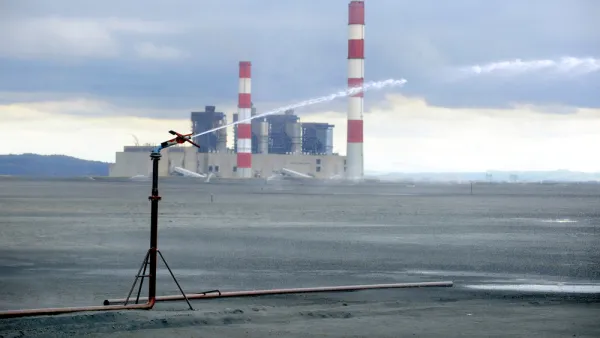
At the center of the EPA's newly proposed Affordable Clean Energy rule is doing away with a permitting process known as New Source Review that requires coal power plants to add scrubbers and other expensive pollution control equipment when upgraded.

The state-sanctioned urbicide of Austin
People don’t kill cities. Freeways do.

US to reduce Colorado River water deliveries to Mexico
A new Colorado Treaty amendment reduces Mexico’s Colorado River water allocation by 250,000 acre feet.

New Jersey’s second-largest city bans standalone data centers
Jersey City will continue to allow co-location facilities, such as those meant for research institutions that store their own data.

Amtrak not solely to blame for New Jersey commuter rail's unreliability, report finds
A new study from the Garden State Initiative found that NJ Transit’s budget grew 20% across a 4 year period, but reliability declined significantly over the same period.

EPA erases limits on planet-warming pollution from power plants
Under Monday’s plan, power plants would still have some limits on how much mercury, arsenic and other contaminants they can emit.

Phoenix announces new on-demand transit service, more frequent RAPID buses
Both new services will launch in October, and are part of Phoenix's Project Effective Access Solutions for Easing Congestion.

FREE Course: Walkable City 1: Why Walkability?
After describing his path towards focusing on walkability as the essence of good planning, Jeff Speck marches through his five principal reasons for making more walkable places.
Reinventing Malls: Planning Alchemy—Turning Gray Fields Into Gold
The course focuses on the opportunities and imperatives that shape reinvention of mall sites.

Eagle County Government
Harvard University Graduate School of Design
Nashville Planning Department
The Architects Foundation
University of Cincinnati Online
The Pocatello Development Authority
The Urban Renewal Agency of the City of Pocatello
Journal of the American Planning Association