Cities across America have a housing crisis on their hands—should they be talking more about trailer parks?


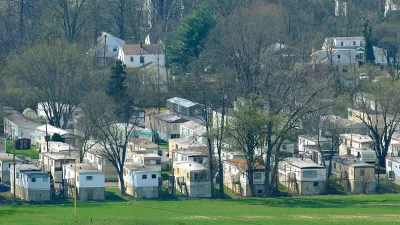
At CityLab, Carson Bear interviews preservationist and landscape architect Eduard Krakhmalnikov, who conducts research on mobile home parks and believes that they fill a “critical gap” in the housing market despite being increasingly endangered by rising land values in many American cities.
“We talk about affordable housing all the time as we should,” Krakhmalnikov tells Bear, “but we never talk about mobile homes or mobile home parks—even though they’re primarily used as affordable housing.”
The advantage of manufactured homes is also the reason they are at risk of extinction; it’s a much more affordable opportunity for homeownership, but the parks in which they are placed are usually privately owned and can therefore be sold.
And the reason they are increasingly valuable as a housing option is precisely what makes them more likely to be redeveloped: residential real estate prices are nearly at a crisis point (or actually at a crisis point) all over the country, and for the owners of mobile home parks, the temptation to sell at a premium is enormous. When they do sell, owners of mobile homes may or may not be able to find an alternative location.
The confluence of need and value has made mobile homes a topic of debate in many U.S. cities over the last several years.
For example, the city council in Aurora, Colorado recently voted for “a 10-month moratorium on rezoning applications for existing mobile home parks” to assess options for preserving affordable housing. In an effort to do just that, several other cities in Colorado have bought the mobile home parks to prevent redevelopment.
Other examples include Washington State, which has set aside some funds to purchase a park in SeaTac to avoid the eviction of those residents, though it may not be enough; Honolulu, which has incredibly high housing costs and has recently used mobile homes to provide housing to formerly homeless individuals and families; in Austin, planners are considering “anti-displacement zoning” that would preserve mobile home parks, among other affordable options; and in New Hampshire, among other places, in some parks residents have organized and bought the land collectively.
Krakhmalnikov suggests a more radical approach to historic preservation as another tool to keep parks from being sold off for redevelopment. “It would be exceptionally difficult to put them in the National Register, the way it’s set up now,” he tells Bear, “but that ultimately opens up opportunities for the future. I think we need to change the way we measure and create historic places.”
FULL STORY: The Case for Preserving Mobile Homes

Manufactured Home Residents Face Heightened Hurricane Risks
The unique construction and ownership structure of so-called 'mobile' homes put their residents at increased risk of property damage, financial loss, and death during extreme weather events.

Defeating SB 827 Did Not Discourage the YIMBY Movement
Though the California housing bill was a high-profile failure for pro-development activists, there are initiatives all over the country that carry its spirit.
California Spends $6.5 Billion on Homeowner Subsidies, 15 Times Less on Renters
A new report from the California Housing Partnership "revealed a wide gap between state support for homeowners and renters."

Planetizen Federal Action Tracker
A weekly monitor of how Trump’s orders and actions are impacting planners and planning in America.

The state-sanctioned urbicide of Austin
People don’t kill cities. Freeways do.

US to reduce Colorado River water deliveries to Mexico
A new Colorado Treaty amendment reduces Mexico’s Colorado River water allocation by 250,000 acre feet.

5 New England states march closer to 800 megawatt wind energy project
Securing federal approval for the project may be complicated under the Trump administration, which has historically been hostile towards domestic wind power.

Baltimore to break ground on $50 million Transit Priority Project
The project will bring faster bus trips, safer streets and better bike connections to Baltimore.

Airbnb launches $250 million 'last-dollar financing' housing accelerator, makes first investment in Austin
The company will put $6.4 million towards affordable housing development in Texas’ capital.

FREE Course: Walkable City 1: Why Walkability?
After describing his path towards focusing on walkability as the essence of good planning, Jeff Speck marches through his five principal reasons for making more walkable places.
Reinventing Malls: Planning Alchemy—Turning Gray Fields Into Gold
The course focuses on the opportunities and imperatives that shape reinvention of mall sites.

Eagle County Government
Harvard University Graduate School of Design
Nashville Planning Department
The Architects Foundation
University of Cincinnati Online
The Pocatello Development Authority
The Urban Renewal Agency of the City of Pocatello
Journal of the American Planning Association