The folks over at City Observatory brew up a "Cappuccino Congestion Index" to show that anything can be shown to cost Americans vast sums of money.



In a (partly) tongue-in-cheek analysis, Joe Cortright uses methods to estimate the cost of traffic congestion to examine another economic scourge: waiting in line for coffee. His grievance is clear. "It's annoying to queue up for anything, but traffic congestion has spawned a cottage industry of ginning up reports that transform our annoyance with waiting in lines into an imagined economic calamity."
Cortright writes, "we've applied the 'travel time index' created by the Texas Transportation Institute to measure the economic impact of this delay on American coffee drinkers [...] When you scale these estimates up to reflect the millions of Americans waiting in line for their needed caffeine each day, the total value of time lost to cappuccino congestion costs consumers more than $4 billion annually."
No one, Cortright says, expects Starbucks to scale up enough to eliminate its morning lines. "But strangely, when it comes to highways, we don't recognize the trivially small scale of the expected time savings (a minute or two per person) and we don't consider a kind of careful cost-benefit analysis that would tell us that very few transportation projects actually generate the kinds of sustained travel time savings that would make them economically worthwhile."
FULL STORY: The Cappuccino Congestion Index

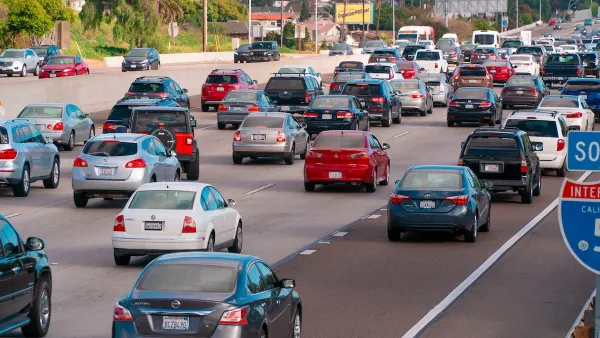
Why Traffic Never Gets Better
Despite abundant research showing that roadway expansions provide limited congestion relief and increase long-term traffic problems, they still occur due to wishful thinking: advocates claim that “this” project is different.
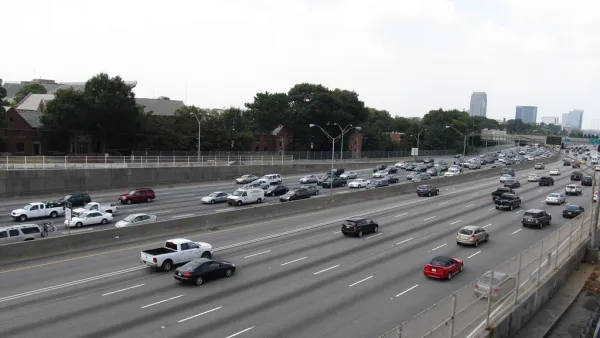
Why Don't State DOTs Believe in Induced Demand?
Despite evidence that widening roadways is only a temporary solution to congestion, a decades-long inertia leads states to continue pushing expansion projects against local opposition.
A Critical Evaluation of the Urban Mobility Report
The Urban Mobility Report (UMR) evaluates traffic congestion problems and recommends congestion reduction solutions. How well does it reflect travelers' priorities?

Planetizen Federal Action Tracker
A weekly monitor of how Trump’s orders and actions are impacting planners and planning in America.

The state-sanctioned urbicide of Austin
People don’t kill cities. Freeways do.

US to reduce Colorado River water deliveries to Mexico
A new Colorado Treaty amendment reduces Mexico’s Colorado River water allocation by 250,000 acre feet.

5 New England states march closer to 800 megawatt wind energy project
Securing federal approval for the project may be complicated under the Trump administration, which has historically been hostile towards domestic wind power.

Baltimore to break ground on $50 million Transit Priority Project
The project will bring faster bus trips, safer streets and better bike connections to Baltimore.

Airbnb launches $250 million 'last-dollar financing' housing accelerator, makes first investment in Austin
The company will put $6.4 million towards affordable housing development in Texas’ capital.

FREE Course: Walkable City 1: Why Walkability?
After describing his path towards focusing on walkability as the essence of good planning, Jeff Speck marches through his five principal reasons for making more walkable places.
Reinventing Malls: Planning Alchemy—Turning Gray Fields Into Gold
The course focuses on the opportunities and imperatives that shape reinvention of mall sites.

Eagle County Government
Harvard University Graduate School of Design
Nashville Planning Department
The Architects Foundation
University of Cincinnati Online
The Pocatello Development Authority
The Urban Renewal Agency of the City of Pocatello
Journal of the American Planning Association