After tremendous success with a streetcar line, the desert city is considering strategies for investing in its historic automobile corridor.


Four years ago, the Sunlink streetcar began running a route originating at the University of Tucson, along 4th Avenue, through downtown, and to the Mercado District. With its success came the kind of business and residential activity seen in other cities that have invested in transit, to the point where, four years later, formerly desolate areas are concerned.
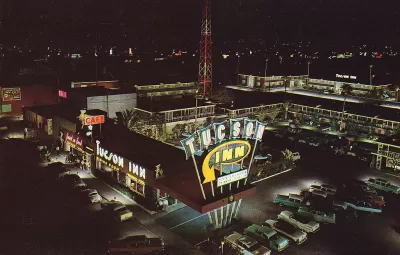
Other areas of Tucson have not fared as well, namely what was once referred to as the Miracle Mile, a stretch of road on the north side of the city that once served as an "automobile gateway.
"With its Old Spanish Trail marketing, Tucson was one of the first cities to promote automobile-based tourism," Gideon Berger writes at CitiesSpeak. "As vehicle ownership skyrocketed in the 1920s, business catering to 'auto-camping' tourists flourished along corridors leading to the city. Eventually, these grew to include 'motor courts' with cabin lodging and some of the nation’s first motels."
Like similar areas in other American cities, the construction of an interstate highway—in this case I-10—Miracle Mile sent the neighborhood into decline.
After its recent success in redevelopment, Tucson won a land use fellowship from the Rose Center for Public Leadership and has revisited the Miracle Mile.
Berger, who is the director of the program for the Rose Center, enumerates a lengthy list of areas for which the fellowship developed recommendations, including both economic and cultural development and protecting residents from the kind of displacement that this sort of development can mean for those who live in it.
Read the full story: Can Tucson, Arizona Bring Back its Miracle Mile?

The Foundational Myth of America's Interstate Highway System
The erroneous belief that the negative impacts of interstate highways are simply "unintended consequences" fails to demand accountability for the project's failures.
New Tool Uncovers Exact Costs of Downtown Highways
A new research tool can help cities calculate the economic potential that could be unlocked by replacing highways with other uses.
How Federal Funds Can Benefit Freeway Removal Projects
The recently passed infrastructure bill dedicates $1 billion to freeway removal and capping, but the sum is only a 'first step' toward redressing the injustices perpetuated by urban highway projects.

Planetizen Federal Action Tracker
A weekly monitor of how Trump’s orders and actions are impacting planners and planning in America.

The state-sanctioned urbicide of Austin
People don’t kill cities. Freeways do.

Colorado’s Largest Data Center Could Rise Next to Homes — Without a Public Hearing
The proposed campus would consume 11 times the power of Denver International Airport; as it has across the country, opposition mounts.

Nation's most wind-powered state turns to coal as data centers increase energy demand
For the first time in decades, Iowa has increased its generation of coal power.

NYC cools commuters with city's first rain garden above a bus stop
New York City officials say the plants in the rain garden can absorb 16 gallons of rainwater during heavy storms.

Brightline West’s future may rely on $6 billion federal loan
The company has until Nov. 2 to make a $400 million equity investment into its proposed high-speed rail line.

FREE Course: Walkable City 1: Why Walkability?
After describing his path towards focusing on walkability as the essence of good planning, Jeff Speck marches through his five principal reasons for making more walkable places.
Reinventing Malls: Planning Alchemy—Turning Gray Fields Into Gold
The course focuses on the opportunities and imperatives that shape reinvention of mall sites.


Greater Baltimore Committee
Eagle County Government
Harvard University Graduate School of Design
The Architects Foundation
University of Cincinnati Online
The Pocatello Development Authority
The Urban Renewal Agency of the City of Pocatello
Journal of the American Planning Association