The Government Accountability Office will investigate why it costs so much more to build transit in the United States than anywhere else in the world. Perhaps this could be the change of systematic change.


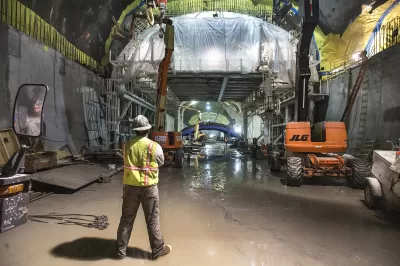
"The astronomical costs of building the Second Avenue subway and other New York public transit projects are now the subject of a federal inquiry," reports Brian M. Rosenthal. The Government Accountability Office will undertake the investigation.
The investigation will include transit projects around the United States, according to Rosenthal, with special attention paid to New York City.
According to Rosenthal, the investigation was enabled by the omnibus spending bill signed last week. The New York Times brought new attention to spending on transit capital investment projects in New York City at the beginning of the year, with a deep investigation of spending on projects like the Second Avenue Subway.
FULL STORY: Why Does Subway Construction Cost So Much? Congress Wants to Find Out

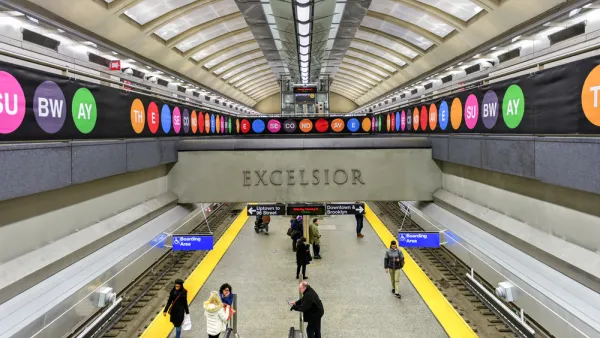
Congressional Report on Transit Spending Stops Short of Accountability
Transit advocates were hoping the U.S. Government Accountability Office was finally going to expose the systematic failures of transit spending in the United States by comparing the practices of other countries.
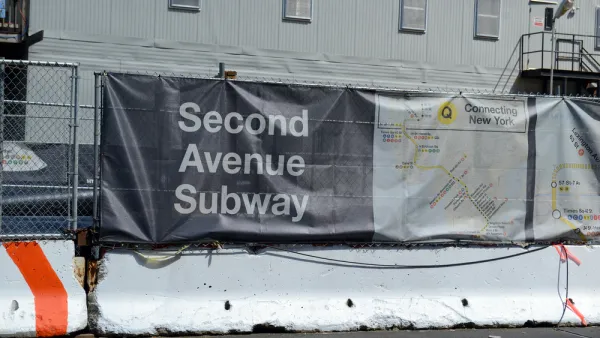
Who Killed the Federal Study of Transit Costs?
The Government Accountability Office was set to investigate why U.S. transit capital investments are so expensive, especially in contrast to comparable European projects, but that study will not leave the station.
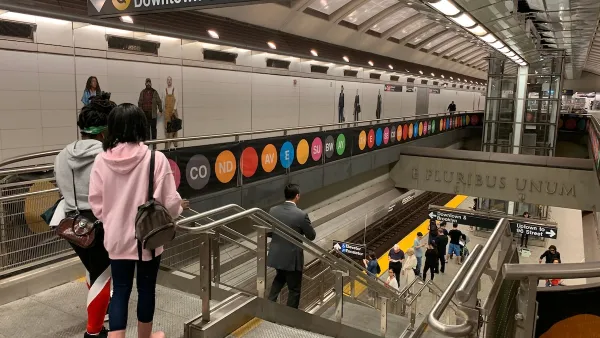
After 50 Years, Subway to East Harlem to Break Ground
The MTA approved a contract to extend the Q Line to three new stations, with surface work slated to begin in September.

Planetizen Federal Action Tracker
A weekly monitor of how Trump’s orders and actions are impacting planners and planning in America.

The state-sanctioned urbicide of Austin
People don’t kill cities. Freeways do.

US to reduce Colorado River water deliveries to Mexico
A new Colorado Treaty amendment reduces Mexico’s Colorado River water allocation by 250,000 acre feet.

Mamdani overhauls NYC's Vision Zero plan with 100 new policy goals
The overhaul aims to reduce traffic deaths and make streets safer for pedestrians, cyclists and drivers through lower speed limits, new safety infrastructure and more.

Amtrak not solely to blame for New Jersey commuter rail's unreliability, report finds
A new study from the Garden State Initiative found that NJ Transit’s budget grew 20% across a 4 year period, but reliability declined significantly over the same period.

EPA erases limits on planet-warming pollution from power plants
Under Monday’s plan, power plants would still have some limits on how much mercury, arsenic and other contaminants they can emit.

FREE Course: Walkable City 1: Why Walkability?
After describing his path towards focusing on walkability as the essence of good planning, Jeff Speck marches through his five principal reasons for making more walkable places.
Reinventing Malls: Planning Alchemy—Turning Gray Fields Into Gold
The course focuses on the opportunities and imperatives that shape reinvention of mall sites.

Eagle County Government
Harvard University Graduate School of Design
Nashville Planning Department
The Architects Foundation
University of Cincinnati Online
The Pocatello Development Authority
The Urban Renewal Agency of the City of Pocatello
Journal of the American Planning Association