The Government Accountability Office was set to investigate why U.S. transit capital investments are so expensive, especially in contrast to comparable European projects, but that study will not leave the station.


The costs of rail projects in Los Angeles have led to a document covering best practices for such public transit projects, "Some people in the United States Senate had the smart idea that the federal government ought to do something similar and included language in their appropriations bill commissioning a Government Accountability Office study of the issue," Mathew Yglesias comments for Vox. However, a federal report on best practices regarding public transit will not be written, because that language didn't make it into the bill that the House of Representatives will see. According to Yglesias, "Nobody seems to want to officially claim credit for killing this."
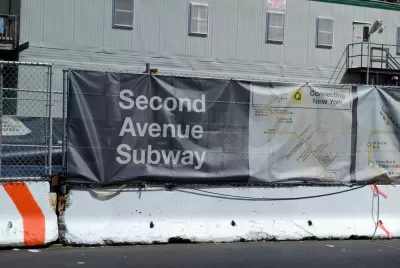
The problem is real. "The Second Avenue Subway in New York City, for example, is being built at a cost of nearly $1.7 billion per kilometer while new subway lines are being built in Paris, Copenhagen, and Berlin for about $250 million per kilometer," Yglesias reports. And while one study or compendium of best practices won't make the problem go away, studying a problem is better than sweeping it under the rug.
FULL STORY: Someone killed a congressional inquiry into America’s sky-high transit construction costs

New York Governor Announces 2024 Transportation Plans
Gov. Hochul’s plans include the long-awaited Second Avenue Subway extension.
Monorail Doesn't Measure Up for Los Angeles, Says Editorial Board
The editorial board of the Los Angeles Times is unimpressed by a plan to build a monorail between the Westside and the San Fernando Valley in the city of Los Angeles.
Transit Capital Investments Planned in Utah
Utah finds itself in a unique situation, with money to spend on expanding transit capacity at a time when many transit agencies are plotting layoffs and service reductions.

The state-sanctioned urbicide of Austin
People don’t kill cities. Freeways do.

US to reduce Colorado River water deliveries to Mexico
A new Colorado Treaty amendment reduces Mexico’s Colorado River water allocation by 250,000 acre feet.

New Jersey’s second-largest city bans standalone data centers
Jersey City will continue to allow co-location facilities, such as those meant for research institutions that store their own data.

Amtrak not solely to blame for New Jersey commuter rail's unreliability, report finds
A new study from the Garden State Initiative found that NJ Transit’s budget grew 20% across a 4 year period, but reliability declined significantly over the same period.

EPA erases limits on planet-warming pollution from power plants
Under Monday’s plan, power plants would still have some limits on how much mercury, arsenic and other contaminants they can emit.

Phoenix announces new on-demand transit service, more frequent RAPID buses
Both new services will launch in October, and are part of Phoenix's Project Effective Access Solutions for Easing Congestion.

FREE Course: Walkable City 1: Why Walkability?
After describing his path towards focusing on walkability as the essence of good planning, Jeff Speck marches through his five principal reasons for making more walkable places.
Reinventing Malls: Planning Alchemy—Turning Gray Fields Into Gold
The course focuses on the opportunities and imperatives that shape reinvention of mall sites.

Eagle County Government
Harvard University Graduate School of Design
Nashville Planning Department
The Architects Foundation
University of Cincinnati Online
The Pocatello Development Authority
The Urban Renewal Agency of the City of Pocatello
Journal of the American Planning Association