At stake are greenhouse gas emission standards for 2022-25 model year passenger vehicles. Relaxing these standards would likely doom efforts to reduce these emissions 40 percent below 1990 levels by 2030 as required by 2016 state legislation.


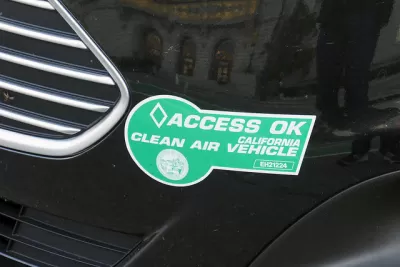
"The [U.S. Environmental Protection Agency] faces an April 1 deadline to decide whether Obama-era corporate average fuel economy standards [CAFE] for cars and light trucks from 2022 to 2025 are attainable or should be revised," reports Bloomberg News. EPA Administrator Scott Pruitt has already dismissed a report issued by the Obama administration that led to the prior administration's rejection of a bid by automakers to reduce fuel economy standards in the midterm review.
Pruitt did not directly answer [during an interview with Bloomberg News on March 13] whether he would seek to revoke waivers from the federal law that allows California to set its own air pollution requirements. But he signaled his concern with California's outsize role.
"California is not the arbiter of these issues," Pruitt said. California regulates greenhouse gas emissions at the state level, "but that shouldn't and can't dictate to the rest of the country what these levels are going to be."
The stakes couldn't be higher for the California Air Resources Board (CARB), the powerful regulatory body charged with reducing greenhouse gas (GHG) emissions by 40 percent below 1990 levels by 2030. Transportation accounts for 39 percent of the state's GHG emissions. Worse yet, "increased fuel consumption in 2015 resulted in a 3 percent increase in emissions from the transportation sector," according to CARB, while emissions from other sectors have been decreasing.
According to Bloomberg, CARB officials offered to consider easing current GHG emission standards in exchange for extending them beyond that 2025, but Pruitt rejected their offer.
Winners and losers
While Calfornia will be the loser in a rejection of the EPA waiver by making by making it more difficult, if not impossible, to meet its SB 32 target, automakers, particularly those that manufacture light trucks, including the profitable and fuel-inefficient (compared to cars) full-sized SUVs, will be the winners.
Automakers aggressively lobbied Trump to take a new look at the standards, arguing that they need to be reviewed in light of surging light-truck sales, low gasoline prices and tepid demand for plug-in vehicles.
Shares of "Fiat Chrysler Automobiles NV, which has the most to gain as the U.S. automaker with the highest percentage of light trucks in its lineup, have more than doubled in value since Trump's election, in part on optimism that the automaker will be able to sell more Jeep SUVs and Ram pickups if the Trump administration rolls back standards set under Obama," adds Bloomberg.
- Reuters: "California-Trump administration fuel-efficiency talks intensify," Jan. 16, 2018
- Union of Concerned Scientists: "Pruitt’s EPA Attempts to Undermine California’s Leadership on Vehicle Standards," Feb. 2, 2018
Hat tip to Al Sattler via Sierra Club California Energy-Climate Committee.
FULL STORY: EPA chief signals a showdown with California over fuel economy rules for automakers


Rollback of Fuel Efficiency Standards Announced by EPA
EPA Administrator Scott Pruitt announced Monday that his agency is siding with auto manufacturers and relaxing greenhouse gas emission standards for new cars and light trucks.
California and 16 States Sue EPA Over Decision to Rollback Vehicle Emissions Rule
Environmental Protection Agency Administrator Scott Pruitt had announced the rollback of greenhouse gas emission and fuel economy standards on April 2. While the auto industry supports the move, not all auto executives agreed.
California and Auto Industry Agree on Vehicle Emissions Standards
Normally having the California Air Resources Board and the auto industry in agreement on emissions standards would be enough, but the Trump administration wants to ensure that California plays no role in setting standards.

The state-sanctioned urbicide of Austin
People don’t kill cities. Freeways do.

US to reduce Colorado River water deliveries to Mexico
A new Colorado Treaty amendment reduces Mexico’s Colorado River water allocation by 250,000 acre feet.

New Jersey’s second-largest city bans standalone data centers
Jersey City will continue to allow co-location facilities, such as those meant for research institutions that store their own data.

Amtrak not solely to blame for New Jersey commuter rail's unreliability, report finds
A new study from the Garden State Initiative found that NJ Transit’s budget grew 20% across a 4 year period, but reliability declined significantly over the same period.

EPA erases limits on planet-warming pollution from power plants
Under Monday’s plan, power plants would still have some limits on how much mercury, arsenic and other contaminants they can emit.

Phoenix announces new on-demand transit service, more frequent RAPID buses
Both new services will launch in October, and are part of Phoenix's Project Effective Access Solutions for Easing Congestion.

FREE Course: Walkable City 1: Why Walkability?
After describing his path towards focusing on walkability as the essence of good planning, Jeff Speck marches through his five principal reasons for making more walkable places.
Reinventing Malls: Planning Alchemy—Turning Gray Fields Into Gold
The course focuses on the opportunities and imperatives that shape reinvention of mall sites.

Eagle County Government
Harvard University Graduate School of Design
Nashville Planning Department
The Architects Foundation
University of Cincinnati Online
The Pocatello Development Authority
The Urban Renewal Agency of the City of Pocatello
Journal of the American Planning Association