Commitment gets tested when a dedicated urbanist, transit rider, and L.A. County planner is relocate to a suburban office. Clement Lau shares his thoughts about the good and the bad of riding an L.A. Metro bus.


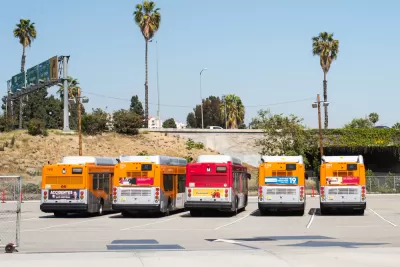
For many urbanists, walking the talk regarding an urban, transit oriented life style while remaining gainfully employed means a reverse commute, i.e., commuting from a downtown home to a job in the suburbs. Such a commute can be more difficult to accomplish via public transit than a traditional commute. Nearly all cities are the center of local and regional transit lines, including light rail. On the suburban ends of such transit lines are often park-n-ride lots and connecting transit routes to capture suburban residents who don't live adjacent to the direct transit routes to urban centers. Of course, the "last mile" remains a conundrum in much of American transit commuting, but it is arguably worse for those having to accomplish a reverse commute. One's personal car can be used to address the first mile gap in a transit commute but not the last mile gap.
When transit user, downtown resident, and L.A. County planner Clement Lau's office was moved from Koreatown to Alhambra, his public transit commute became a rather time consuming multi-leg endeavor. His new Alhambra workplace is only reachable from downtown by using, at least part of the way, an automobile or bus. Nevertheless, his walk-subway-bus-walk commute has some hidden rewards. On the other hand, he has become fully aware of the hierarchy of public perception about transit modes, with buses occupying (unfairly) the bottom rung. Nevertheless, he believes there are some significant opportunities for improving the L.A. bus network, without major infrastructure expenditures. For example, improvement is needed in the areas of reliability, scheduling, and communicating with users, and getting real time information to them when there are delays. To read more of his observations and recommendations, please see the source article.
FULL STORY: Riding the Bus: The Good, the Bad, and the Ugly

D.C.-Area Residents Want Bus Lanes and Free Transfers, Survey Shows
New survey findings identify transit priorities among residents in D.C. and surrounding areas, and indicate broad support for public investments.
Providence train station to gain new bus hub
The new hub will replace the one currently located at Kennedy Plaza.
Two Years In, a Look at the Twin Cities Fare Discount Program
In 2017, Metro Transit in the Twin Cities raised fares but also started a program for low-income riders to help ease the burden of travel costs.

Planetizen Federal Action Tracker
A weekly monitor of how Trump’s orders and actions are impacting planners and planning in America.

The state-sanctioned urbicide of Austin
People don’t kill cities. Freeways do.

US to reduce Colorado River water deliveries to Mexico
A new Colorado Treaty amendment reduces Mexico’s Colorado River water allocation by 250,000 acre feet.

Mamdani overhauls NYC's Vision Zero plan with 100 new policy goals
The overhaul aims to reduce traffic deaths and make streets safer for pedestrians, cyclists and drivers through lower speed limits, new safety infrastructure and more.

Amtrak not solely to blame for New Jersey commuter rail's unreliability, report finds
A new study from the Garden State Initiative found that NJ Transit’s budget grew 20% across a 4 year period, but reliability declined significantly over the same period.

EPA erases limits on planet-warming pollution from power plants
Under Monday’s plan, power plants would still have some limits on how much mercury, arsenic and other contaminants they can emit.

FREE Course: Walkable City 1: Why Walkability?
After describing his path towards focusing on walkability as the essence of good planning, Jeff Speck marches through his five principal reasons for making more walkable places.
Reinventing Malls: Planning Alchemy—Turning Gray Fields Into Gold
The course focuses on the opportunities and imperatives that shape reinvention of mall sites.

Eagle County Government
Harvard University Graduate School of Design
Nashville Planning Department
The Architects Foundation
University of Cincinnati Online
The Pocatello Development Authority
The Urban Renewal Agency of the City of Pocatello
Journal of the American Planning Association