The rise of online retail has come with a flurry of delivery trucks that don't always have good places to stop. Researchers from Amazon's hometown are on the case.


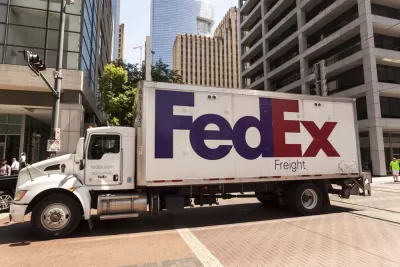
While a drone-based future for goods delivery gets a lot of hype, we're still stuck with trucks and vans (and some bikes). As Timothy A. Schuler writes, "The increase in deliveries has major implications for Complete Streets programs, which seek to accommodate the needs of pedestrians, bicyclists, transit riders, and vehicular traffic within existing corridors."
In Amazon's hometown of Seattle, researchers are looking into the issue. "Recently, the City of Seattle partnered with the University of Washington (UW) and several major retailers to launch the Urban Freight Lab, a three-year research effort to better understand the rapidly changing landscape of goods delivery."
Curbside goods delivery is often a regulatory blank slate. "Unlike public transit, goods delivery has no single governing body or regulatory agency. [...] As a result, municipal governments often lack reliable data on where loading bays and loading zones are located, and whether or not they are meeting demand."
Anne Goodchild, director of UW's Supply Chain Transportation and Logistics Center, put it this way: "How much do we ask the transport to modify itself for the place? And how much do we modify the place for the transport?"
Read the full story: Curb Clots

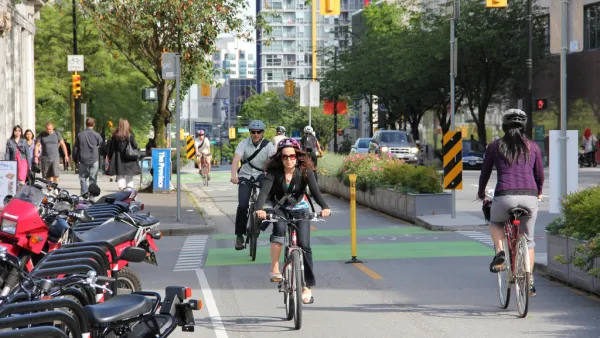
Vancouver Is 'True North' for Seattle Bike Lane Advocates
In Seattle, securing every new bike lane seems like a "tooth and nail" fight. But across a border to the north, vigorous initial opposition melted away as a connected system took shape.
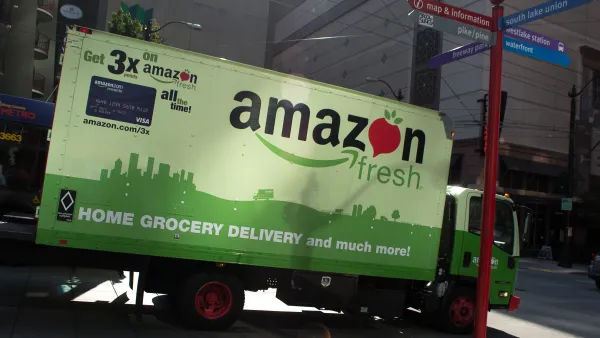
Online Retail Curbs Urban Traffic
Despite claims that urban truck traffic continues to rise, recent data shows no real increase in urban vehicle miles traveled. Online shopping may be helping keep people off the roads.
Seattle Adjusts Signals for Downtown Protected Bike Lane
Brandon G. Donnelly reports that after implementing a Downtown protected bike lane along 2nd Avenue, Seattle has had to make some adjustments to the signaling for the lane.

Planetizen Federal Action Tracker
A weekly monitor of how Trump’s orders and actions are impacting planners and planning in America.

The state-sanctioned urbicide of Austin
People don’t kill cities. Freeways do.
Colorado’s Largest Data Center Could Rise Next to Homes — Without a Public Hearing
The proposed campus would consume 11 times the power of Denver International Airport; as it has across the country, opposition mounts.

Nation's most wind-powered state turns to coal as data centers increase energy demand
For the first time in decades, Iowa has increased its generation of coal power.

NYC cools commuters with city's first rain garden above a bus stop
New York City officials say the plants in the rain garden can absorb 16 gallons of rainwater during heavy storms.

Brightline West’s future may rely on $6 billion federal loan
The company has until Nov. 2 to make a $400 million equity investment into its proposed high-speed rail line.

FREE Course: Walkable City 1: Why Walkability?
After describing his path towards focusing on walkability as the essence of good planning, Jeff Speck marches through his five principal reasons for making more walkable places.
Reinventing Malls: Planning Alchemy—Turning Gray Fields Into Gold
The course focuses on the opportunities and imperatives that shape reinvention of mall sites.

Greater Baltimore Committee
Eagle County Government
Harvard University Graduate School of Design
The Architects Foundation
University of Cincinnati Online
The Pocatello Development Authority
The Urban Renewal Agency of the City of Pocatello
Journal of the American Planning Association